LinkedIn Content Calendar for CEOs: Cadence and Batching Strategy
Most CEO LinkedIn strategies fail for the same reason: inconsistency. A founder publishes 2–3 posts one week, then disappears for three weeks. They show up after a media mention and vanish again. The algorithm notices. Followers expect consistency and the feed gets deprioritized when it doesn't appear.
The difference between a CEO who generates leads and builds reputation on LinkedIn and one who posts sporadically isn't smarter ideas—it's a system for consistency. It's a content calendar that fits into a realistic schedule, a batching process that doesn't feel like additional work, and a delegation framework that lets the CEO own the voice without owning all the execution.
This guide gives you the actual system: how often to post, when to post it, how to batch content to save time, and how to delegate without losing your authentic voice.
Table of Contents
- The Right Posting Cadence for CEOs
- Timing: When to Post for Maximum Reach
- The Batching System That Actually Works
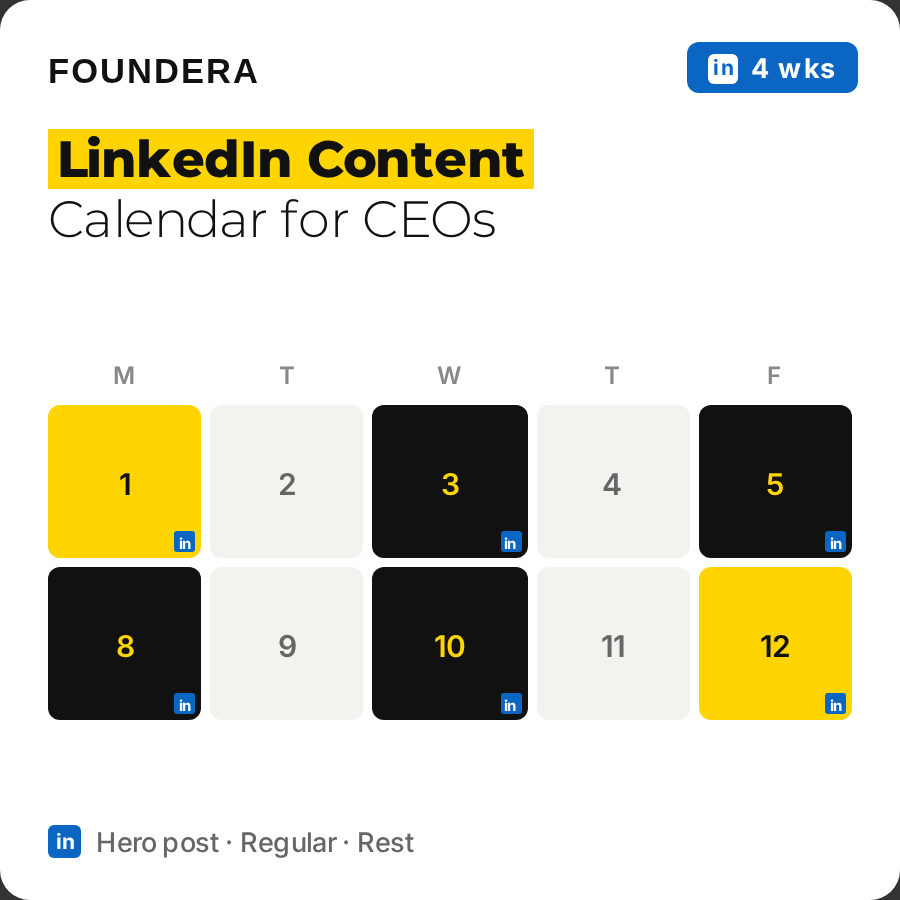
- Building Your 4-Week Content Calendar
- Delegation Framework: Ghostwriter to Publisher
- Monthly and Quarterly Reviews
- Adjusting Your Calendar as You Scale
- Frequently Asked Questions
The Right Posting Cadence for CEOs
The first question every CEO asks: "How often should I post?" The answer depends on your stage, your goals, and your current LinkedIn presence, but there's a science to it.
The minimum viable posting frequency is 2 times per week. At two posts per week, you're visible enough for the algorithm to prioritize your content, but not so frequent that you feel like you're constantly creating. Most CEOs who post 2x/week see meaningful growth in engagement and inbound over 60–90 days.
The optimal posting frequency for rapid growth is 4 times per week (roughly daily). This is the frequency where you see exponential engagement and opportunity generation. Posts published daily are top-of-mind, the algorithm gives you consistent inventory to win on, and your audience knows to expect fresh content. The trade-off is that this requires serious batching or delegation.
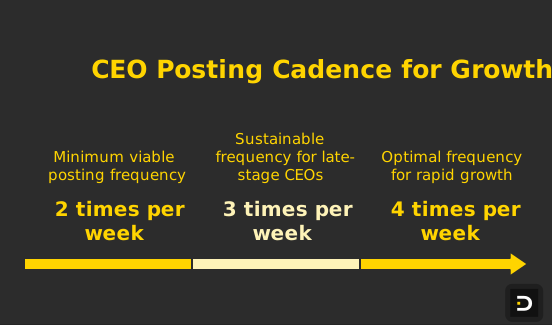
The sustainable frequency for late-stage CEOs is 3 times per week. This is the Goldilocks zone: frequent enough that the algorithm treats you as an active content creator (you're in people's feeds regularly), but not so frequent that you're constantly churning. It's sustainable to batch weekly (record/write content for the week in one session) and delegate the publishing/engagement pieces.
Here's what the data shows: CEOs posting 2x/week see 20–40% growth in profile views monthly. CEOs posting 3x/week see 40–100% growth. CEOs posting 4–5x/week see 100–300% growth. But going from 3x/week to 5x/week requires a bigger time investment or delegation—you're not simply doubling effort, you're often tripling it.
For most founders: Start with 2x/week. If you're raising money, hiring, or executing a major company milestone, move to 3x/week for 8–12 weeks before the event. If LinkedIn is a core business development channel (you close deals through inbound), invest in consistent 4–5x/week posting with strong delegation or ghostwriting.
Timing: When to Post for Maximum Reach
It's not just how often you post—it's when. LinkedIn has clear patterns in when posts perform best.
Peak engagement times (in most markets) are:
Tuesday through Thursday, 8am–11am in your local timezone. This is when business professionals are checking LinkedIn before work and during their morning coffee. Posts published during this window get more early engagement (comments and shares in the first hour), which signals to LinkedIn's algorithm that the post is valuable, triggering broader distribution.
Friday mornings still work well but with slightly lower engagement (people are winding down the work week). Weekend posts get buried—fewer people on LinkedIn Saturday/Sunday means slower growth.
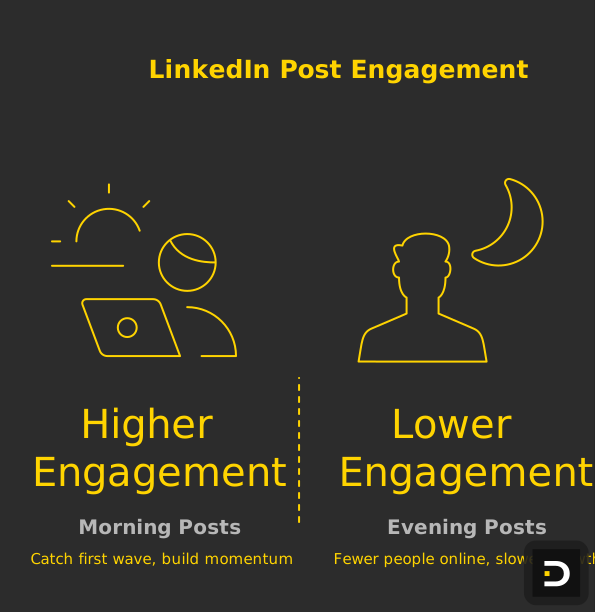
Early morning beats evening. A post published at 7:30am gets more engagement than the same post at 4pm, even if more total people are online at 4pm. The reason is simple: morning posts catch the first wave of engagement and accumulate momentum before evening.
The practical implication: If you're going to post twice a week, publish on Tuesday and Thursday morning. If you're posting 3 times per week, add Monday morning. If you're posting 4 times weekly, you can add Wednesday and Friday mornings.
There are exceptions (if your audience is global, you might post at a time that works for multiple zones; if your company culture is heavily European or Asian, adjust accordingly). But for most US/UK-based tech founders, Tuesday-Thursday 8–11am is optimal.
Set a calendar reminder or use LinkedIn's scheduling feature. LinkedIn lets you schedule posts up to 2 weeks in advance. If you batch content on Monday for the whole week, schedule them to post Tuesday–Friday morning automatically. You don't have to be present at publishing time—scheduling takes the pressure off.
The Batching System That Actually Works
The reason most CEOs stop posting consistently: they try to produce one post at a time, and it feels exhausting. Record something today, edit it, publish it tomorrow, think of ideas the next day. The context switching is draining.
Batching solves this by front-loading the thinking and creation. You do the creative heavy lifting once per week, then let publishing happen on autopilot.
The weekly batching schedule:
Monday (90 minutes): Ideation and outline
Spend 30 minutes reviewing the past week. What happened at your company? What did customers say? What industry news caught your attention? What questions are you getting from investors or prospects? Write down 4–6 ideas (just titles, one sentence each).
Spend 30 minutes researching. Look at what's trending in your industry this week. Check what your competitors posted. Read LinkedIn's top posts in your category. Note patterns. Steal ideas (not verbatim, but frameworks and angles).
Spend 30 minutes outlining. For each of the 4–6 ideas you identified, write a loose outline: hook (one sentence that makes someone stop scrolling), 2–3 main points, close/CTA. You don't need to write full posts yet—just enough structure to know what you're writing about.
Tuesday–Wednesday (90 minutes total): Writing or recording
If you're having a ghostwriter produce content: send them the 4–6 outlines. They write full posts (or transcribe your voice notes into posts). Turnaround is usually 24 hours.
If you're writing yourself: Spend 45 minutes writing 3–4 posts. This is much faster when you already have outlines. You're not staring at a blank page—you're filling in the outline. Then spend 45 minutes reviewing and editing them. Done.
If you're using video: Record 4 talking-head videos back-to-back (45 minutes). Then edit them (30–45 minutes). Store them in a shared folder. Caption them and write descriptions asynchronously over Wednesday.
Thursday (60 minutes): Review and schedule
Review your finished content (4–6 posts). Edit for clarity, flow, and LinkedIn voice (more casual than formal, more conversational than corporate). Add any links, tags, or CTAs. Write headlines.
Schedule them to publish Tuesday–Friday of the coming week using LinkedIn's scheduler. Pick your optimal times (Tuesday–Friday, 8–11am). Done.
Friday (30 minutes): Engagement plan
Look at what posts you'll be publishing next week. Plan your engagement strategy. Which posts do you want to personally reply to first thing in the morning? (Usually your most important pieces—the ones closest to your core narrative.) Which ones can a team member handle? Write a quick note to your team about what to prioritize.
Total time investment: 270 minutes (4.5 hours) per week for 4–6 posts. That's roughly 45 minutes per post including ideation, writing, review, scheduling, and engagement planning. Compare this to the alternative (one post at a time, one idea per day, scattered engagement) and batching saves 3–4 hours per week.
Building Your 4-Week Content Calendar
Here's what a realistic CEO LinkedIn content calendar looks like. This assumes 3x/week posting (12 posts per month). You can adjust the number up or down based on your target frequency.
Week 1: Company narrative focus - Tuesday: Company milestone or update (new hire, new feature, anniversary, etc.) - Thursday: Lesson learned from building the company (failure you survived, insight you gained) - Saturday: Industry commentary (trend you're watching, prediction about the market)
Week 2: Founder narrative focus - Monday: Personal perspective (your background, why you care about this problem) - Wednesday: Customer story or case study (real result you've helped someone achieve) - Friday: Contrarian take (opinion that challenges conventional wisdom)
Week 3: Education focus - Tuesday: How-to or framework (5-step process you use, advice you give frequently) - Thursday: Market insight (what you're seeing in customer conversations, data point that matters) - Saturday: Advice for other founders (what you wish you'd known, pattern you notice in the market)
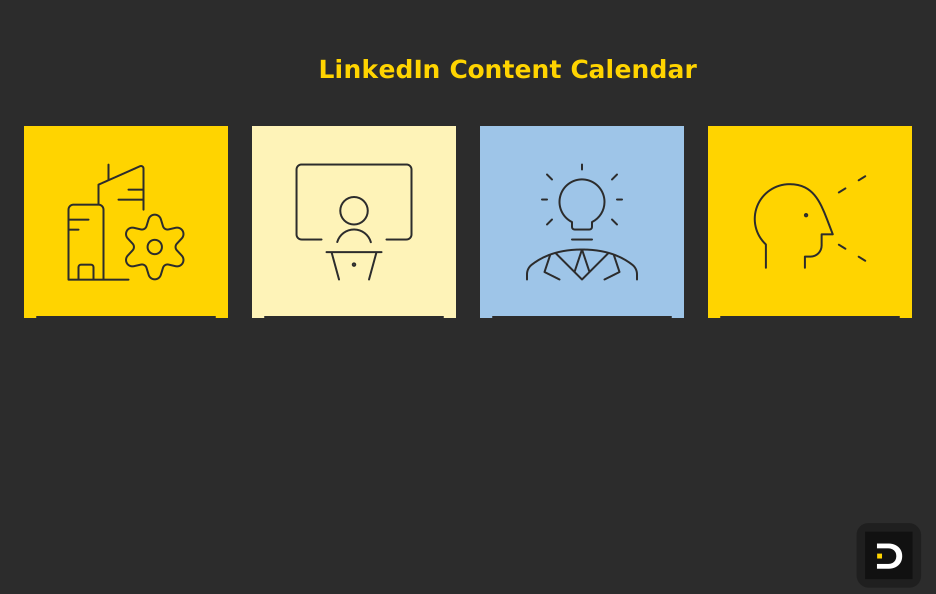
Week 4: Thought leadership focus - Monday: Industry reaction to news (what just happened and why it matters) - Wednesday: Research or data share (study you found, benchmark you researched, methodology you've validated) - Friday: Vision or aspiration (where you think the market is going, what you're building toward)
This four-week cycle mixes company narrative, personal narrative, education, and thought leadership. When you repeat it monthly, your audience gets variety. They see you as a leader, a person, an educator, and a thinker.
Sample posts for Week 1:
Tuesday–Company Narrative: "We just hired our VP of Product, and it's one of the most important decisions we've made all year. Not because she's brilliant (she is), but because this is the moment our company moves from 'founder-led product' to 'team-led product.' We built the foundation—now we're building the structure. If you're a founder thinking about when to hire your first product leader, happy to share what we're looking for and why now was the time. [tag 3–5 people in your network who might connect you with candidates]"
Thursday–Lesson Learned: "We burned through our first $500K in funding in 18 months and had nothing to show for it except learnings and debt. The mistake: we tried to sell to enterprise customers before we had product-market fit. We'd pitch before we built. Now I have a rule: 10 paying customers from our core market before we sell to anyone else. Lesson: fit comes before sales. [Question: What's the most expensive lesson you've learned as a founder?]"
Saturday–Industry Commentary: "Everyone's talking about AI in cybersecurity, and most of it is hype. But there's one category where AI is actually changing the game: threat detection. The pattern recognition AI is finally good enough to catch anomalies humans miss, and that changes everything about how we think about detection. Other AI use cases in security? Still mostly marketing."
These posts take 30–45 minutes to write when you have a clear outline. They feel authentic because they reflect what you actually think and what's happening in your company.
Delegation Framework: Ghostwriter to Publisher
Most CEOs can't execute this calendar alone and still run a company. Delegation is essential, but it has to preserve your voice.
The delegation framework has three layers: ideation (you), creation (ghostwriter or team), publishing and engagement (team).
Layer 1: Ideation (You, 30 minutes/week)
You own the ideas. Every Monday, you spend 30 minutes identifying 4–6 ideas for the week. These can come from: a conversation you had with a customer, a question you're getting from investors, a company milestone, a market trend you're watching, a failure you survived, a pattern you're noticing.
Write one sentence per idea. Don't write the full post—just capture the kernel. Send this list to your ghostwriter or content team.
Layer 2: Creation (Ghostwriter or content team, 2–3 hours/week)
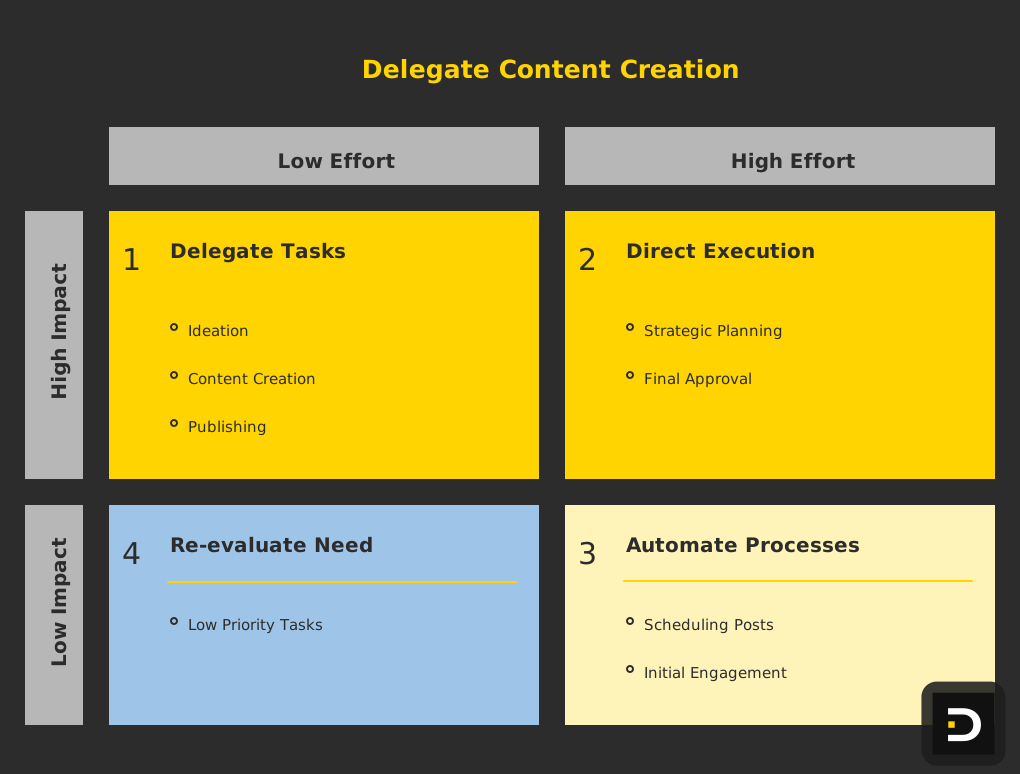
Your ghostwriter takes the ideas and writes full posts (300–500 words each). They interview you or pull from past interviews to understand your voice. They research links and credibility points. They write 4–6 full posts and send them back to you for approval.
If you're working with a strong ghostwriter, they're not changing your ideas—they're expanding them using your voice and perspective. You should recognize yourself in the post.
Layer 3: Publishing and Engagement (Team, 1–2 hours/week)
Approving posts, scheduling them to go out at the right times, managing initial engagement (replying to early comments), and tracking performance. A team member can own this entirely. They don't need your input on every comment—most engagement is fairly straightforward. They escalate only if someone asks a substantive question that requires your thinking.
Time breakdown:
- You: 30 minutes ideation per week
- Ghostwriter: 2–3 hours creation per week ($50–150 per week depending on rates, or $200–600 monthly for a dedicated freelancer)
- Team member: 1–2 hours publishing and engagement per week ($500–1,500 monthly for a part-time contractor or junior team member)
Total external cost: $700–2,100/month for a complete system. In exchange, you get 12–16 posts per month that feel authentic, maintain consistency, and drive engagement without you spending more than 2 hours per week on execution.
Monthly and Quarterly Reviews
A content calendar isn't static. Every month, review what's working and what isn't. Every quarter, reset and refocus.
Monthly review (30 minutes):
Look at your 3–4 most engaged posts from the previous month. What do they have in common? Was it the topic? The format? The angle? Look at your lowest-engagement posts. What fell flat? Did the hook not work? Was the topic off-target?
Adjust your ideation topics based on what worked. If customer stories outperform company updates 3:1, do more customer stories. If contrarian takes don't get engagement but educational content does, lean into education.
Quarterly reset (90 minutes):
Every three months, step back and ask: Is this content ladder supporting my business goals? If you're raising money, are your posts building your thought leadership narrative? If you're hiring, do your posts attract talent? If you're trying to establish yourself as a category leader, is your content claiming and owning that territory?
Adjust your broader strategy. Maybe you shift from 50% thought leadership, 30% company updates, 20% personal narrative to 40% thought leadership, 40% personal narrative, 20% company updates (because recruiting is now your priority). These shifts show up in your monthly ideation focus.
Adjusting Your Calendar as You Scale
Your content calendar should evolve as your company evolves.
Early stage (pre-Series A): 2x/week posting, very informal, mostly lessons learned and market commentary. The goal is visibility with founders and early investors. Low production value is actually authentic.
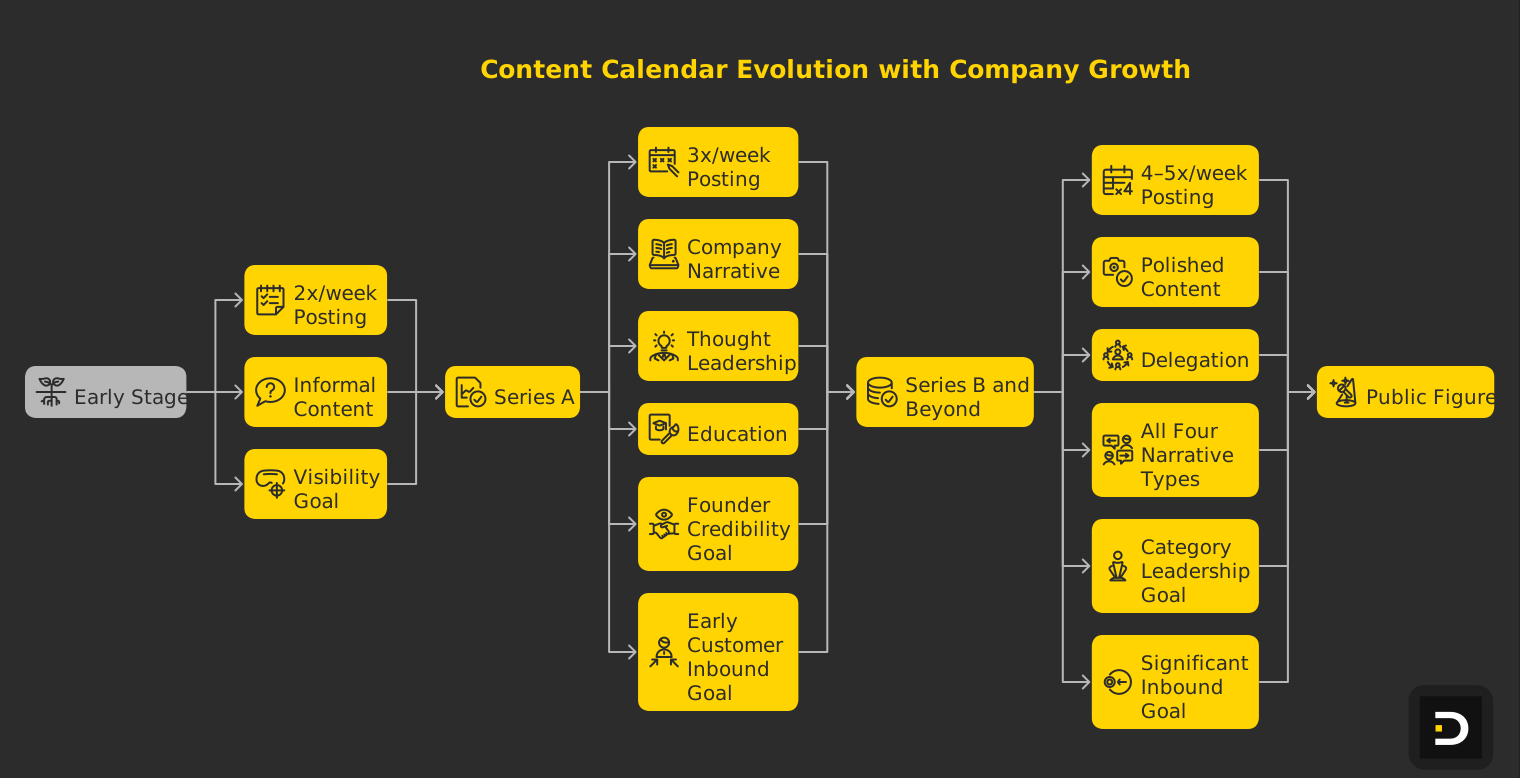
Series A: 3x/week, mix of company narrative, thought leadership, and education. The goal is founder credibility and early customer inbound. Production value increases slightly but still authentic.
Series B and beyond: 4–5x/week, more polished, strong delegation, mix of all four narrative types. The goal is category leadership and significant inbound. You're now a public figure for your space, and your content reflects that professionalism.
Grow your output by increasing frequency before you increase production value. Going from 2x/week to 3x/week is easier than going from highly polished 2x/week to even more polished 2x/week. Consistent, authentic beats rare and perfect.
Frequently Asked Questions
What if I miss a post? Does it break my consistency?
Missing one post occasionally is fine. The algorithm doesn't penalize you for a single miss. But missing a whole week does reset momentum. Try to post at least 1–2 times per week minimum, even if you're swamped. If you know you'll be traveling or in crunch mode, batch ahead and schedule posts in advance.
Should I repurpose the same post across different platforms?
Adapt, don't replicate. The same core idea can become a LinkedIn post (300–500 words, professional tone), a Twitter thread (3–5 tweets, more conversational), a newsletter article (1,000 words, deeper), and a video (90 seconds, visual). The core idea is consistent. The format is different.
How do I measure if my content calendar is working?
Track four metrics: monthly profile view increases (should see 20–50% growth within 3 months of consistent posting), engagement rate (aim for 2–5% over time), inbound inquiries (track how many people mention "saw your LinkedIn post" in initial conversations), and business impact (if you're tracking, deals or partnerships influenced by your content).
What if I hate writing? Can I do video instead?
Absolutely. Some CEOs are natural writers. Others are natural talkers. If you're a talker, use video. Record a 2–3 minute talking head video, have someone transcribe it, edit it into a LinkedIn post, and post the transcript. You own the voice authentically—it's literally your voice. Many top-performing CEO accounts do this.
Should I engage with comments personally or delegate it?
You personally engage with your most important posts (your core narrative pieces, thought leadership takes where you want to be in conversation). Delegate engagement on less critical posts. If someone asks a substantive question on a delegated post, escalate it to you. This balance keeps you connected to your audience without drowning in comment replies.
Ready to Build Your LinkedIn Thought Leadership?
Consistency wins. A CEO who posts 3 times per week for 90 days with a clear content calendar beats a CEO who posts sporadically with slightly better ideas. The algorithm rewards consistency. Your audience expects it. Your results depend on it.
The system is simple: batch your ideation weekly, delegate creation and publishing, review monthly, adjust quarterly. This takes 2–4 hours of your actual time per week and generates 12–16 posts per month.
Start with 2x/week if you're new to this. Don't try to jump to 5x/week immediately. Build the system with 2x/week, then scale frequency as it becomes automatic.
For deeper guidance on what to actually write about, check out executive-linkedin-content-strategy-2026 for narrative strategy, or explore linkedin-ghostwriting-for-founders to understand how to hire someone to help you execute.
The next post you publish should be part of a system, not a one-off. Build the calendar. Commit to the cadence. Watch what happens in 90 days.