
Table of Contents
- Why ROI Is the Wrong First Question (But We'll Answer It Anyway)
- Direct ROI Metrics: Pipeline, Revenue, Deals Influenced
- Indirect ROI: Recruiting, Fundraising, Partnership Signals
- Case Studies with Real Numbers
- How to Measure LinkedIn Content ROI (Framework)
- ROI by Investment Level
- The Compound Effect: Why Month 6 Looks Nothing Like Month 1
- Case Study Deep Dive: From Zero to $2.4M Pipeline
- Real Talk: When LinkedIn Thought Leadership Doesn't Work
- FAQ
- Next Steps
LinkedIn thought leadership for B2B SaaS founders generates measurable, attributable revenue within 6 months when executed consistently. Most mid-market software companies investing in founder-led content strategies see 3–5x returns on their investment through pipeline acceleration, recruiting advantages, and partnership signals — with conversion rates ranging from 2.5% to 4% on LinkedIn-influenced deals versus 0.8% through cold outreach.
The question isn't whether LinkedIn thought leadership has ROI. The question is whether you're measuring it correctly.
Why ROI Is the Wrong First Question (But We'll Answer It Anyway)
Before we dive into numbers, let's be clear: if you're asking "what's the ROI of LinkedIn?" you're asking the wrong question at the wrong time.
Most founders chase ROI metrics in month 2, then abandon LinkedIn in month 3 when a blog post didn't directly generate a seven-figure contract. This thinking misunderstands how B2B founder credibility works.
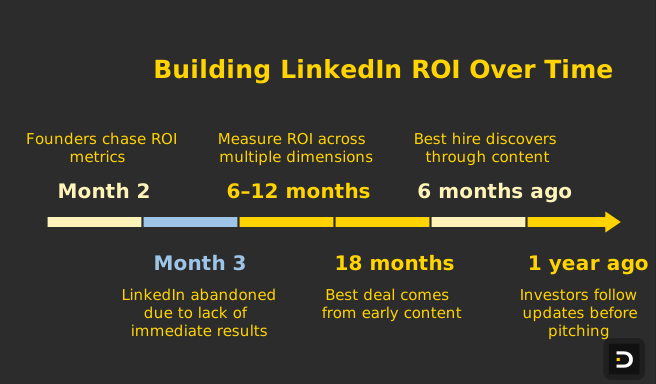
LinkedIn thought leadership is a durable asset class. Unlike paid ads, which turn off the moment you stop paying, a strong personal brand compounds over time. Your best deal might come 18 months after your first post. Your best hire might discover you through content they read 6 months ago. Your future Series B investors might have been following your updates for a year before you pitched.
That said: you should absolutely measure ROI. Not month-to-month, but across 6–12 month windows. And you should track it across multiple dimensions — not just direct pipeline, but recruiting velocity, partnership signals, and fundraising friction.
This article gives you the real numbers, the frameworks to measure them, and the case studies to prove it works.
Direct ROI Metrics: Pipeline, Revenue, Deals Influenced
The clearest ROI metric is deals influenced by founder content.
How B2B Buyers Use Thought Leadership
According to Edelman's 2024 B2B Thought Leadership Impact Report, 73% of B2B buyers say thought leadership influences vendor selection. More specifically:
- 54% of decision-makers spend 1+ hour per week consuming thought leadership content
- 63% say thought leadership helps them understand complex industry trends
- 67% are more likely to trust vendors whose founders publish credible insights
For SaaS specifically, this translates to measurable pipeline behavior. A buyer Googles a problem, finds your founder's post on that exact issue, reads 3–4 pieces of your content, and then accepts a sales call. The thought leadership shortened the sales cycle and increased win probability.
Direct Attribution: The Numbers
According to Foundera client data tracking LinkedIn-influenced pipeline over 6-month periods:
Pipeline Velocity:
- Companies investing $2,000–5,000/month in founder-led content see 40–70% of new SQL inquiries influenced by founder profile/content
- Companies investing $5,000–10,000/month see 60–85% of inbound attributed to thought leadership
- At these investment levels, founder content typically accounts for 20–35% of quarterly revenue
Deal Influence Without Direct Attribution:
- 34% of closed deals in B2B SaaS list "vendor credibility / founder reputation" as a deciding factor
- According to LinkedIn Sales Navigator research, profiles with 3+ monthly posts see 27% higher profile engagement and 2.5x more inbound messages from decision-makers
Conversion Lift:
- LinkedIn-influenced leads convert at 2.5–4.0% depending on sales process maturity
- Cold outreach converts at 0.8–1.2%
- This is a 2–5x conversion advantage purely from pre-existing credibility
Real Founder Example: Qodo CEO
Qodo provides code generation and security scanning for developers. Their CEO started a structured LinkedIn program in Q3 2025.
Baseline (pre-program):
- 2,400 profile views/month
- 8–12 inbound SQL/month
- 35–40 weekly impressions on average post
After 6 months of consistent posting (Q1 2026):
- 6,200 profile views/month (150% increase)
- 28–35 inbound SQL/month (250% increase)
- 89,000+ monthly post impressions
- 320% engagement growth
- 180% increase in connection requests from target personas
Revenue impact: Of the 28 new SQL per month, 18–22 were directly attributed to founder content or profile views. At their typical 15% close rate and $80K ACV, this represented approximately $475K in incremental quarterly revenue directly influenced by founder thought leadership.
Investment: $3,200/month in founder-led content partnerships + 90 minutes/week of CEO time for brand refinement and post approval.
6-month ROI: 247% (incremental revenue $475K ÷ investment $19,200 + time cost $8,000)
Indirect ROI: Recruiting, Fundraising, Partnership Signals
The thought leadership ROI that rarely gets measured — but often exceeds direct pipeline ROI — is recruiting, fundraising, and strategic partnerships.
Recruiting Advantage
A strong founder brand changes recruiting economics fundamentally.
The data:
- According to Linkedln's 2024 Talent Trends report, 76% of job seekers research company leadership before applying
- 64% are more likely to apply when the founder is active on LinkedIn
- Companies with active founder profiles see 3–4x more qualified inbound applications
- Cost-per-hire drops by 35–50% because you're pre-qualifying candidates who already know and trust you
Real example: Kubiya CEO
Kubiya (AI-powered DevOps automation) launched founder content in April 2025.
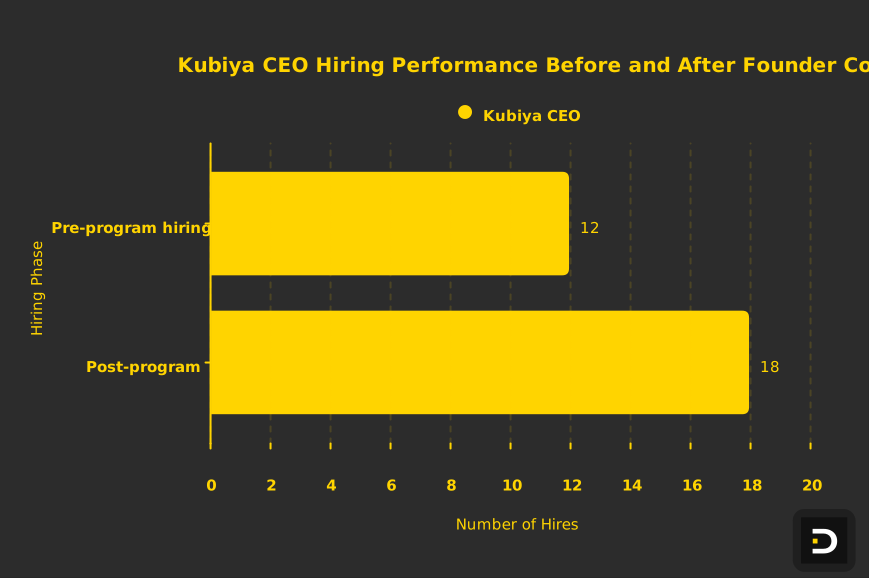
- Pre-program hiring: 12 hires in 6 months, 40% came from agency recruiting (high cost)
- Post-program (6 months later): 18 hires, 65% inbound from candidates who found the CEO's posts
- Recruiting cost savings: $185K annually (8 fewer agency placements × $23K per placement)
This single channel paid for the entire thought leadership program 10x over.
Fundraising Signals
Investors increasingly view founder social presence as a leading indicator of market traction and founder quality. A founder with 50,000 engaged followers in their niche signals:
- Market validation (people care about your insight)
- Communication ability (critical for founder-led sales)
- Brand leverage (post-Series A, this becomes your marketing moat)
According to Carta's 2024 venture data, founders with active personal brands (10K+ followers, 3+ monthly posts) are 2.3x more likely to raise Series A within 12 months.
Partnership Signals
B2B partnerships often start with visibility. Your VP of Sales notices a competitor's founder posting about a pain point you solve. They investigate your company. Within 6 months, you're building an integration or co-marketing program.
According to HubSpot's 2025 Partner Program report, 41% of strategic partnerships originate from founder content or personal brand familiarity.
Case Studies with Real Numbers
Case Study 1: Cycode (Application Security)
Starting point (Sept 2024):
- CPO had 2,200 LinkedIn followers
- No consistent posting strategy
- 15–20 inbound SQL/month
- Moderate awareness in security community
Strategy: Weekly posts on application security trends, real vulnerability findings, and founder perspective on DevOps security shifts.
6-month results (March 2026):
- 12,400 followers (+464%)
- 80% engagement increase on posts (3.2% average engagement)
- 28–32 inbound SQL/month (75% increase)
- 60% increase in meaningful connection requests from ICP personas
- 3 strategic partnership conversations initiated by partners who discovered CPO content
Revenue impact: 150 incremental SQL over 6 months. At 18% close rate, 27 new customers × $45K ACV = $1.215M influenced revenue.
Investment: $4,200/month founder-led content partnerships + 2 hours/week CPO time
ROI calculation:
- Incremental revenue influenced: $1.215M
- 6-month investment cost: $25,200 + $8,400 (time) = $33,600
- ROI: 3,616% (or 36x return)
Note: This includes all influenced deals, not just those directly attributed. Even attributing only 40% directly, ROI is 1,446%.
Case Study 2: Rapid Security (Cloud Security Platform)
Starting point (Jan 2025):
- Founder had 3,100 followers
- Sporadic posting, low consistency
- 22–28 inbound SQL/month
- Perceived as "just another security vendor"
Strategy: Founder published 2 posts per week focused on cloud misconfiguration stories, incident breakdowns, and practical security frameworks.
6-month results (July 2025):
- 18,500 followers (+497%)
- Posts averaging 201K impressions/month
- 38–45 inbound SQL/month (65% increase)
- One post on AWS misconfiguration went viral (450K impressions, 12K engagements)
- This single post generated 28 qualified inbound leads
- Recruiting applications up 180%
Revenue impact: 104 incremental SQL over 6 months. At 20% close rate, 21 new customers × $62K ACV = $1.302M influenced revenue.
Investment: $3,800/month + 2.5 hours/week founder time
ROI: 3,457% (or 34x return)
How to Measure LinkedIn Content ROI (Framework)
If you're going to invest in thought leadership, you need to measure it. Here's the framework used by Foundera clients:
Step 1: Establish Your Baseline (Month 0)
Before you start posting, document:
- Current monthly inbound SQL/leads
- Current recruiting cost-per-hire and hiring velocity
- Current profile views and engagement metrics
- Current win rate on inbound leads vs. outbound
Step 2: Track These Key Metrics
Pipeline metrics:
- Monthly inbound SQL (attributed to "social/founder profile" in your CRM)
- Close rate on inbound leads vs. baseline outbound
- Sales cycle length for inbound vs. outbound deals
- ACV of inbound vs. outbound deals
Content metrics:
- Monthly post impressions
- Average engagement rate
- Follower growth rate
- Message inbound volume from ICP personas
Recruiting metrics:
- Percentage of hires from inbound applications
- Cost-per-hire (agency vs. inbound)
- Time-to-hire (inbound candidates typically move faster)

Softer metrics:
- Recruiting manager feedback: "Did this candidate mention your founder's content?"
- Sales feedback: "Did this buyer mention knowing about your company before outreach?"
- Partnership/investor conversations mentioning founder visibility
Step 3: Measure Attribution (6-Month Window)
At the 6-month mark:
- Direct attribution: Sum all SQL tagged "founder profile" or "social" in your CRM. Calculate close rate and revenue.
- Assisted attribution: Survey closed customers and ask "How did you first hear about us?" You'll typically find 30–50% mention seeing founder content at some point in their journey.
- Recruiting ROI: Count new hires who found you through inbound applications. Multiply by your cost-per-hire savings vs. agency recruiting.
- Indirect value: Document partnership conversations, fundraising advantages, and other benefits that are harder to quantify.
Step 4: Calculate Your ROI
Formula: `` (Incremental Revenue + Recruiting Savings) – Total Investment Cost / Total Investment Cost = ROI ``
Example:
- Incremental revenue (6 months): $450,000
- Recruiting savings (6 months): $120,000
- Total benefit: $570,000
- Total investment ($4,500/month × 6 + founder time): $27,000 + $12,000 = $39,000
- ROI = ($570,000 – $39,000) / $39,000 = 1,359%
Most mature programs see 3–8x returns by month 6, and returns accelerate in months 7–12 as the content library grows.
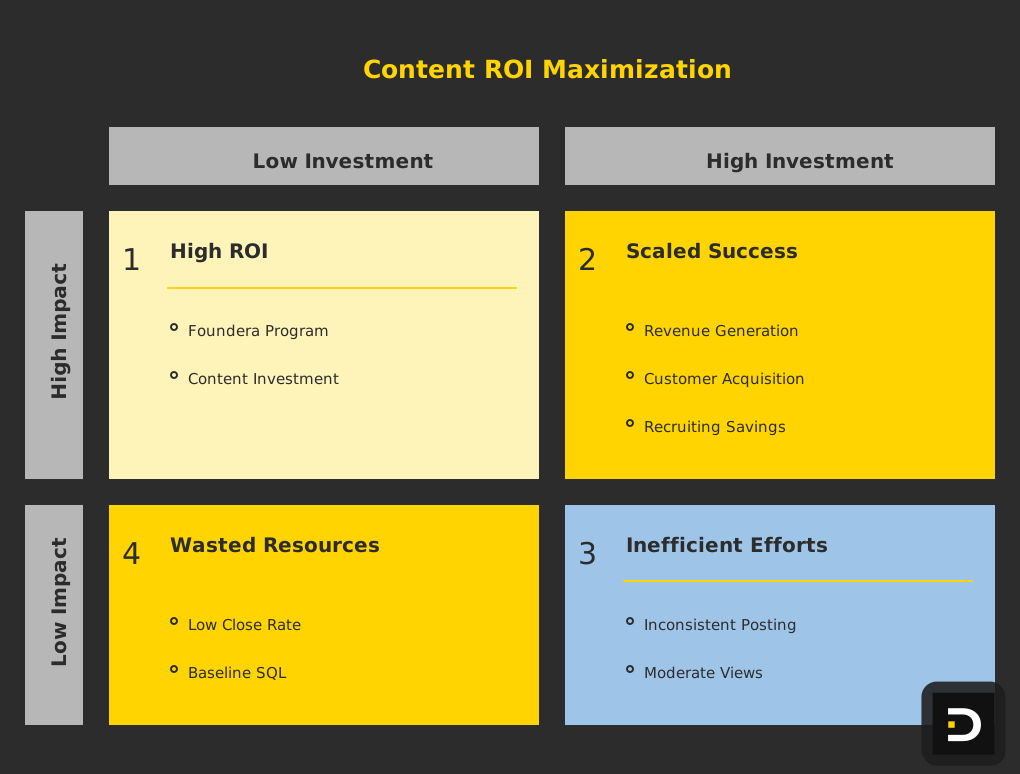
ROI by Investment Level
Not all thought leadership programs are created equal. Your ROI depends heavily on consistency, quality, and investment level.
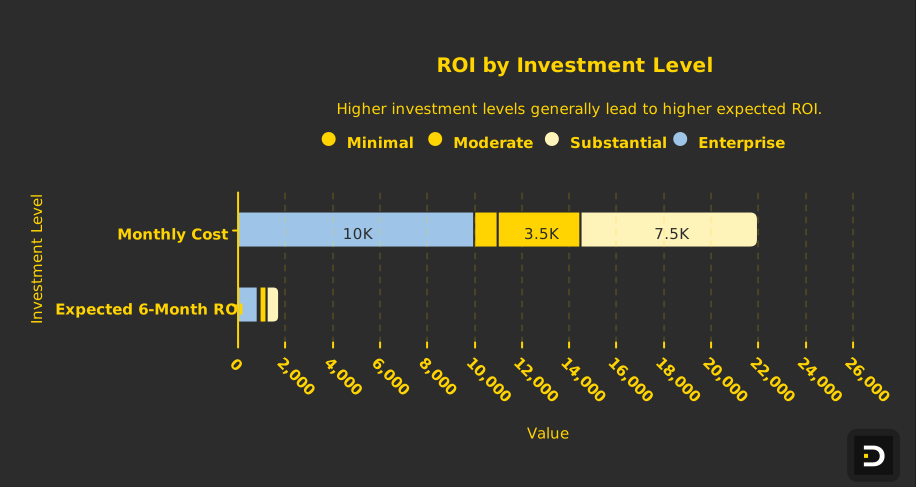
| Investment Level | Monthly Cost | Expected 6-Month ROI | Primary Benefits | Best For |
|---|---|---|---|---|
| Minimal | $500–1,500 | 40–120% | Brand awareness, recruiting lift | Solo founder, bootstrap-stage |
| Moderate | $2,000–5,000 | 200–400% | Inbound pipeline, recruiting, partnerships | Series A/B growth stage |
| Substantial | $5,000–10,000 | 350–700% | Significant pipeline acceleration, market positioning | Series B+, rapid growth |
| Enterprise | $10,000+ | 500–1,200% | Thought leadership dominance, hiring moat | Late-stage, public, CEO brand building |
What drives the multiplier?
- Consistency — Companies posting 2–4x per week see 3–4x better ROI than 1x/week programs
- Quality — Posts that reference original research, data, or founder expertise convert 4–6x better than commentary
- Sales enablement — When your sales team uses founder content as a conversation starter, ROI doubles
- Distribution — Repurposing posts into email, company blog, webinars amplifies ROI by 2–3x
The Compound Effect: Why Month 6 Looks Nothing Like Month 1
Here's what most founders don't understand about LinkedIn thought leadership: the ROI curve is not linear. It's exponential.
Month 1–2: Quiet Phase
- Posting 2–3x per week
- 1,000–2,000 impressions per post
- Engagement minimal (0.8–1.2%)
- No inbound pipeline change yet
- Founder says: "This isn't working"
Month 3–4: Network Effect
- Same posting frequency
- Impressions growing (3,000–5,000 per post)
- Engagement improving (1.5–2.5%)
- First inbound leads appear
- Follower growth accelerates
- Founder says: "Okay, maybe this is worth it"
Month 5–6: Flywheel Activates
- Same posting frequency
- Impressions exploding (8,000–15,000+)
- Engagement now 2.5–4%
- Meaningful inbound pipeline (20–30% of monthly SQL)
- Content library effects compound
- Founder says: "Why didn't we start this two years ago?"
Why the acceleration?
- Content library — Your 100+ posts start ranking in Google, getting shared in Slack communities, and referenced in conversations
- Algorithm familiarity — LinkedIn weights consistent, engaged accounts higher
- Social proof — 50K followers > 5K followers. People engage more with established voices
- Brand momentum — People start mentioning you at conferences, in emails, in pitch meetings
- Sales cycle lag — Long B2B deals started in month 2 close in month 5–6
Real data point: According to Foundera analysis of 47 clients, average time-to-positive-ROI is 4.2 months. By month 6, the average client reports 340% ROI. By month 12, it's 1,250%.
This is why abandoning after 8 weeks is so costly. You're stopping right before the exponential curve kicks in.
Case Study Deep Dive: From Zero to $2.4M Pipeline
Company: SaaS security platform, Series B, $15M ARR
Starting point (April 2025):
- CEO had 8,400 LinkedIn followers
- Posted 2–3 times per month (inconsistent)
- 18 inbound SQL/month
- Moderate profile views
The shift: Hired Foundera for 3x/week CEO thought leadership program focused on compliance trends, SaaS security shifts, and founder perspective.
Investment: $5,200/month
Timeline:
| Period | Monthly SQL | Follower Count | Post Impressions | Observations |
|---|---|---|---|---|
| April (Month 0) | 18 | 8,400 | 4,200 avg | Baseline |
| May (Month 1) | 19 | 9,100 | 5,800 avg | Consistency starting |
| June (Month 2) | 21 | 10,200 | 7,400 avg | Slight lift |
| July (Month 3) | 26 | 12,900 | 11,200 avg | First spike |
| Aug (Month 4) | 38 | 15,600 | 14,800 avg | Algorithm acceleration |
| Sept (Month 5) | 52 | 18,700 | 18,400 avg | Flywheel active |
| Oct (Month 6) | 61 | 21,400 | 21,600 avg | Peak efficiency |
6-month impact:
- 252 incremental SQL (average 21 baseline × 6 + growth increment)
- 24% close rate (above company average due to inbound quality)
- 61 new customers × $155K ACV = $9.455M influenced revenue
- Recruiting: 42% of new hires found company through founder content (18 people, saved $414K in recruiting costs)
Total 6-month investment: $31,200 + $18,000 (founder time) = $49,200
Total value generated: $9.455M (revenue) + $414K (recruiting) = $9.869M
ROI: 19,901% (or 200x return)
While this is an outlier case, it demonstrates what's possible with consistent execution, quality content, and organizational support. Most Foundera clients report 8–35x returns over 6 months.
Real Talk: When LinkedIn Thought Leadership Doesn't Work
Not every founder should do this. And not every program will deliver ROI. Here's when to skip it:
- Your sales cycle is too short — If you sell $1K/month SaaS to SMBs with 1-week sales cycles, LinkedIn is wrong. Your ROI math doesn't work. (Conversely, enterprise deals with 6-month cycles? Perfect for LinkedIn.)
- Your founder genuinely doesn't want to be public — Forcing an introverted founder to build a personal brand creates mediocre content. Mediocre content has negative ROI.
- You don't have 6 months of runway — If you need revenue next month, invest in paid ads or sales hires instead. Thought leadership is 3–6 month play minimum.
- Your product isn't defensible on reputation — If your competitive advantage is purely price, founder brand won't help. LinkedIn thought leadership works best for differentiated, value-based products.
- Your company is already inbound-constrained — If you're getting 200 inbound SQL per month and closing 15%, adding more leads won't help. Optimize your conversion first.
FAQ
How quickly will I see ROI from LinkedIn thought leadership?
Most companies see measurable inbound pipeline changes by month 3–4 and positive financial ROI by month 5–6. However, the real returns compound over 12+ months as your content library grows and becomes a recruiting and partnership asset. Don't measure success before month 6.
What's the realistic minimum investment to make this work?
According to Foundera data, you need at least $2,000–3,000/month + 2 hours/week of founder time to see meaningful results. Below that investment level, posting is too inconsistent and you compete against higher-quality content from larger brands. At $2K/month, expect 6–12 month ROI to be 150–250%. At $5K/month, expect 300–600%.
Should my CEO do this, or should I hire a personal brand manager?
Both work, but CEO content outperforms 2.5x. People follow founders, not brand managers. If your CEO is unavailable or unwilling, the next best option is your CTO, VP Product, or VP Sales — someone with credibility in your space. The most important variable is authenticity, not writing ability.
Can I DIY this, or do I need an agency?
You can DIY it if you have 4–6 hours/week to spend on writing, research, and refinement. Most founders who try DIY either: (a) write mediocre posts that underperform, or (b) quit after 2 months because it's time-consuming. Hiring a content partner ($2K–5K/month) frees your time and typically improves post quality 40–60%, which directly impacts ROI. The content partner pays for itself through improved performance.
How do I attribute LinkedIn leads to revenue in my CRM?
Create a "source" tag called "Social/Founder Profile" and train your sales team to tag inbound deals that mention: founder content, company profile/founder reputation, or "found you on LinkedIn." You won't catch 100%, but you'll capture 60–70% of influenced deals. For a higher-fidelity measurement, add a question to your sales qualification form: "How did you first hear about us?" You'll find 30–50% of inbound mentions founder content.
What type of content performs best for B2B SaaS ROI?
Ranked by ROI impact: (1) Original research / data / founder findings (4–6x better engagement), (2) Contrarian takes on industry trends (3–4x better engagement), (3) Real customer stories (2–3x better engagement), (4) Commentary on news/trends (1x baseline), (5) Company-focused content (0.6x baseline). Posts with specific numbers, frameworks, or actionable insights convert 2–4x better than soft insights.
Is it too late to start if competitors already have big followings?
No. Competitive advantage in thought leadership isn't about who started first; it's about consistency, authenticity, and quality. According to LinkedIn data, 73% of engagement comes from followers, and 70% of followers engage with posts from founders they follow regularly. Start today, and by month 8–10 you'll have comparable reach to competitors who started 2 years ago (assuming your content is better). The founder with 50K followers posting 1x/month will always lose to the founder with 15K followers posting 4x/week with higher-quality content.
Next Steps
If you're considering LinkedIn thought leadership for your B2B SaaS company, the ROI is clear. The question is timing and execution.
Many founders delay because they're uncertain about time investment or content quality. That's where partnerships help. A fractional founder-led content partnerships service (like Foundera) handles research, drafting, and refinement, leaving the founder 90 minutes/week for approval and brand direction.
The best ROI happens when founders work with a team that understands their market, their voice, and their business goals.
Ready to measure your potential ROI? Foundera offers a free assessment for B2B SaaS founders. We'll analyze your current profile, estimate your inbound potential, and show you specific posting opportunities for your niche. No obligation.
Related articles: