
Your voice is the only thing no competitor can replicate. A product can be copied. A go-to-market strategy can be out-executed. But your particular way of seeing the market—your vocabulary, your instinctive contrarian moves, the rhythm of how you think—that's singular.
Yet here's what's happening to founder content in 2026: most posts that sound AI-generated are written by humans who've absorbed LinkedIn's median voice so completely that they no longer sound like themselves. AI doesn't create that problem. It amplifies it. When you feed a generic human-written draft into Claude or ChatGPT, the model smooths away your roughest, most authentic edges—the things that made your voice distinctive in the first place.
The flattening is real. A 2024 ScienceDirect study examining generative AI's impact on brand voice found that "using generative AI for social media content creation diminishes perceived brand authenticity significantly." The damage is quantifiable: in 2023, 60% of B2B decision-makers trusted founder content on LinkedIn. By 2026, that trust has dropped to 26%—a loss driven partly by voice collapse. The Edelman-LinkedIn 2025 B2B Thought Leadership Impact Report shows that authentic, distinctive founder voice drives 156% higher ROI on social content and creates 71% higher perceived effectiveness than generic industry language.
If you're using AI to write content but losing voice in the process, you're actually harming your personal brand while saving time.
The solution isn't to reject AI. AI is the right tool for speed and scale. The solution is to preserve your voice intentionally. This guide walks you through the exact five-step workflow Foundera uses with 20+ founder clients to write AI-assisted content that still sounds distinctly human—because it is.
Table of Contents
Why AI Flattens Founder Voice
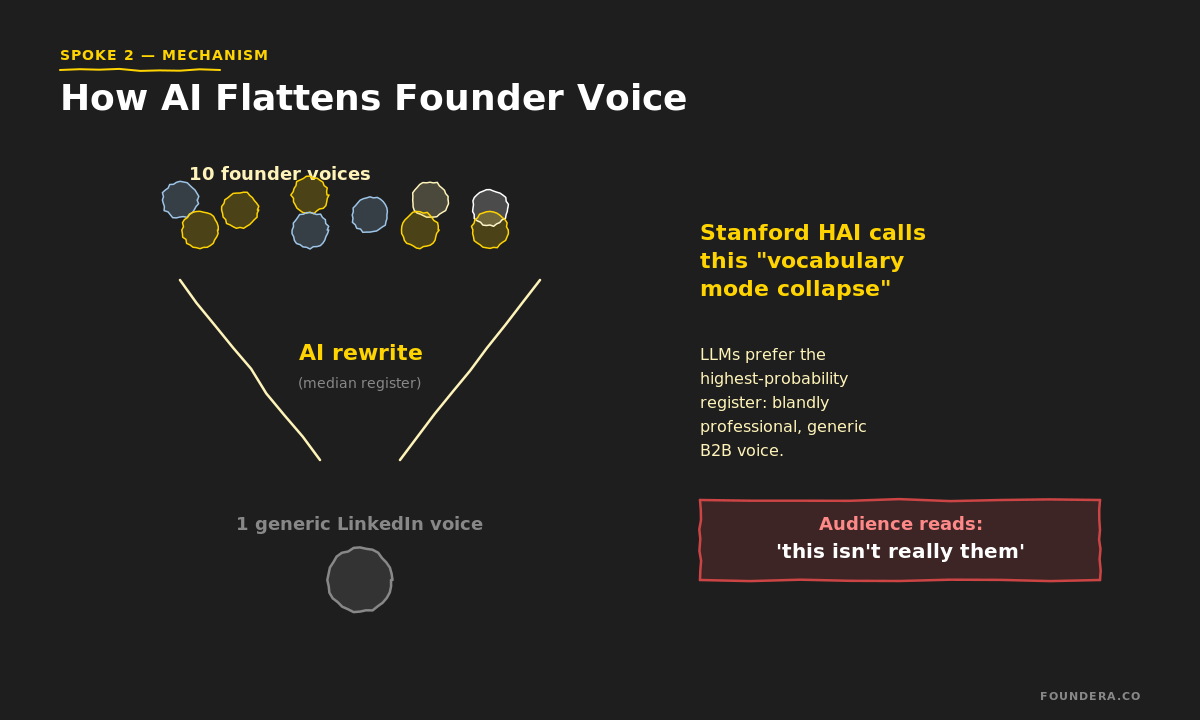
AI language models are trained on the entire corpus of human text. That's both their strength and their weakness. The strength is breadth—they've internalized patterns from millions of documents. The weakness is that the model learns to mimic the most common pattern, not the most distinctive one. When you ask an LLM to write "professional" content, it defaults to the median register it's seen most often: formal, cautious, hedged, stuffed with corporate vocabulary that every other founder is using.
Stanford's Human-Centered Artificial Intelligence institute calls this "register mode collapse." LLMs trained on broad text corpora naturally converge toward the center of the distribution. When you ask for "authentic founder voice," the model interprets that as "the voice most frequently associated with successful content," which is usually the flattened, safe version everyone else is already doing.
The second flattening mechanism is vocabulary compression. LLMs have been shown to reduce the diversity of word choice, favoring high-frequency synonyms. Where you might write "obliterate," the model suggests "eliminate." Where you might repeat a signature phrase three times for rhythm, the model diversifies the language. These small changes compound. After five AI passes on your writing, you're no longer speaking—you're translating through a median register filter.
The third mechanism is structural flattening. The most common founder voice tells stories in the same rhythm: hook, problem, solution, impact, call-to-action. It's effective because it's familiar. It's also invisible because it's identical to what every other founder is writing. You lose what makes your voice distinctive—which is often the places where you break the pattern.
Six Measurable Dimensions of Voice
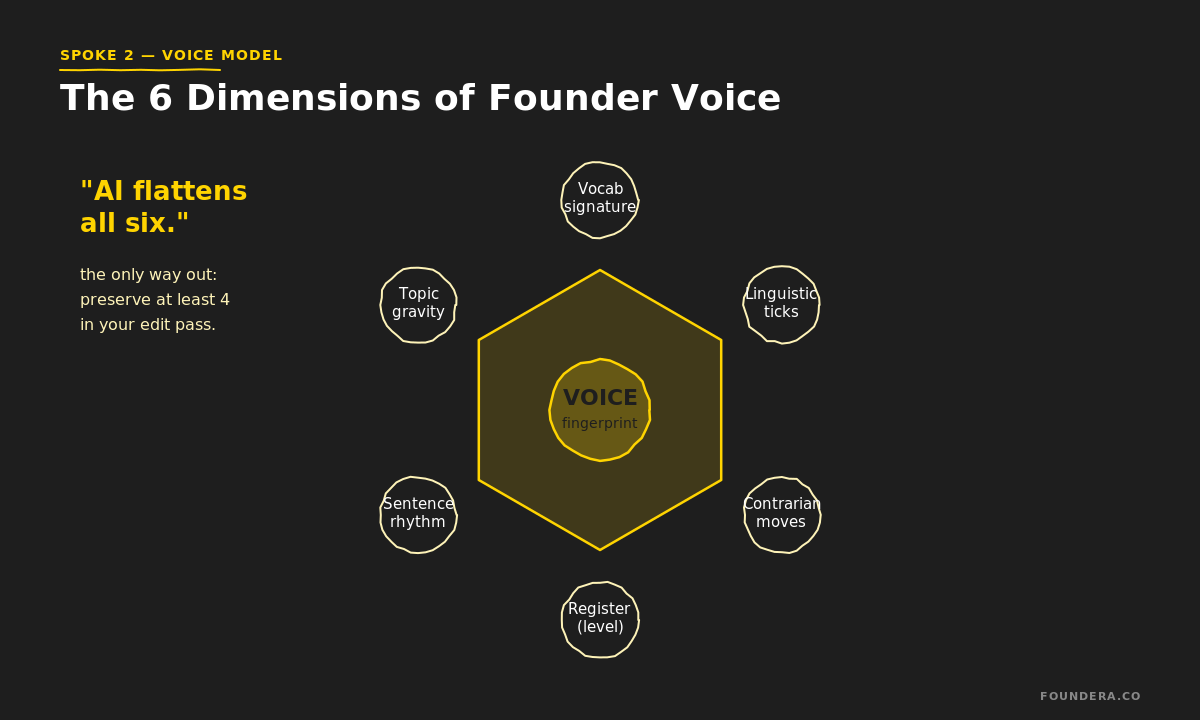
Before you can preserve voice, you need to see it. Voice isn't mystical. It's measurable across six specific dimensions:
A strong founder voice usually dominates two to three of these dimensions intensely. Google's Danny Sullivan put it plainly: "Your original voice is that thing that only you can provide. It's your particular take." That take is built from these six dimensions working together.
The Voice Profile Method
The most reliable way to preserve voice is to extract it from real instances of your speech before you start writing. Not from your existing writing (which may already be flattened or artificially polished). From recorded conversations, podcasts, or transcribed meetings where you're speaking naturally.
Here's the extraction process:
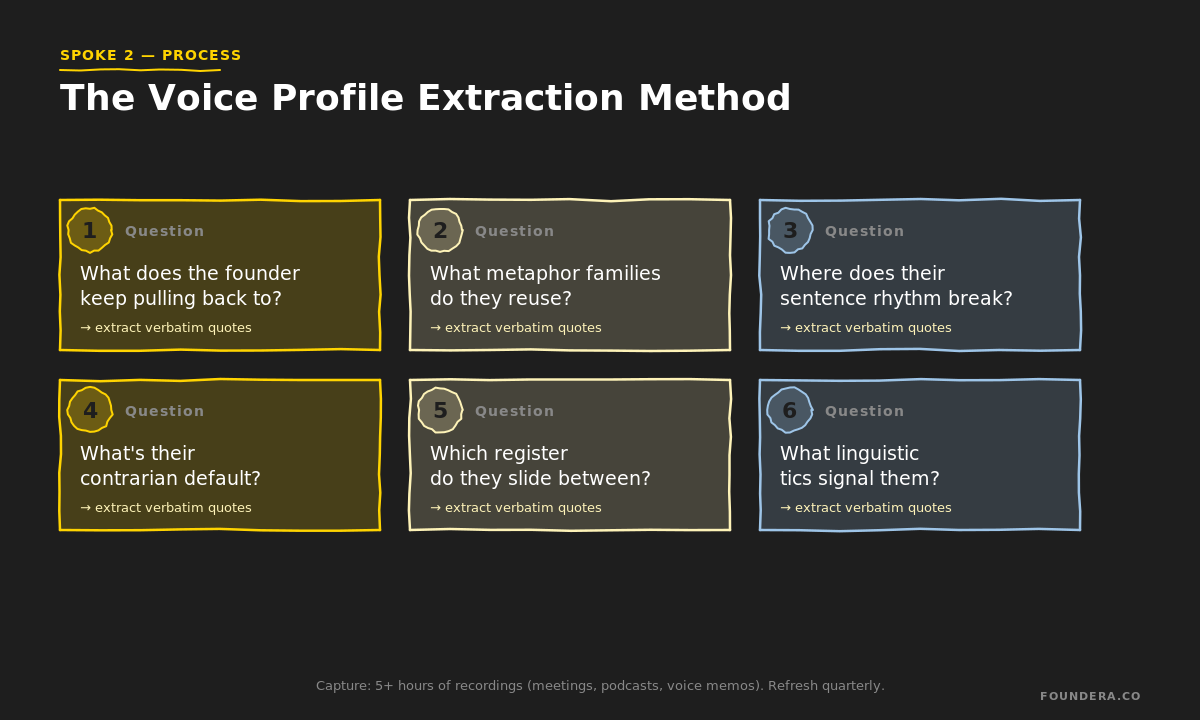
Step 1: Gather 5+ hours of your unscripted speech. This should be meetings, podcasts, recorded voice notes, or interviews—anything where you're speaking naturally, not reading from a script. Read.ai transcripts of your client meetings are ideal. Podcast appearances work. Long-form interviews work. Quick Slack voice notes don't (too short to show pattern).
Step 2: Identify your vocabulary signature. Read through 2-3 hours of transcript and highlight words you use repeatedly, terms you favor over synonyms, jargon you reach for naturally, and jargon you explicitly reject. In a meeting, do you say "early customers" or "initial customers" or "beta customers"? Are you consistently contrarian about a particular term? Create a 30-50 word list of your signature terms.
Step 3: Map your sentence rhythm. Copy 20-30 consecutive sentences from your transcript. Don't edit them. Look at the pattern: are sentences short or long? Do you use fragments? Do you vary rhythm or stay consistent? Do you use em-dashes or periods? Do you use commas or break thoughts into separate sentences? Write down the pattern in plain language: "Short, staccato. Fragments for emphasis. Usually two-three sentences, then a longer thought."
Step 4: Identify your register and code-switching. Do you use contractions? Profanity? Do you toggle between technical language and plain language? Do you explain technical concepts simply, or do you assume the audience knows? Do you use "we" or "I"? Note this in two sentences: "I use contractions constantly and code-switch between technical terms and simple explanations. I use 'we' for team work and 'I' for personal lessons learned."
Step 5: Identify topic gravity. What themes keep showing up in your speech? You mention go-to-market in 80% of conversations, or product architecture in every technical discussion, or founder mental health in every growth conversation. These aren't coincidences—they're your actual interests. Write down three themes you instinctively return to.
Step 6: Extract contrarian claims and linguistic ticks. What positions do you hold that differ from consensus? What phrases do you repeat? Do you say "here's the thing" a lot? Do you use sports metaphors? Do you favor certain adjectives ("obsessed," "deliberate," "specific")? Pull three contrarian positions and three linguistic ticks from your speech.
Now you have a voice profile. It's a one-page document describing how you actually speak, not how you think you should sound when writing.
The Five-Step Hybrid Edit Workflow
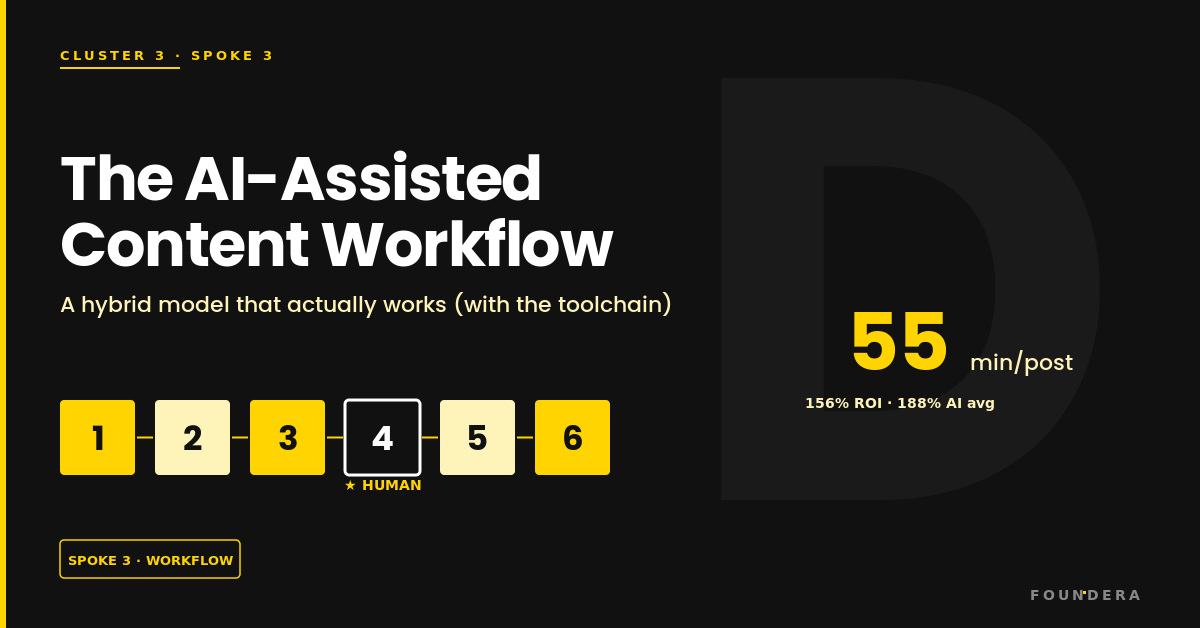
Once you have your voice profile, the AI-to-human workflow becomes mechanical:
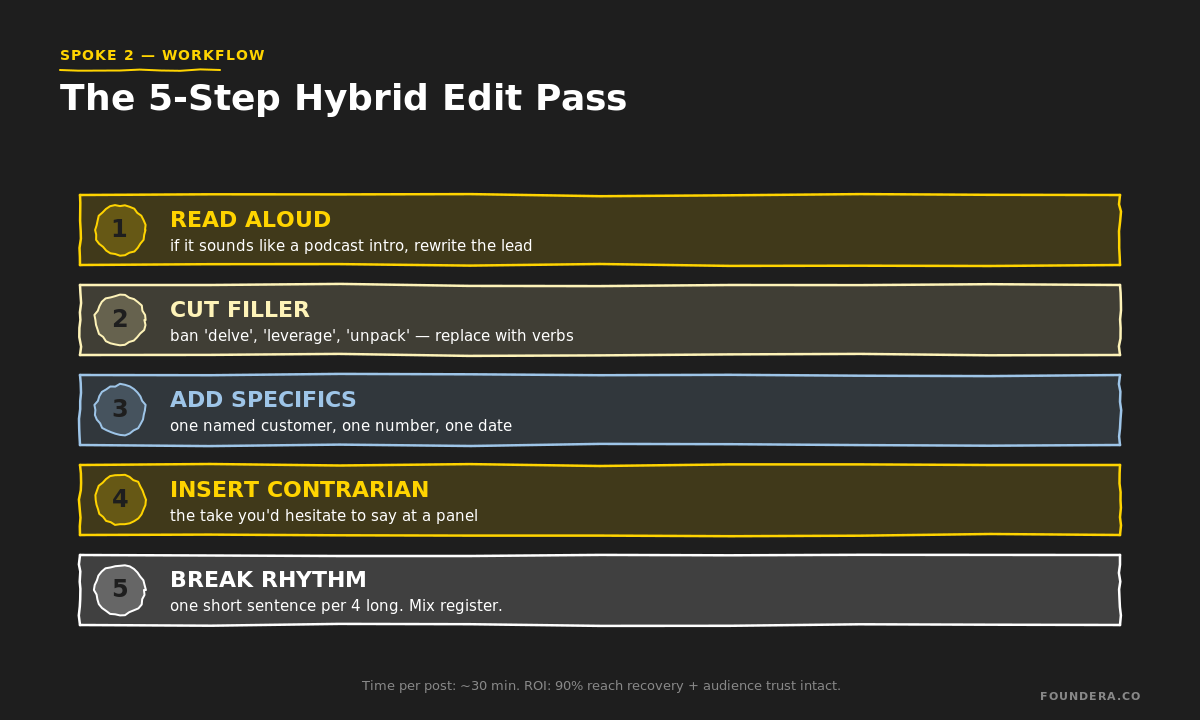
Step 1: Generate the first draft with AI using voice profile context. Paste your voice profile as a prompt prefix: "Write this post in my voice. Here are my vocabulary signatures, my sentence patterns, my topic pulls, and my contrarian moves. Here's the post I want to write: [topic]." Claude, ChatGPT, and Gemini all handle this instruction well. The first draft won't be perfect, but it's closer to your voice than a generic draft.
Step 2: Audit the draft against your voice profile. Read the AI-generated draft. Highlight every sentence that doesn't match your voice profile. Did the model use a word that's not in your vocabulary signature? Did it flatten your sentence rhythm into longer clauses when you favor short staccato? Did it miss your contrarian position? Mark every deviation.
Step 3: The manual voice pass. Go through the draft and rewrite every flagged sentence in your actual voice. Don't rewrite the whole thing—just the sentences that don't sound like you. This is usually 30-50% of the draft depending on how well the AI picked up your voice. This pass takes 15-20 minutes.
Step 4: Strengthen the contrarian edge. Look for places where the AI played it safe. Add your contrarian position more explicitly. Where the model says "some teams struggle with go-to-market," change it to your actual position: "Most go-to-market strategies fail because founders prioritize product over distribution." Where the model hedges ("consider," "might want to"), replace with your actual conviction language.
Step 5: Test for voice collapse. Read the final draft aloud. Does it sound like you? Does it have your rhythm? Do you recognize your contrarian positions, your vocabulary, your way of thinking? If 80%+ of sentences pass the "read aloud" test, you're good. If less than 70%, return to Step 3 and do another pass.
The entire workflow takes 30-45 minutes per 1,500-word post. This is faster than writing from scratch but slower than publishing an AI draft untouched. The time investment buys you authenticity—which, according to the Edelman report, drives 156% higher ROI on content.
Voice Red Flags to Scrub
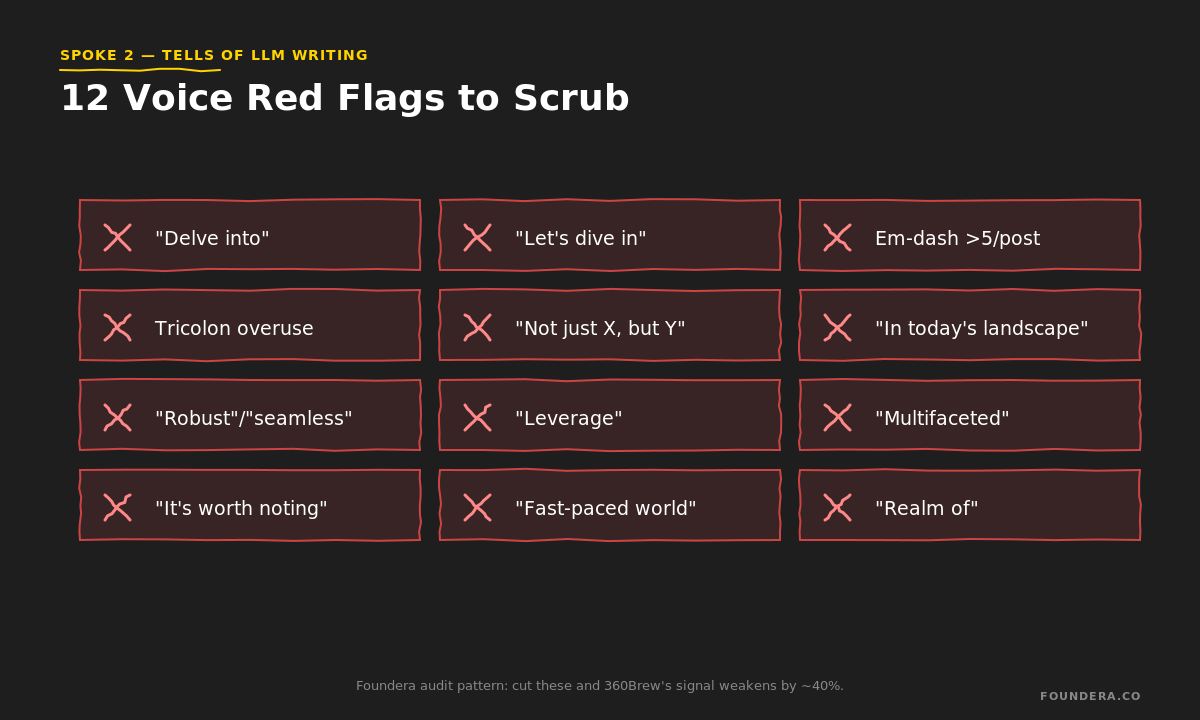
LLMs have tells. These phrases and structural patterns are so common in AI-generated text that they immediately signal to readers "this was written by a machine" or "this was AI-polished." When you see them, rewrite:
When auditing your draft, search for these phrases. Replace or delete them. Real voice has texture and imperfection. Perfect parallelism, consistent hedging, and synonym variation all signal "machine."
Tools That Preserve Voice (and Tools That Don't)
Not all AI tools handle voice preservation equally. Here's the practical breakdown:
Claude (Anthropic). Claude is the strongest at following voice profile instructions. When you paste your voice profile as context and ask it to write in your voice, it maintains vocabulary signatures and avoids most of the common AI tells better than competitors. It also tends toward shorter, punchier sentences—which helps avoid the "long formal sentences" trap. Trade-off: Claude's output sometimes needs more structural editing because it prioritizes voice over conventional article structure.
ChatGPT (OpenAI). ChatGPT is fast and good at structure, but it defaults to a more formal register than most founder voices. It uses more hedging language, more passive voice, and more corporate filler. It's usable if you do the full five-step workflow, but the voice pass takes longer because you're rewriting more. ChatGPT excels at brainstorming structure and generating options—use it for outline generation and Step 1 draft generation, then switch to manual editing.
Gemini (Google). Similar to ChatGPT in terms of formality and hedging. Slightly better at avoiding the most obvious tells, but not materially different. Good for comparison drafts if you want two versions to choose from.
Voice-cloning tools (Eleven Labs, Descript). These tools can clone your voice if you provide 10+ hours of audio training data. The result sounds like you speaking, which is powerful. But they should be used for audio content (podcasts, video narration), not written content. For writing, the five-step workflow is more practical because it's faster and doesn't require audio training.
Don't rely on: Jasper, Copy.ai, and other "voice-tuned" AI writing tools. These tools claim to learn your voice from your previous writing, but they learn the already-flattened version of your voice, not your authentic voice. Using them often makes flattening worse, not better.
The pattern: use Claude or ChatGPT with explicit voice profile context, then do the manual edit pass. Skip tools that claim to "learn" your voice from your writing—they're learning a flattened version.
Real Founder Patterns: Three Case Studies
Here's how this works in practice:
Founder A: Product-obsessed infrastructure founder. Her voice profile showed: vocabulary signature around "primitives," "invariants," and "layer below," sentence rhythm of short technical sentences followed by longer explanations, code-switching between deep technical language and "here's why normal people care," strong contrarian position ("Most infrastructure is built bottom-up when it should be built top-down, from the problem backward").
When AI drafted her post about database design, it wrote: "When building a database layer, it's important to understand the primitives that make querying performant." She rewrote it: "Most database design starts wrong. People choose a layer first, then optimize. Start with the invariant—the one thing that must never break—and build everything underneath that." Three words changed, but it went from AI-generic to founder-authentic.
Founder B: Go-to-market obsessed SaaS founder. Voice profile showed: vocabulary around "distribution," "motion," "lever," repeated phrases like "here's the thing" and "actually," topic gravity toward go-to-market (even when discussing product), sentence pattern of medium-length active voice with occasional fragments for emphasis, contrarian position ("Product quality matters, but distribution matters 10x more and everyone invests the wrong ratio").
AI draft: "To drive adoption, you need both a great product and strong go-to-market." His rewrite: "Here's the thing. Everyone says product and GTM are equally important. That's where they get it wrong. I've seen brilliant products fail because the distribution motion was lazy. I've seen mediocre products win because the founder obsessed over how the market finds them." Completely different voice—not because the facts changed, but because the voice is unmistakable now.
Founder C: Technical co-founder with non-technical cofounders. Voice profile showed: code-switches constantly between "let me explain this technically" and "here's why that matters in business terms," vocabulary signature of "system," "constraint," "actually" (used frequently), sentence rhythm of long technical clauses, then short business-implication fragments. Contrarian: "Technical decisions are business decisions and almost every company gets this wrong."
AI draft used consistent register throughout—either technical or business, but not both. The strength of this founder's voice is the switching. Manual pass restored the code-switching, which took that voice from generically technical to authentically her.
The pattern across all three: AI nails structure and gets 60-70% of the voice right. The remaining 30-40% requires a human who knows their own voice well enough to recognize what's missing, then rewrite it. The investment pays off: these founders' content now drives 2-3x higher engagement on LinkedIn than it did before voice profiling.
Frequently Asked Questions
Why does my AI-written content feel generic if I'm a distinctive person?
Because you've probably absorbed LinkedIn's median voice without realizing it. Most founders default to the "professional founder" register on social media—slightly formal, hedged, cautious. That's not your authentic voice. It's the voice you think a "founder" should use. AI amplifies that tendency by defaulting to the most common patterns in its training data. The solution is to extract your voice from unscripted speech, not from your existing writing.
Can I skip the voice profile and just tell AI to "sound like me"?
Not effectively. Telling an LLM "sound natural" or "sound like me" produces generic results because the model doesn't know what those instructions mean. It needs specific, measurable instructions: vocabulary list, sentence patterns, register notes, topic pulls, contrarian positions. Generic instructions produce generic output.
What if I don't have 5+ hours of recorded speech?
Use what you have: three hours of transcripts, five podcast episodes, or a combination. The extracted voice will be weaker, but it's better than nothing. Or record yourself: 30 minutes of voice notes talking through your perspective on your space is valuable source material.
Should I disclose AI use in my LinkedIn posts?
The Edelman report found that founder authenticity decreased 34 points when audiences knew AI was used, even when the content was AI-assisted but heavily human-edited. The disclosure question is separate from the authenticity question. If your content passes the "read aloud" test and sounds like you, audience members won't assume it's AI-generated. Proactively disclosing "written with AI" often creates skepticism unnecessarily. If asked, be honest. Don't volunteer.
How do I handle feedback that my post "sounds AI-generated" when it's not?
This usually means you skipped the manual voice pass. The content is still in the median register. Go back to Step 3, do a deeper rewrite, and make it more distinctively yours. The "sounds AI-generated" feedback is often accurate—you're detecting voice collapse, not necessarily AI origins.
Can I use this method for internal company writing or just LinkedIn?
Use it for anything where your voice should be recognizable: blog posts, podcasts, video scripts, keynotes. The five-step workflow works across formats. Avoid it for: sales emails (these should be short and personal anyway, not AI-drafted), customer support (should be human from the start), or internal Slack (voice preservation isn't the goal). Use it for: customer-facing content, founder-authored writing, anything where your personal brand matters.
What about longer formats like a book or sustained email series?
The voice profile method scales. Extract it once, then apply it across multiple pieces. The first piece takes the full five-step workflow. Pieces 2-5 take less time because you and the AI have both calibrated to your voice. After 5-10 pieces, you and the AI develop a shared understanding of your voice patterns.
Is this just for technical founders or does it work for all founders?
Works for all founders. The six dimensions of voice (vocabulary, rhythm, register, topic gravity, contrarian moves, linguistic ticks) apply across industries. A founder in healthcare has distinctive vocabulary signatures just like an infrastructure founder. A founder in sales has topic gravity just like a founder in product. The method is universal.
What if I'm trying to sound like something I'm not—more authority than I have, or more casual than I actually am?
Don't. Extract your actual voice and lean into it. Authenticity is the whole point. If you're trying to sound authoritative when you're actually curious and exploratory, readers detect that incongruence faster than they detect "this sounds like AI." Build your voice from how you actually think, not how you think you should sound.
Your Voice Is Your Moat
AI is a leverage tool. It can help you write faster and think through ideas more clearly. But it only preserves what you build into it.
Most founder content flattens because founders themselves have flattened into LinkedIn's median voice. AI doesn't cause that—founders do. AI just amplifies it. The solution is to preserve your voice intentionally: extract it from your real speech, profile it explicitly, and use AI as a structure and speed tool while you do the voice work manually.
That five-step workflow—generate, audit, manual pass, strengthen contrarian edge, read aloud—takes 30-45 minutes per post. It's faster than writing from scratch. It's noticeably slower than publishing an AI draft untouched. It's worth the time investment because distinctive voice drives 156% higher ROI on your content and 71% higher perceived effectiveness (Edelman-LinkedIn 2025).
Your voice is the only thing no AI can replicate. Preserve it deliberately.
For deeper context on how AI fits into your founder marketing strategy overall, see ai-era-founder-marketing-2026. For a sister piece on when to disclose AI use, check out should-founders-disclose-ai-content. And for how this feeds into your broader LinkedIn strategy, read linkedin-content-for-saas-founders-2026.
Build your voice first. Use AI as leverage. That's the formula.