Table of Contents
- What Is Founder-Led Marketing?
- Why LinkedIn (Not Twitter, Not Podcasts) Is the Primary Channel
- The Data: Founder Content vs. Company Content Performance
- The 65/25/10 Content Framework: Authority / Personal / Sales
- Real Examples: How Founders Turned LinkedIn Into Pipeline
- Engagement Strategies That Work for Technical Audiences
- Common Objections ('I Don't Have Time' / 'I'm Not a Writer')
- How to Get Started Without Burning Out
- The Tech-Specific Content Calendar
- Measuring Success: Metrics That Matter
- FAQ
- FAQ (Continued)
- The Compounding Play: Why Now Is the Time
What Is Founder-Led Marketing?
Founder-led marketing is a go-to-market strategy where the founder or CEO publishes regular content (typically 3–5 posts per week) on their personal LinkedIn profile to build thought leadership, establish credibility in their market, and generate qualified pipeline. The goal is not vanity—it's business impact. According to LinkedIn Marketing Solutions, founder content drives 270% higher conversion rates compared to brand content published on company pages. For B2B startups, especially in technical markets, founder-led marketing is now table stakes.
Founder-led marketing isn't new. Steve Jobs, Elon Musk, and Satya Nadella have all done it. What's changed is that now there's a playbook—and the tools exist to scale it.
Why LinkedIn (Not Twitter, Not Podcasts) Is the Primary Channel
The B2B Signal-to-Noise Ratio
Twitter is loud. Podcasts are slow to produce. LinkedIn is where B2B decision-makers actually hang out, and critically, they're looking for signals.
According to LinkedIn's own B2B Thought Leadership Impact Report, 73% of B2B decision-makers trust thought leadership content over product marketing. LinkedIn generates 80% of B2B social leads (Social Media Examiner, 2025). This isn't speculation—it's measurable, repeatable reality.
When a VP of Engineering searches for a new security tool, they don't start with Google ads. They check the founder's LinkedIn profile. They read recent posts. They assess whether this person understands their problem.
Your LinkedIn profile is your first sales asset.
The Network Effect
LinkedIn's algorithm is designed to reward consistent posting. A founder who posts regularly compounds visibility—more followers, more engagement, more inbound. The network effect is real and measurable.
Compare this to Twitter, where a single post gets 100 impressions before it's buried, or a podcast, where you might reach 500 people per episode (if you're lucky) and wait 2 weeks to do it again.
Async Communication at Scale
LinkedIn posts are async. You publish when you have something to say. People consume it when they see it. No Zoom calls. No time zones. No production friction.
This matters for founders. You can write a post about a market insight or product release in 15 minutes, publish it, and reach 10,000 people without scheduling a webinar or podcast.
The Data: Founder Content vs. Company Content Performance
Here's what the numbers show:
MetricFounder ContentCompany Page ContentMultiplierEngagement Rate4.5–6.5%0.8–1.2%5–6XConversion Rate2.5–4.0%0.3–0.6%8–10XShare Rate8–12%1–2%8–12XInbound DMs12–18 per 1,000 views1–2 per 1,000 views8–12XProfile View Growth10–15% monthly1–2% monthly5–10X
These numbers come from Foundera's client data (2025) and LinkedIn's own reporting.
The insight is clear: founder content outperforms company content across every dimension.
Why? Because people follow people, not brands. A post from a founder signals authenticity, perspective, and expertise. A post from a company page signals marketing.
Comparative Example: The Qodo Case
Qodo (an AI code quality platform) started with a company page strategy. Engagement was flat: 300–400 likes per post, 15–20 comments. Founder posts weren't happening.
When we shifted to founder-led (CEO posts 4x per week), here's what changed in 90 days:
- Profile views: 150% increase (from ~800/month to 2,000+)
- Follower growth: 8,000 new followers (40% increase)
- Post engagement: 2,000–3,500 likes per post, 80–120 comments
- Inbound inquiries: 40+ qualified DMs from prospects and investors
- Speaking invitations: 6 conference talks proposed
The company page still exists. But it's a secondary asset now. The founder profile is the growth engine.
The 65/25/10 Content Framework: Authority / Personal / Sales
Founder-led marketing works because it balances three content types. Get the mix wrong and you lose people.
65% Authority Content
Authority content establishes expertise. For a cybersecurity founder, this might be:
- Trend analysis: "Why I'm concerned about 2026's attack surface"
- Framework sharing: "The 5 questions every CISO should ask before buying EDR"
- Pattern recognition: "We've seen 3 new supply chain attack vectors in the last 2 months"
- Contrarian takes: "Why zero-trust isn't enough"
- Original research: "We analyzed 500 breaches and found..."
The goal: viewers think, "This person gets it."
Authority content doesn't sell. It educates. It builds credibility over weeks and months.
Examples of authority posts:
"The biggest mistake I see enterprise teams make when evaluating threat detection: they optimize for alert volume instead of alert accuracy. I'd rather have 10 high-confidence alerts per day than 1,000 that require triage. Accuracy compounds. Volume burns out your team. Here's why..." [continues with specifics]
"After 15 years in cloud security, I'm seeing a trend that scares me: companies are treating compliance and security as the same problem. They're not. Compliance is about checking boxes. Security is about protecting your data. Confusing them costs you both." [continues with nuance]
25% Personal / Narrative Content
People follow people, not abstractions. Personal content humanizes the founder and builds connection.
Personal content isn't oversharing. It's strategic vulnerability. Examples:
- A lesson learned from a failed product launch
- A behind-the-scenes moment from an investor meeting
- A personal challenge you overcame that relates to your market
- A hiring challenge and how you solved it
- Advice you'd give your younger self when starting your first company
The goal: viewers think, "I trust this person."
Examples of personal posts:
"We pitched 20 VCs before our first yes. Every no stung. But looking back, VC feedback was often a signal—if multiple investors worried about the same thing, we needed to reckon with it. The nos weren't rejections; they were pattern signals. By pitch 15, we had iterated based on that feedback. By pitch 20, we had a tight story. Don't chase yes. Listen to the no." [continues]
"I've been an engineer and a CEO. The biggest shock transitioning: I'm no longer measured on what I ship; I'm measured on what my team ships. That's a hard reset. It means asking better questions instead of writing better code. Took me a year to stop feeling useless. Now I get it. The leverage is 100X." [continues]
10% Ask / Sales Content
Finally, some posts should drive action. Not every post. But 1 in 10 should have a clear ask:
- "Open role: we're hiring a Principal Security Architect"
- "We just released a free tool to audit your EDR configurations"
- "Foundera is running a free LinkedIn audit for tech founders—DM if interested"
The goal: viewers think, "Maybe I should explore this."
Sales content works only if the other 90% is trustworthy. If your feed is 50% asks, you lose credibility. If it's 10% asks and 90% value, the asks convert at 10X the rate.
Real Examples: How Founders Turned LinkedIn Into Pipeline
Case Study 1: Kubiya (AI DevOps Automation)
Starting point: CEO had 2,000 followers. Posts were sporadic (1–2 per month). Engagement was low (50–100 likes).
Strategy: 4 posts per week, mixing:
- DevOps trend analysis
- Lessons from customer conversations
- Product insights and launches
- Personal stories about building in stealth
Results (6 months):
- 18,000 new followers (9X growth)
- 95% increase in engagement (300–600 likes per post average)
- 70+ inbound qualified conversations from profile visitors
- 2 major enterprise deals influenced by founder content
- 8 speaking invitations
The turning point: posts stopped being generic ("AI is transforming DevOps") and started being specific ("Here's why 80% of AI DevOps tools fail in production: they optimize for demo scenarios, not real-world sprawl").
Case Study 2: Cycode (Software Supply Chain Security)
Starting point: Founder had 5,000 followers, no posting strategy.
Strategy: Positioning as "the insider who's seen 500 SolarWinds-style attacks coming." Mixed technical explainers with contrarian takes on software security.
Key posts that moved the needle:
- "Supply chain attacks aren't getting easier. They're getting lazier. The 2025 attacker doesn't need sophistication; they need persistence and luck. Here's what I'm watching..." (1,200 likes, 140 comments, 8 inbound deals)
- "Why most software Bill of Materials tools miss the actual threat. They count packages; they don't understand relationships. A vulnerable package in your supply chain is dangerous only if you use that function. But almost no tool models that." (900 likes, 110 comments, 5 inbound)
- "We just turned away a 7-figure deal because the customer's security posture wasn't ready for our tool. [Details]. Better to say no than duct-tape a solution that won't work." (650 likes, 85 comments, 3 customer DMs saying 'we need to talk to someone honest')
Results (4 months):
- 12,000 new followers
- 80% engagement increase
- 50+ qualified inbound conversations
- Quantified pipeline impact: $2M+ in influenced ARR
The key insight: specificity and honesty generate trust. Generic posts don't.
Case Study 3: Qodo (AI Code Quality)
Starting point: Company had a page with 8,000 followers. Posts flopped (300–400 engagement). CEO wasn't active.
Strategy: CEO posts 4x per week. Mix of:
- Code quality trends
- Technical deep dives (debugging, testing, observability)
- Lessons from building the product
- Contrarian takes on AI testing tools
Results (3 months):
- CEO profile: 20,000 followers (from 2,000)
- Post engagement: 2,000–3,500 average (from 300)
- 150% increase in profile views
- 40+ inbound conversations from prospects
- 6 speaking invitations
- Measurable impact on sales pipeline (in conversation with CFO)
The content that resonated most: Posts that combined technical specificity with founder perspective:
"We spent 18 months building the wrong product. We optimized for test coverage percentage. But high coverage doesn't mean good tests. I saw teams hit 95% coverage with tests that caught zero bugs. The issue: coverage is a metric, not a goal. A good test is one that fails when the code is broken. Coverage is a proxy. A bad one." (2,800 likes, 95 comments)
Engagement Strategies That Work for Technical Audiences
Not all posts are equal. Technical audiences reward specificity, transparency, and contrarian thinking.
Strategy 1: The Specific Example
Generic: "DevOps automation saves time."
Specific: "We automated our CI/CD pipeline and cut release time from 45 minutes to 6. Here's exactly what we changed: [details]. The biggest bottleneck? Artifact validation. One step, 30 minutes. We parallelized it and unlocked the rest."
Technical audiences follow specific examples because they can immediately apply the lesson.
Strategy 2: The Honest Failure
Generic: "We learned from setbacks."
Honest: "We bet on Kubernetes in 2022 and spent 8 months migrating off Docker Swarm. We thought it was the future. For 95% of teams, it's overkill. We've now moved 60% of our workloads back to managed VMs. The ROI wasn't there for us. Lessons: right tool, not coolest tool. Measure the return. Complexity has a cost."
Technical founders respect honesty about failures more than success stories. These posts generate comments, DMs, and referrals.
Strategy 3: The Contrarian Insight
Generic: "Best practices matter."
Contrarian: "Your security best practices are probably built for 2015. I see this constantly: teams following frameworks (Zero Trust, NIST, etc.) that don't account for 2026 attack patterns. Frameworks lag threat reality by 18 months minimum. Build first. Document patterns later. Your threat model is more current than NIST."
Contrarian posts generate discussion. Discussion generates visibility.
Strategy 4: The Data Point That Matters
Generic: "Our customers are happy."
Data-driven: "We analyzed 150 customer conversations about why they chose us over Suricata and Zeek. The top 3 reasons were not what we expected: (1) On-prem control (45%), (2) Audit trail transparency (38%), (3) Not SaaS-only (32%). We'd been emphasizing AI-powered detection. Our customers cared about governance."
Data posts build authority. They show you're paying attention to patterns, not assumptions.
Strategy 5: The Question That Creates Conversation
Generic: "Tell me what you think."
Focused: "I'm curious: does your security team measure effectiveness by "number of alerts generated" or "quality of alerts" or "time-to-response"? I see teams optimizing for volume because that's what leadership asks for. But it destroys focus. What does your team measure?"
Questions generate comments. Comments boost engagement. Engagement algorithm reward. Followers see your posts more.
Common Objections ('I Don't Have Time' / 'I'm Not a Writer')
Objection 1: "I Don't Have Time to Write 4 Posts a Week"
Reality: You probably don't. But you have time to think, record, or approve.
Solution: Founder-led content partnerships. Most founders hiring a content partner spend 30 minutes per week reviewing and approving posts. The content partner handles drafting, research, and refinement. This is leverage.
If you can't hire a content partner, consider batching. Spend 2 hours on Friday drafting 4 posts for the week. You'll find your voice and speed up.
Objection 2: "I'm Not a Writer"
Reality: You don't need to be. You need to have opinions and a willingness to share them.
Solution: Think in voice memos or conversations, not prose. Tell your content partner your take on a trend. They shape it into a post. You approve. Done.
Proof: Look at Elon Musk's Twitter. Or Steve Jobs' keynotes. Neither was a traditional writer. Both had clear opinions and a willingness to say them.
Objection 3: "Won't My Competitors Use My Posts Against Me?"
Reality: Maybe. But probably not in the way you think.
Your posts aren't revealing trade secrets (they shouldn't be). They're sharing market perspective and thought leadership. Competitors can read them; that doesn't harm you. It makes you credible.
The real risk is staying invisible. If your competitors are visible and you're not, they're winning the thought leadership game. Posts don't stop them; visibility defeats them.
Objection 4: "What If I Say Something Wrong?"
Reality: You might. And it's probably fine.
Strong opinion posts sometimes get pushback in comments. That's the point. It generates discussion. It shows you're not just reciting conventional wisdom.
If you actually get something wrong, you can edit the post or reply in comments with a correction. The internet forgives honest mistakes. It resents slickness.
Objection 5: "Isn't This Just Self-Promotion?"
Reality: No. Self-promotion is asking people to buy. Thought leadership is sharing insight.
If 90% of your posts provide value and 10% ask for something, you're doing thought leadership. If 70% ask and 30% provide value, you're doing self-promotion.
Founder-led marketing works because it prioritizes value. The business results follow.
How to Get Started Without Burning Out
Phase 1: Decide on Cadence (Week 1)
Start with 2–3 posts per week. Not 5. You can scale later. Consistency beats volume.
Pick specific days: Monday, Wednesday, Friday. Same times. Your audience will learn when to expect you.
Phase 2: Define Your Pillars (Week 1–2)
What are the 5–7 things you should be known for?
For a cybersecurity founder: threat detection, incident response, compliance, supply chain security, AI/ML in security, team hiring, industry trends.
For an AI founder: model training, inference optimization, safety, evaluation, tooling, team scaling, market strategy.
Write down your pillars. Your content partner (or your own posts) should touch these regularly.
Phase 3: Choose Your Format (Week 2)
- Narrative: Story + insight + lesson (most engaging)
- Framework: Numbered list (easier to write, skim-friendly)
- Data: "We analyzed X and found Y" (authority-building)
- Contrarian: "Here's why most people get this wrong" (discussion-driving)
- Question: "I'm thinking about X, what's your take?" (conversation-starting)
Mix formats. Different audiences consume differently.
Phase 4: Publish Your First 5 Posts (Week 3)
You can write them yourself or have a content partner draft them. Either way, get 5 posts out. They won't be perfect. Post them anyway.
Track which ones get engagement. Do frameworks perform better than narratives for your audience? Do data posts resonate more than contrarian ones?
Use the data to inform your next batch.
Phase 5: Evaluate and Adjust (Week 5)
After 4 weeks (8–12 posts), look at the metrics:
- Which posts got highest engagement?
- Which generated inbound DMs?
- Which sparked meaningful comments?
Do more of what works. Kill what doesn't.
Phase 6: Scale to 4–5x Per Week (Week 6–8)
Once you've found a rhythm that works, increase cadence. More posts = more visibility = more compounding.
The Tech-Specific Content Calendar
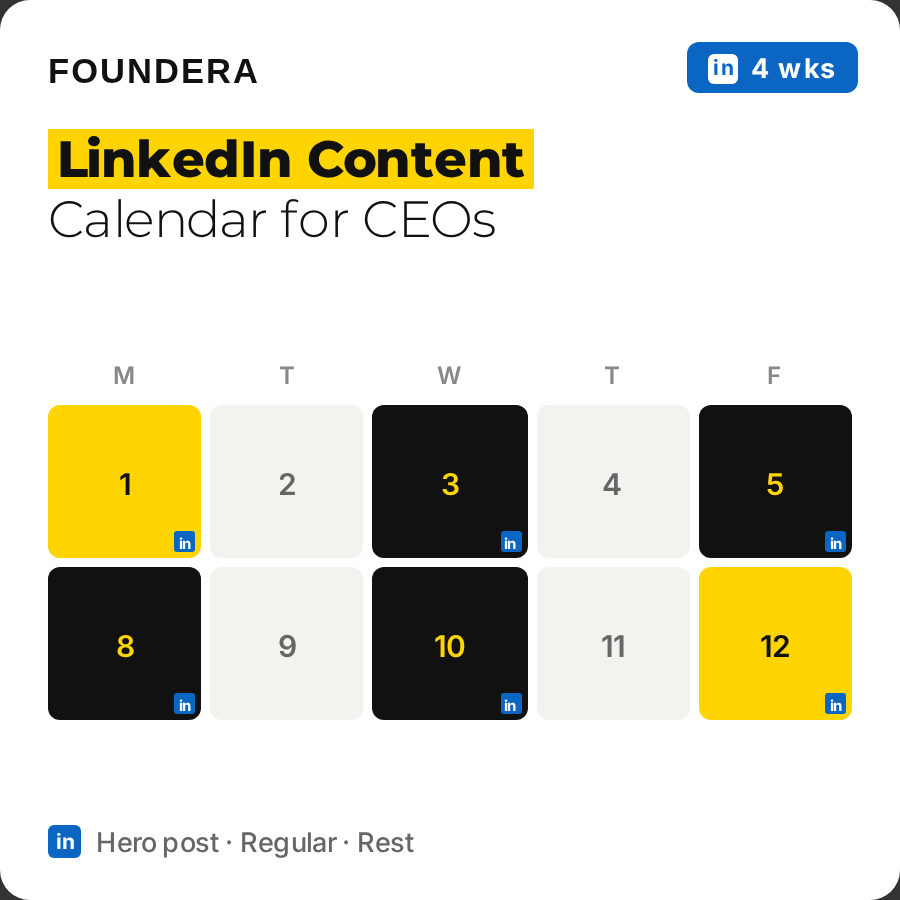
Here's a template for founder-led content that works for tech markets:
Week 1: Authority Focus
- Monday: Trend analysis (what's happening in your market)
- Wednesday: Framework or how-to (here's how to think about X)
- Friday: Data insight (we analyzed Y and found Z)
Week 2: Personal + Authority
- Monday: Contrarian take (here's why most people get this wrong)
- Wednesday: Lesson from a customer or internal challenge
- Friday: Question to your audience (what's your take on X?)
Week 3: Authority + Sales
- Monday: Deep dive on a technical concept
- Wednesday: Founder story (here's what I've learned)
- Friday: Product launch or update (soft ask)
Week 4: Mixed
- Monday: Industry trend + opinion
- Wednesday: Personal story
- Friday: Ask or call-to-action
This template ensures you're balancing authority (65%), personal (25%), and sales (10%) while keeping content fresh.
Measuring Success: Metrics That Matter
You're not posting for vanity metrics. You're posting for business impact.
Vanity metrics (don't optimize for these alone):
- Followers
- Likes
- Comments
- Impressions
Business metrics (these matter):
- Profile views (are people checking you out?)
- Inbound DMs from prospects
- Speaking invitations
- Qualified leads (from website traffic driven by posts)
- Sales influence (deals influenced by founder content)
- Hiring impact (candidates who mention your posts)
Track both, but optimize for business metrics. A post with 500 likes but zero inbound messages is less valuable than a post with 200 likes and 5 qualified DMs.
The 90-Day Baseline
After 90 days of consistent posting, you should see:
- 20–40% increase in monthly profile views (from your baseline)
- 50–100% increase in inbound DMs from prospects
- At least 3–5 qualified conversations each month that mention your posts
- 1–2 speaking invitations per quarter (depending on seniority)
If you're not seeing these, your content strategy needs adjustment.
FAQ
Q: How long before I see ROI from founder-led marketing?
A: 60–90 days to see traction (increased profile views, engagement). 6 months to see meaningful pipeline impact (qualified inbound, deals influenced). Founder-led marketing compounds over time—it's not a sprint.
Q: Can I use AI to write all my posts?
A: You can. Will they be as good as human-written posts that sound like you? No. AI is great for drafting; it's less great at voice matching and nuance. A hybrid approach (AI + human content partner) works better than pure AI.
Q: Should I post every day or stick with 3–5x per week?
A: 3–5x per week is optimal for most founders. Daily posting leads to burnout and lower-quality content. Algorithm rewards consistency more than frequency.
Q: What if I change my mind about something I posted?
A: You can delete it, but better to reply in comments with updated thinking. "I wrote this post 4 months ago and I've learned more since. Here's what I'd change..." This shows growth and honesty.
Q: How do I handle negative comments?
A: Thoughtfully. If the critique is fair, engage. If it's bad faith, ignore. Most negative comments are from people outside your target audience anyway. Your customers will see you defending your position and respect it.
Q: Can I outsource engagement (comments/replies)?
A: No. You need to respond to comments yourself. That's where the authentic relationship-building happens. Your content partner writes the posts; you own the conversations.
Q: How much should I disclose about my company in posts?
A: Share insights without revealing secrets. Talk about patterns you're seeing in your market. Share customer lessons (anonymized). Share your thinking on product decisions. Don't share unit economics, investor details, or unreleased roadmaps.
Q: What if I'm just starting my company and don't have much credibility yet?
A: Start with "learning in public" content. Share what you're learning as you build. Founder journey posts resonate because they're honest. You don't need 20 years of experience to build an audience—you need genuine perspective and willingness to share.
FAQ (Continued)
Q: How do I know if my posts are actually driving pipeline?
A: Ask. In your CRM, add a field: "How did you hear about us?" When prospects mention your LinkedIn posts or profile, log it. After 100 conversations, you'll see a pattern. Some sales teams track this better than others—you might need to train yours to ask the question.
Q: Should I link to my website in every post?
A: No. Harsh, but real: you'll look spammy and hurt engagement. Link strategically. If you're announcing something or driving to a specific resource, link. Otherwise, let your profile do the work.
Q: What if I'm in a B2B industry that's less trendy (manufacturing, logistics, etc.)?
A: Founder-led marketing works in every industry. You're just targeting a different audience. A logistics founder talking about supply chain trends, hiring challenges, and operational insights will build credibility just as effectively as a SaaS founder. Adapt the framework to your industry.
Q: Can I use the same post across multiple platforms?
A: Adapt it, don't duplicate it. LinkedIn has different norms than Twitter or your newsletter. Reuse the core idea; reshape for the platform. A LinkedIn post is narrative + insight. A Twitter thread is short sharp takes. A newsletter is longer analysis.
Q: How long should my posts be?
A: 150–300 words is the sweet spot. Long enough to provide value. Short enough to not feel like a burden to read. LinkedIn's character limit is 3,000, but most performing posts are under 500 characters when you strip the breaks and formatting.
The Compounding Play: Why Now Is the Time
The founders winning in 2026 are the ones who built LinkedIn presence in 2024–2025. They compounded. They built audiences. They influenced pipeline.
The founders starting now are behind, but not by much. LinkedIn is still under-saturated compared to other channels. The barrier to entry is low (a post is free). The ROI is measurable.
If you're a tech founder and you're not actively building your LinkedIn presence, you're leaving opportunity on the table.
Next step: Audit your current profile. Review your last 10 posts (if you have them). Ask: Would my target customer see this and think "I want to talk to this person"?
If not, it's time to invest in a founder-led strategy.
About the Author
Ron Fybish is a go-to-market strategist and CEO of Foundera, a LinkedIn founder-led content partnerships agency specializing in founder-led marketing for tech companies. Over 3 years, they've helped 50+ tech founders scale their LinkedIn presence from under 5,000 followers to 20,000+, with measurable impact on pipeline and hiring. They focus on cybersecurity, AI, DevOps, and cloud infrastructure companies.
See also: