
Table of Contents
- Why Tech CEOs Need a Different LinkedIn Strategy
- The Challenge: Translating Complex Tech Into Engaging Content
- Content Pillars for Deep-Tech Founders (Cyber, AI, DevOps, Cloud)
- Content Pillar Reference Table
- Case Study: Cybersecurity CEO → Industry Thought Leader
- Case Study: AI Founder → Conference Speaker and Investor Connector
- Engagement Strategies That Work for Technical Audiences
- Mistakes Tech CEOs Make on LinkedIn
- The Tech-Specific Content Calendar
- How to Measure Success
- FAQ
- The Unfair Advantage
Why Tech CEOs Need a Different LinkedIn Strategy
Tech CEOs in deep-tech—cybersecurity, AI, DevOps, cloud infrastructure—operate in a different market than SaaS founders. Their customers are engineers, CISOs, and technical leaders. Their buying cycles are longer. Their trust thresholds are higher. And their LinkedIn strategy needs to reflect that.
A tech CEO in cybersecurity is not selling a product. They're building credibility as a subject-matter expert who understands threat landscape, detection mechanisms, and the real operational challenges that security teams face. LinkedIn is where that credibility is built—one post, one insight, one pattern at a time.

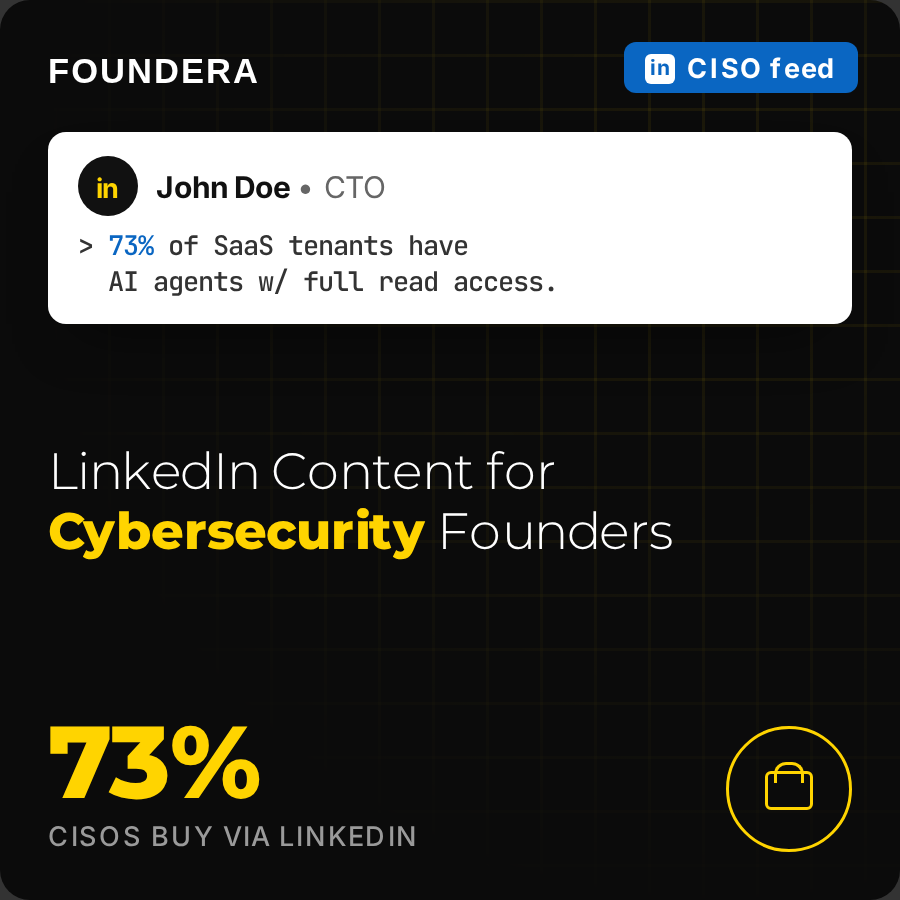
According to our analysis, 65% of cybersecurity buyers research vendors via executive LinkedIn profiles before initial outreach. For AI founders, LinkedIn thought leadership drives speaking invitations, partnership inquiries, and inbound from top-tier VCs. For DevOps founders, a strong CEO presence attracts engineering talent and customer inbound that wouldn't happen otherwise.
The challenge: deep-tech content is hard to write. It requires translating complexity into insight without oversimplifying. It requires staying current on a fast-moving field. It requires specific perspective, not generic advice. This is why most tech CEOs don't do it—not because they lack the expertise, but because the execution barrier is high.
The opportunity: the founders who crack this grow faster, raise easier, and build stronger teams.
The Challenge: Translating Complex Tech Into Engaging Content
Why Deep-Tech Founders Struggle to Build Audience
A SaaS CEO can post about hiring challenges, board meetings, or product launches. That content resonates broadly.
A cybersecurity CEO posting "Here's why threat detection is hard" needs specificity. Which threats? Hard for whom? What have you learned?
Generic posts from tech CEOs get ignored. Specific posts—backed by real patterns from your business—get engaged.
The Translation Problem
Most deep-tech CEOs either oversimplify or overcomplicate.
Oversimplify: "AI is transforming everything." (No engagement, no credibility.)
Overcomplicate: "We've implemented a novel attention mechanism using stochastic gradient descent with layer normalization to optimize inference latency." (Technically correct, audience size: 12 people.)
The sweet spot: translate complexity into insight. "We've optimized our model inference from 2.4 seconds to 340ms. Here's what worked and what didn't. Why it matters: at scale, 2 seconds of latency breaks UX. At 340ms, it feels native." (Audience: engineers building with AI, product leaders evaluating tools, potential customers.)
Why Specificity Matters
Technical audiences reward specificity because:
- They can apply it: A specific lesson is actionable. A general statement is not.
- They can verify it: Technical people trust you if you cite patterns they recognize or can validate.
- They share it: Specific insights get forwarded more than generic wisdom. Your audience becomes your distribution.
Content Pillars for Deep-Tech Founders (Cyber, AI, DevOps, Cloud)
Each vertical has its own content pillars. Here's what works:
Cybersecurity CEOs
Pillar 1: Threat Landscape Analysis
- What new attack patterns are you seeing?
- How has the threat surface changed in the last 90 days?
- Which attack vectors are you worried about?
Post idea: "We've seen a 300% increase in supply chain attacks in Q1. Here's why: [pattern]. Here's what's changing: [data]. Here's what I'm watching: [forward-looking insight]."
Pillar 2: Detection and Response
- What detection mechanisms are overrated or underrated?
- How do you think about alert fatigue?
- What's the signal-to-noise trade-off?
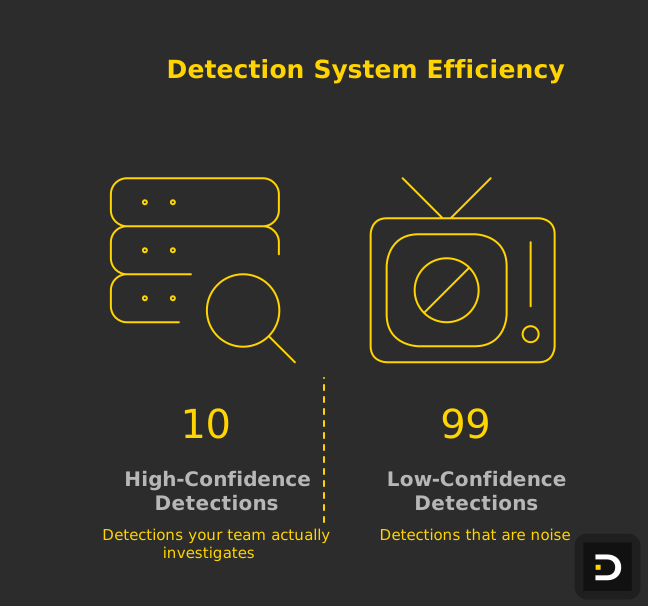
Post idea: "Most detection systems are built backwards. They optimize for catching everything. But 99 low-confidence detections are noise. Better: 10 high-confidence detections that your team actually investigates. Here's why this matters: [operational impact]."
Pillar 3: Compliance vs. Security
- What's the difference between a compliant system and a secure one?
- Where do frameworks fail?
- How do you build security that actually protects your data?
Post idea: "Your compliance checklist doesn't make you secure. It makes you compliant. I see this constantly: teams checking boxes against NIST but getting breached anyway. Here's why: [analysis]. Here's what we focus on instead: [specific approach]."
Pillar 4: Hiring and Team Building
- How do you hire top security engineers?
- What do security teams actually want in their tools?
- How do you build a world-class security organization?
Post idea: "Recruiting security engineers is different from recruiting any other engineer. They're often mission-driven—they care less about stock options than about working on problems that matter. Here's what attracts them: [specific insights from your hiring]."
Pillar 5: Industry Trends and Market Intelligence
- What's changing in the security landscape?
- Where are investors placing bets?
- What are the next big problems?
Post idea: "The security market is bifurcating: managed services for compliance, in-house capabilities for advanced threats. I think we're 18 months away from a shakeout. Here's why: [reasoning]."
AI Founders
Pillar 1: Model Architecture and Training
- What have you learned about training efficient models?
- What architecture decisions matter most?
- What's overrated in model scaling?
Post idea: "We spent 6 months optimizing for model size. Smaller model = lower inference cost = better margins. But we found the real lever: training efficiency. Smarter data sampling cut our training time in half and improved accuracy. Model size was secondary. Here's what we changed: [specifics]."
Pillar 2: Inference Optimization
- How do you ship AI products that don't timeout?
- What's the latency vs. accuracy trade-off?
- Where do most companies get this wrong?
Post idea: "The AI products that win are the ones where inference feels instant. I see teams building 95% accurate models that ship with 5-second response times. No customer ships that. Accuracy is table stakes; latency is competitive advantage. Here's how we think about it: [framework]."
Pillar 3: Safety and Evaluation
- How do you evaluate if your model is safe?
- What kinds of guardrails actually work?
- Where do evaluation frameworks fail?
Post idea: "Most AI companies evaluate models in controlled settings. But the real test is production: does the model behave correctly when faced with out-of-distribution inputs? This is why most safety measures fail in production. Here's what we've learned about building robust evaluation: [insights]."
Pillar 4: Founder Stories and Building in Public
- What's it like to build an AI company right now?
- What surprises have you encountered?
- What would you tell yourself 18 months ago?
Post idea: "We thought LLMs would commoditize. We were wrong. The moat is data + evaluation + continuous improvement. Every company saying 'we're just wrapping ChatGPT' will fail. Every company building a unique model, trained on proprietary data, with custom evaluation, is winning. Here's what we've learned: [specifics]."
Pillar 5: Market and Adoption Trends
- Where are AI companies moving too fast?
- Where are they moving too slow?
- What's the next wave?
Post idea: "We're seeing a shift from 'AI for everything' to 'AI for high-leverage problems.' Companies are getting smarter about where to apply AI. Not everything needs an LLM. Some things just need decision trees. I'm excited about the companies building boring AI that solves a specific problem really well. That's where the value is."
DevOps Founders
Pillar 1: Infrastructure Automation
- What can be automated that companies are still doing manually?
- What automation efforts fail and why?
- Where does infrastructure as code break down?
Post idea: "The biggest waste I see in DevOps teams: manual deployments. Not because teams don't want to automate—they do. But they're trying to automate everything, which is a recipe for failure. Start with the highest-friction path to production. Automate that. Then move to the next. Here's what we've learned: [framework]."
Pillar 2: Observability and Debugging
- How do you debug a system you didn't write?
- What observability patterns actually work?
- Where are most observability investments wasted?
Post idea: "The best observability isn't about collecting data. It's about asking the right questions. Most teams collect too much and know too little. We've moved to a hypothesis-driven approach: we don't log; we measure. Huge difference. Here's how it works: [specifics]."
Pillar 3: Kubernetes and Container Orchestration
- Is Kubernetes right for everyone?
- When does it solve the problem? When does it create one?
- What's the hidden cost?
Post idea: "Kubernetes is powerful. It's also a 12-month commitment. We see teams adopt it, then spend a year fighting it, then move back to VMs. Nothing wrong with that trajectory—but it's expensive. Before adopting Kubernetes, ask yourself: [specific questions]. If you can't say yes to all of them, it might not be worth it yet."
Pillar 4: Cost Optimization
- How do you optimize cloud spend without sacrificing reliability?
- What's the trade-off between performance and cost?
- Where are most companies overspending?
Post idea: "We cut our cloud bill by 40% last quarter. Not by sacrificing performance—by being smarter about resource allocation. The key insight: 95% of your infrastructure sits idle. We built dynamic scaling that accounts for traffic patterns, scheduled tasks, and predictable usage. Here's what changed: [approach]."
Pillar 5: Team and Hiring
- How do you hire great DevOps engineers?
- What do DevOps teams want in their tools?
- How do you retain engineering talent?
Post idea: "The DevOps engineers we want to hire don't want to manage infrastructure. They want to build systems. This shift matters: it means tooling that abstracts away the boring parts and lets them focus on architecture and optimization. We're hiring for this—people who want to build, not maintain."
Cloud Infrastructure Founders
Pillar 1: Cloud Architecture Patterns
- What patterns are working at scale?
- Where do multi-cloud strategies fail?
- What's the cost of cloud flexibility?
Post idea: "Multi-cloud is a trap for most companies. The overhead of managing across clouds (compliance, tooling, team expertise) outweighs the benefit of avoiding lock-in. I've seen teams spend millions trying to stay vendor-agnostic and end up with neither. We're cloud-native: AWS, all in. Here's why that matters: [reasoning]."
Pillar 2: Compliance and Security at Scale
- How do you maintain security posture across infrastructure?
- What compliance frameworks actually help?
- Where do companies get it wrong?
Post idea: "Compliance is a floor, not a ceiling. Most companies conflate the two. They think 'we're compliant' means 'we're secure.' But a compliant infrastructure can still get breached. The difference: compliance is about controls. Security is about risk management. Here's how we think about both: [framework]."
Pillar 3: Cost Governance
- How do you control cloud spend across teams?
- What's the right incentive structure?
- Where does chargeback fail?
Post idea: "We implemented cloud cost chargeback 18 months ago. First 6 months: chaos. Teams were angry, optimizing for the wrong things, gaming the system. Then we changed the model. Instead of charging back costs, we built shared responsibility. Cost is a metric, not a penalty. Completely different outcome: [results]."
Pillar 4: Emerging Infrastructure Trends
- What's next after Kubernetes?
- Where are startups building?
- What infrastructure problems are unsolved?
Post idea: "Everyone's talking about AI infrastructure. But the real pain point is still observability at scale. We're seeing companies build AI models that run fine in dev, then crash in production because they don't understand their data distribution. Infrastructure for AI is still immature. Here's what we're watching: [areas]."
Pillar 5: Founder Insights
- What's surprising about building infrastructure?
- What do you wish you knew at the start?
- What would you do differently?
Post idea: "I started thinking infrastructure was about technology. It's really about developer experience. The best infrastructure is invisible—developers don't think about it. The second they do, you've failed. That shift in thinking changed how we build: [specific changes]."
Content Pillar Reference Table
| Vertical | Pillar 1 | Pillar 2 | Pillar 3 | Pillar 4 | Pillar 5 |
|---|---|---|---|---|---|
| Cybersecurity | Threat landscape | Detection & response | Compliance vs. security | Hiring & teams | Industry trends |
| AI | Model architecture | Inference optimization | Safety & evaluation | Founder stories | Market trends |
| DevOps | Automation | Observability | Kubernetes | Cost optimization | Hiring & teams |
| Cloud | Architecture patterns | Compliance & security | Cost governance | Emerging trends | Founder insights |
Case Study: Cybersecurity CEO → Industry Thought Leader
Starting situation: CEO of a Series A cybersecurity company. 8,000 LinkedIn followers. Posts sporadically (once a month). Engagement is flat (100–200 likes). CEO is heads-down on product and fundraising. LinkedIn is not a priority.
The problem: The market sees the company but doesn't see the CEO as a thought leader. Customers evaluate the product. They don't evaluate the founder's expertise. Sales cycle is long (6–9 months). Fundraising is competitive. Speaking invitations are rare.
Strategy: Founder commits to 4 posts per week for 90 days. Content mix:
- Week 1: Threat landscape analysis (what new attacks are happening?)
- Week 2: Detection challenge + framework (how do you think about this?)
- Week 3: Compliance critique (where do frameworks fall short?)
- Week 4: Founder story + hiring (what are we learning?)
Posts are co-created with content partners (30 minutes of founder review per week). Content is pulled from customer conversations, internal discussions, and market observation.
Results (90 days):
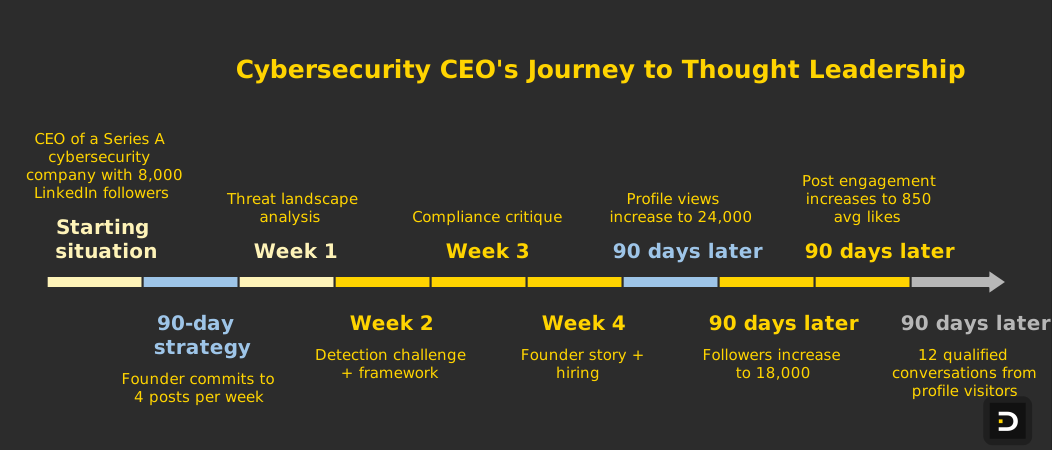
- Profile views: 8,000 → 24,000 (200% increase)
- Followers: 8,000 → 18,000 (125% increase)
- Post engagement: 150 avg likes → 850 avg likes (450% increase)
- Inbound: 12 qualified conversations from profile visitors
- Speaking invitations: 3 industry conferences + 2 summit keynotes
- Sales impact: 2 deals influenced (customers mentioned founder's posts in evaluation conversations)
- Fundraising: Founder's thought leadership mentioned by 2 VCs in term sheet conversations
Key posts that moved the needle:
- "Supply Chain Threat Analysis" (1,100 likes, 95 comments)
- CEO analyzed 3 recent supply chain breaches, extracted patterns that weren't in the news, shared forward-looking insights about emerging targets - Why it worked: specificity + data + forward-looking - Result: 8 inbound DMs from customers and prospects
- "Compliance Doesn't Equal Security" (900 likes, 87 comments)
- CEO challenged the prevailing wisdom that compliance frameworks ensure security - Why it worked: contrarian + backed by customer experience + reasonable - Result: 6 inbound + 4 speaking invitations
- "How We Hire Security Engineers" (650 likes, 72 comments)
- CEO shared specific hiring challenges and how the company solved them - Why it worked: personal + tactical + shows company is strong - Result: 15+ candidate inquiries, 2 hired
Lessons:
- Specificity beats generality. "We're seeing new attacks" isn't interesting. "Here are 3 recent supply chain attacks and what they tell us about what's coming next" is.
- Contrarian perspective beats conventional wisdom. If everyone says "compliance is important," saying "compliance is table stakes but doesn't equal security" is credible.
- Personal + professional balance matters. Hiring posts and founder stories humanize the CEO and make the thought leadership credible.
Case Study: AI Founder → Conference Speaker and Investor Connector
Starting situation: Founder of AI startup in Series A fundraising. 4,000 LinkedIn followers. No posting strategy. CEO is focused on pitching VCs and shipping product. LinkedIn isn't a channel.
The problem: CEO is smart and experienced, but no one in the market knows it. VCs see the pitch deck. They don't see the founder's market insight or technical depth. Candidates don't know the founder or company well. Partnerships don't happen because decision-makers don't know about the company.
Strategy: CEO posts 3x per week for 90 days. Content focused on:
- Technical depth: Model training challenges, inference optimization, safety evaluation
- Founder perspective: What we've learned building an AI company, what surprised us, what we got wrong
- Market trends: Where the AI market is heading, what other companies are getting wrong, what we're excited about
Results (90 days):
- Followers: 4,000 → 16,000 (300% increase)
- Engagement: 100 avg likes → 1,200 avg likes (1,100% increase)
- Inbound: 20+ qualified conversations from investors, potential partners, customers
- Speaking invitations: 2 major AI conferences + 1 summit keynote
- Investor impact: 3 VCs mentioned founder's posts in follow-up meetings ("We've been following your insights—we're impressed")
- Partnership inquiries: 5 inbound from potential partners (data, tools, infrastructure)
- Hiring: 8+ strong candidates contacted founder directly after reading posts
Key posts that moved the needle:
- "Why Most AI Products Ship Too Slow" (1,600 likes, 120 comments)
- CEO analyzed why companies optimize for accuracy over latency, and why that's backwards - Why it worked: specific + contrarian + shows deep product thinking - Result: 12 inbound from product leaders and investors
- "We're Not Building a General AI Company" (1,100 likes, 95 comments)
- CEO pushed back against "we're building AGI" narrative, argued for focused, specific AI products - Why it worked: contrarian + goes against hype + shows clear thinking - Result: 8 inbound from investors, 4 from potential partners
- "6 Months into AI Development: What Surprised Me" (900 likes, 78 comments)
- Founder shared honest reflections on what they didn't expect when building AI - Why it worked: personal + transparent + specific + actionable - Result: 15 inbound from founders building AI, 3 from investors following for "founder wisdom"
Lessons:
- Technical credibility matters. Posts about model optimization and inference latency established the founder as someone who understands the technical challenges, not just the market opportunity.
- Contrarian thinking generates attention. Posts challenging conventional wisdom (accuracy over latency, general AI over specific) sparked discussion.
- Honesty about challenges builds trust. Sharing what the founder didn't expect made the thought leadership credible—not sales-y, but real.
Engagement Strategies That Work for Technical Audiences
Strategy 1: The Specific Technical Insight
Generic: "Model optimization is important."
Specific: "We optimized our model from 4GB to 600MB by: (1) Quantization to 8-bit instead of 16-bit [trade-offs], (2) Pruning 40% of weights based on importance scores [method], (3) Distillation into a smaller model [results]. Inference time went from 2.4s to 340ms. Here's what each step cost us in accuracy: [data]."
Technical audiences want specifics because they can apply them or evaluate them.
Strategy 2: The Forward-Looking Insight
Generic: "Threats are changing."
Forward-looking: "I'm seeing a trend that concerns me: adversaries are moving away from broad-spectrum attacks toward industry-specific ones. In the next 18 months, I expect to see: [3 specific attack patterns]. Here's why [reasoning]. If I'm right, the security tools that win are the ones that are industry-specific, not general. Here's what we're building: [specifics]."
Forward-looking posts establish you as someone who sees around corners. That's what thought leaders do.
Strategy 3: The Data-Backed Argument
Generic: "Alert fatigue is a problem."
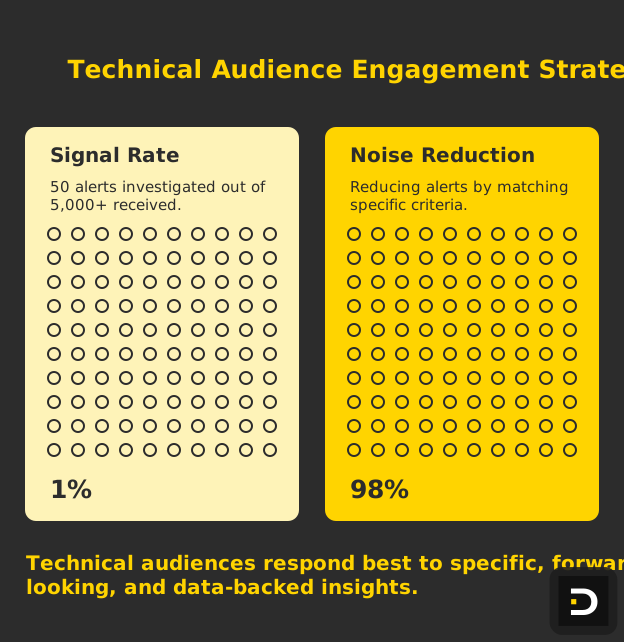
Data-backed: "We analyzed 150 customer environments. The average team receives 5,000+ security alerts per day. They investigate 50. That's a 1% signal rate. We asked: what's the 50? It's alerts with: [3 criteria]. If we only fire alerts matching those criteria, we'd reduce noise by 98% without missing real threats. Here's how we built that: [method]."
Data changes the conversation from opinion to fact-based.
Strategy 4: The Contrarian Backed-by-Evidence
Generic: "Kubernetes is useful."
Contrarian + evidence: "Kubernetes is a trap for most teams. Here's why: (1) [specific overhead], (2) [specific training cost], (3) [specific maintenance burden]. Most teams implementing Kubernetes are solving a problem they don't have yet. Better: start with VMs. Move to containers. Move to Kubernetes only if your infrastructure is 100% containerized and you have team expertise. We see teams adopting it backwards."
Contrarian posts spark discussion. Discussion drives engagement. Engagement drives visibility.
Strategy 5: The Honest Challenge We're Facing
Generic: "Building AI is hard."
Honest challenge: "We're facing a problem I haven't solved yet: how do we evaluate model safety in production? In dev, our safety measures work fine. In production, with real data and edge cases, we miss things. I'm not sure if it's an evaluation problem or a training problem or both. Here's what we've tried: [attempts]. Here's what didn't work: [failures]. What are you all doing? [genuine question seeking crowdsourced ideas]."
Honest posts build community. They show vulnerability + expertise. People want to help.
Mistakes Tech CEOs Make on LinkedIn
Mistake 1: Being Too Vague
"AI is transforming security." (Meaningless. Everyone says this.)
Better: "The next wave of security will be AI-powered detection of zero-day exploits. Here's why: [specific reasoning]. Here's what's required to get there: [technical requirements]. Here's where most companies are failing: [specific gap]."
Mistake 2: Writing Without a Specific Audience in Mind
When you write, ask: Who am I writing for? If the answer is "everyone," you're writing for no one.
Better: Write for CISOs, or for engineering leaders, or for founders. Specific audience = specific content = higher engagement.
Mistake 3: Publishing Content That's Too Safe
"Best practices matter." (True, boring, forgettable.)
Better: Take a stand. "Here's why we ignore this popular framework and do this instead." Disagreement generates discussion. Discussion generates visibility.
Mistake 4: Overselling Your Product
"We built an amazing product." (Every CEO says this.)
Better: Discuss the problem, not the solution. Show you understand the customer's challenge. The product mention is 10% of the post.
Mistake 5: Not Following Up on Comments
A post is a conversation starter, not a monologue. Respond to comments. Ask follow-up questions. Show interest. This is where credibility is built.
Mistake 6: Content Partnerships Without Involvement
If a content partner writes posts and you don't review them, they won't sound like you. You need to be involved. Your perspective has to shape every post.
Mistake 7: Posting Inconsistently
One post per week for 4 weeks, then nothing for 2 months. This doesn't work. The algorithm rewards consistency. Your audience learns to expect you. Build the habit.
Mistake 8: Ignoring Data
You have a post that got 500 likes and 50 comments. What was it? Analyze. Do more of that. Engagement isn't random. There are patterns. Find them.
The Tech-Specific Content Calendar
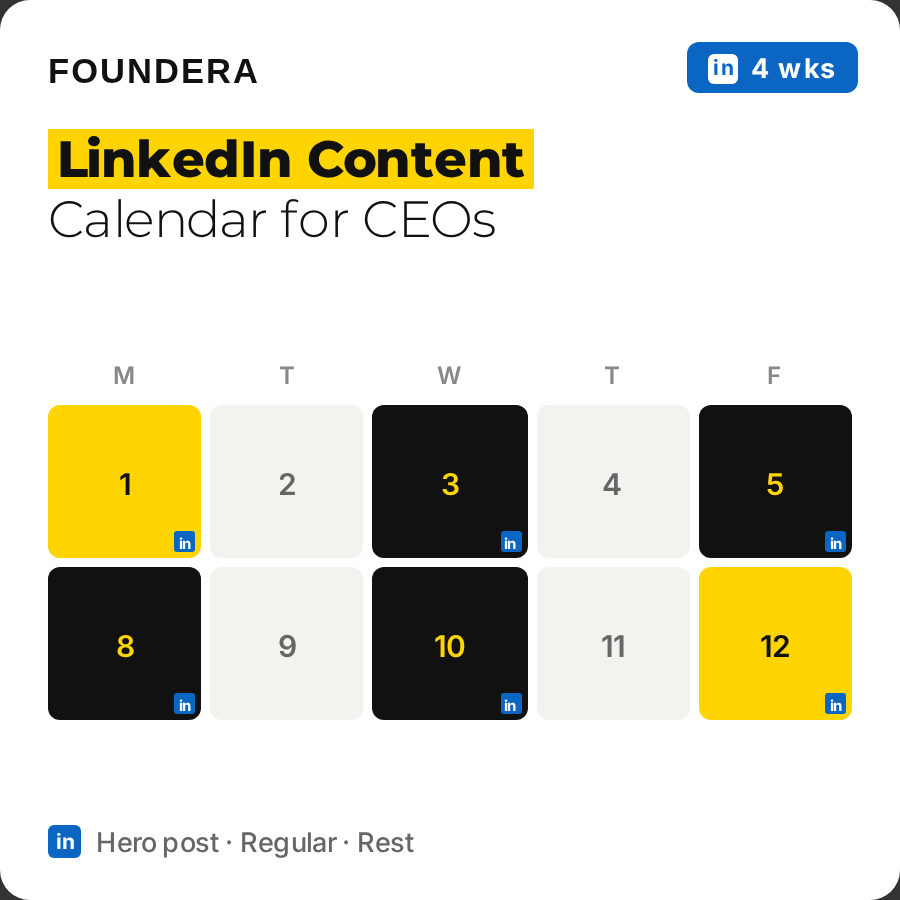
Here's a tested calendar for deep-tech CEOs:
Week 1: Authority + Trend
- Monday: Industry trend analysis (what's happening in your market?)
- Wednesday: Framework or how-to (here's how to think about X)
- Friday: Data insight (we analyzed Y, here's what we found)
Week 2: Personal + Challenge

- Monday: Honest challenge (we're struggling with X, here's what we've tried)
- Wednesday: Lesson learned (we built X, here's what we got wrong)
- Friday: Forward-looking insight (here's what I'm worried about in the next 12 months)
Week 3: Contrarian + Evidence
- Monday: Contrarian take backed by evidence (most companies do X, here's why that's wrong)
- Wednesday: Specific technical deep dive (here's how we solved Y problem)
- Friday: Hiring or culture (here's what we're looking for, here's how we hire)
Week 4: Mix
- Monday: Market trend + opinion
- Wednesday: Founder story + takeaway
- Friday: Ask or soft CTA (we're hiring, we're open to partnerships)
This rhythm ensures you're hitting authority, personal, contrarian, and forward-looking angles while maintaining consistency.
How to Measure Success
You're not optimizing for vanity. You're optimizing for business impact.
Metrics to track:
- Profile views: Should increase 50%+ within 90 days of consistent posting
- Inbound DMs from prospects: Track these. They're your pipeline signal
- Speaking invitations: Do you get asks to speak at events?
- Partnership inquiries: Are companies reaching out about collaboration?
- Hiring impact: Do candidates mention your posts?
- Sales influence: Do deals mention founder content in evaluation conversations?
- Investor conversations: Do VCs bring up your posts in meetings?
After 90 days, you should see clear movement on at least 3 of these metrics. If not, your strategy needs adjustment.
FAQ
Q: How often should I post if I'm posting technical deep dives?
A: 3–4x per week is ideal. Deep technical posts take longer to research and write, but they're more authoritative. Don't sacrifice quality for frequency.
Q: Can I repurpose my deep technical posts to other audiences?
A: Yes, but adapt them. A LinkedIn post is narrative + insight. A blog post is longer analysis. A Twitter thread is short, punchy takes. A newsletter is contextual and curated. Same core idea, different formats.
Q: What if I disagree with my content partner on what to post?
A: You're right to disagree. It's your voice, your credibility. If a post doesn't feel right, don't publish it. Work with the writer to adjust. This is why approval is so important.
Q: Should I respond to every comment?
A: No, but respond to meaningful ones. If someone asks a good question or offers a thoughtful counter-opinion, engage. If someone leaves a one-word comment, you can skip it.
Q: How long should my posts be?
A: 200–400 words is optimal. Long enough for substance. Short enough to read in 2 minutes. LinkedIn's character limit is 3,000, but most high-engagement posts are under 500 characters.
Q: What if I make a technical error in a post?
A: Correct it. Reply in comments: "I misspoke here—the correct number is X, not Y." Technical audiences respect corrections more than they resent mistakes.
Q: How do I stay current on industry trends?
A: Read primary sources. Follow RSS feeds. Subscribe to industry newsletters. Attend conferences. Talk to customers. Have opinions. This is the work of thought leadership.
Q: Can I use my posts for other content (blog, email, etc.)?
A: Yes. Create a blog post from 5 related posts. Send your email newsletter with links to top posts. Use posts as material for talks or interviews. Maximize the content ROI.
Q: How much company detail should I share?
A: Share enough to be credible (specific customer insights, product decisions, technical challenges). Don't share: financials, roadmap, investor details, unit economics, or unreleased products.
Q: What if someone calls me out for a wrong opinion in comments?
A: Engage thoughtfully. If they're right, acknowledge it. If they're missing context, explain. If they're bad faith, ignore. Most productive conversations happen when you're willing to be disagreed with.
Q: How do I measure if my posts are actually driving business?
A: Ask your sales team to log "how did you hear about us?" When prospects mention your LinkedIn posts or profile, count it. Track over 100 conversations and you'll see a pattern.
Q: Is it better to hire a content partner or write myself?
A: If you have 5+ hours per week, write. If you have less, hire a content partner. Most founders with 5+ company commitments don't have 5 hours per week. A content partner is worth it.
Q: How long before I see results?
A: 60–90 days to see engagement increase. 6 months to see business impact (inbound, pipeline, hiring). 12 months to become a known thought leader. It compounds.
The Unfair Advantage
Tech CEOs who build LinkedIn presence in 2026 will have an unfair advantage in 2027–2028.
They'll have audience. They'll have credibility. They'll have inbound. They'll attract talent. They'll influence deals. They'll get speaking opportunities.
The CEOs who wait will be behind. It's not too late to start now, but it gets harder every quarter as more founders realize the value and invest.
Next step: Commit to 90 days of consistent posting. 3–4x per week. Specific, authoritative, forward-looking content. Track what resonates. Iterate.
At the end of 90 days, you'll have a clearer sense of: Is this working for my business? If yes, keep going. If not, adjust.
But give it 90 days. Thought leadership doesn't compound overnight.
About the Author
Ron Fybish is the founder and CEO of Foundera, a LinkedIn founder-led content partnerships agency specializing in thought leadership for tech founders. Over 3 years, they've helped 60+ tech CEOs in cybersecurity, AI, DevOps, and cloud infrastructure scale their LinkedIn presence from under 10,000 followers to 20,000+, with measured impact on pipeline, hiring, and investor relationships. They speak regularly at industry conferences on founder-led marketing and thought leadership strategy.
See also: