Your personal leadership brand statement is the one sentence a stranger should be able to repeat after reading your LinkedIn for thirty seconds. Not your bio. Not your tagline. The thing they tell their cofounder when they say "you should follow this person."
Most founders don't have one. Most who do have one have something generic - "helping founders build great companies" - that says nothing specific enough to remember. This guide fixes that.
What a personal leadership brand statement is
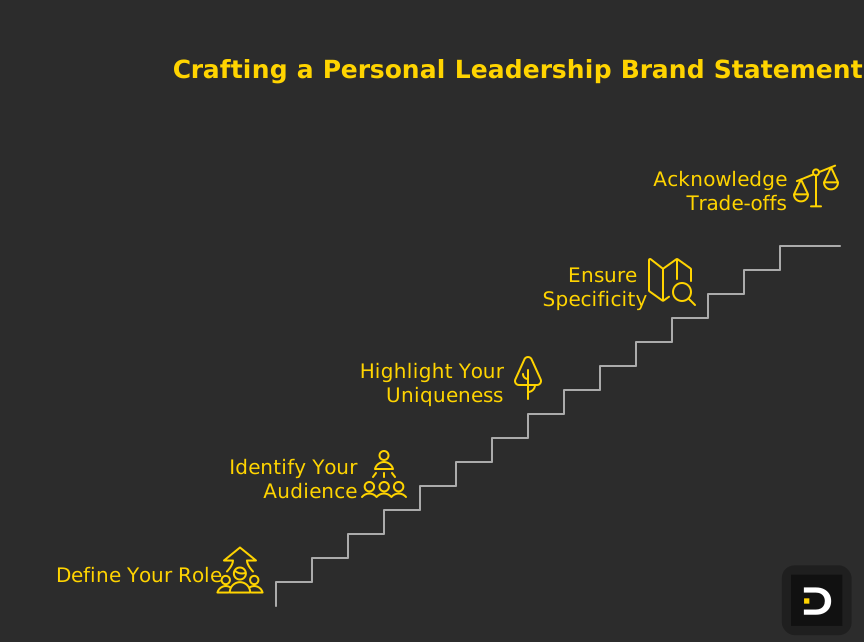
A personal leadership brand statement is a single sentence that captures three things: what you do, who you serve, and the specific way you do it that nobody else does. It is not a job title. It is not a value proposition for your company. It is a statement of your professional identity as the operator behind the work.
Three things have to be true for a brand statement to work:
- It's specific enough to disagree with. Generic statements ("I help leaders grow") describe everyone in your space. Real brand statements stake a position.
- It implies trade-offs. If your statement could apply to your three closest competitors, it's not yours yet.
- It survives a year. Brand statements that hinge on a passing trend ("I help leaders navigate AI transformation") age out fast. Brand statements anchored to a durable POV last.
Why most founder statements fail
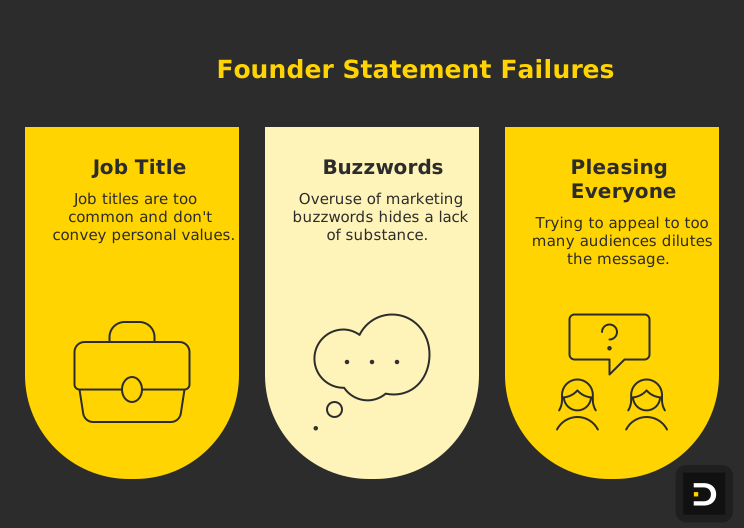
Three common failure modes:
Failure 1: Job-title disguised as identity. "CEO and co-founder of [Company]" tells me your role. It doesn't tell me what you stand for. Strangers can read your job title from the LinkedIn header.
Failure 2: Marketing buzzwords stacked. "Passionate about democratizing AI for the next generation of builders" is four buzzwords disguised as a sentence. Strip them out and there's nothing underneath.
Failure 3: Trying to please everyone. Brand statements that mention 4 audiences ("founders, investors, operators, and customers") please nobody. Pick one audience.
The 4-step framework to write yours
Step 1: The specific person you serve. Not "founders." Not "B2B SaaS founders." Try "cybersecurity founders raising their Series A." The more specific, the sharper.
Step 2: The specific outcome you deliver. Not "growth" or "success." Try "go from $1M ARR to $10M ARR without hiring more than five reps." Outcomes are concrete, not aspirational.
Step 3: The specific method that's yours. What do you do that nobody else in your space does? "I build security-first founder-led growth engines without paid ads." If you can't name the method, find it.
Step 4: One sentence stitching all three. "I help cybersecurity founders raising their Series A go from $1M to $10M ARR through security-first founder-led growth engines."
If your draft is over 25 words, cut. If a peer reads it and can guess any of the three elements wrong, sharpen.
15 real founder examples (with breakdowns)
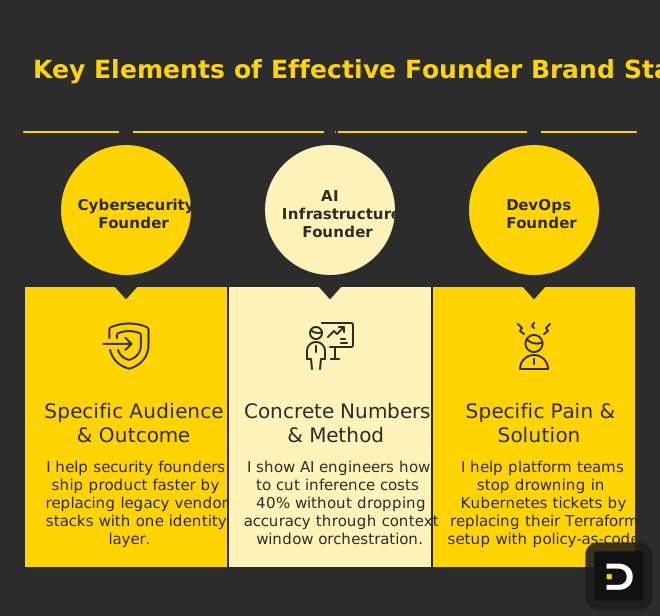
Real brand statements we've seen work. Names anonymized.
Cybersecurity founder (early-stage): "I help security founders ship product faster by replacing legacy vendor stacks with one identity layer." Specific audience, specific outcome, specific method.
AI infrastructure founder: "I show AI engineers how to cut inference costs 40% without dropping accuracy through context window orchestration." Concrete numbers signal credibility.
DevOps founder: "I help platform teams stop drowning in Kubernetes tickets by replacing their Terraform setup with policy-as-code." Specific pain, specific fix.
Fintech founder: "I build the infrastructure that lets banks ship a new product in 30 days instead of 18 months." Time compression is the value prop.
B2B SaaS founder: "I help vertical SaaS founders survive horizontal AI by doubling down on what AI can't copy: deep workflow integration." Defensible position.
Healthtech founder: "I help clinical workflow founders sell into hospital procurement without burning out their sales team." Specific friction point.
Climate tech founder: "I help climate hardware founders close enterprise contracts five times faster by reframing the buyer conversation around energy resilience." Reframing as method.
Data infrastructure founder: "I help data teams cut their ELT bill 60% by moving from row-store to columnar pipelines." Specific savings.
Cybersecurity scale-up CEO: "I help post-Series-B cybersecurity CEOs avoid the 'second product trap' that kills companies between $20M and $100M ARR." Stage-specific pattern.
AI agents founder: "I help operations teams ship their first AI agent in 90 days by treating it as a hiring problem, not a software problem." Counterintuitive framing.
Vertical SaaS founder: "I help dental practice owners replace seven legacy tools with one platform that pays back in 90 days." Concrete consolidation play.
Developer tools founder: "I help engineering leads ship code 4x faster by replacing their 12-step PR review process with a 3-step async flow." Process-replacement frame.
Founder-coach hybrid: "I help technical co-founders become CEOs without losing the engineering edge that made them founders in the first place." Identity preservation as value.
Marketing tech founder: "I help B2B marketers prove pipeline impact in 30 days by replacing dashboards with a single conversion signal." Anti-dashboard positioning.
Sales tech founder: "I help SDR teams hit quota without burning out by replacing 60 calls a day with 6 warm conversations." Volume-replacement frame.
The pattern across all 15: a specific person, a specific outcome, a specific method. None could apply to two different companies.
How to test your statement on LinkedIn
Three tests before you commit:
Test 1: The peer recognition test. Send the draft to five people in your category who know your work. Ask: "Does this sound like you specifically, or could it be anyone in our space?" If three or more say "could be anyone," sharpen.
Test 2: The buyer recognition test. Send to three buyers who have bought from you. Ask: "If you were re-introducing me, would you use this language?" If they say no, the statement is for you, not for them.
Test 3: The hire recognition test. Send to two senior people who could one day work for you. Ask: "After reading this, would you take a first call?" If no, the statement isn't generating recruiting energy.
If all three tests pass, ship it. Use it in your LinkedIn header, your bio summary, your podcast intros, your email signature. Repetition is what makes it stick in the market.
Editing checklist

Five passes to run on your statement:
- Strip every buzzword. "Passionate," "democratizing," "transformative," "innovative." Out.
- Cut every word that's true of two competitors. Be brutal.
- Test for verb specificity. "Help" is weak. "Cut," "compress," "replace," "ship" are concrete.
- Test for noun specificity. "Companies" is weak. Name the industry, the stage, or the role.
- Read it aloud. If it doesn't sound like something you'd say in conversation, rewrite.
A brand statement that survives all five passes is one you can use for two years before it needs a refresh.
Frequently asked questions
Do I really need a personal leadership brand statement? If you want recognition outside your immediate network, yes. If you're content with being known only by people who already know you, you don't.
How long should it be? One sentence. Under 25 words. If you need two sentences, you don't have a statement yet - you have a paragraph.
Can I have more than one? No. Multiple statements dilute. One sharp statement compounds.
Should I include my company name? Not in the statement itself. The statement is about you as an operator. Your company name belongs in your bio one line below.
How often should I refresh it? Annually, or when your strategic focus genuinely shifts. Refreshing more often signals strategic uncertainty.
What if my role changes? Your role changes. Your brand statement evolves with it. The framework stays the same; the specifics update.
Should I write it myself or hire a brand strategist? Write it yourself first. A strategist can help refine, but only you know which version captures the texture of how you actually think.
Your next move
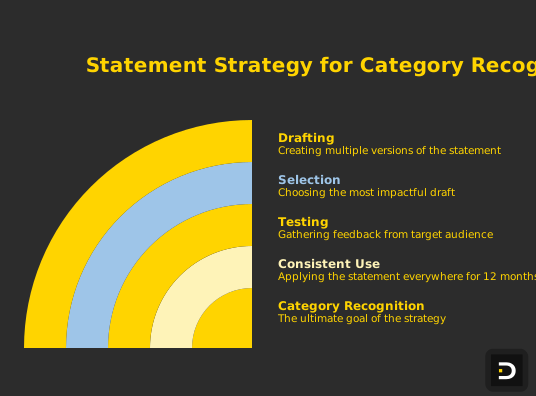
Open a doc. Write five drafts of your statement in 15 minutes. Pick the one that scares you slightly. Test it with five people in your category. Commit to using it everywhere for 12 months. Re-evaluate in year two.
The founders who have a statement and use it consistently end up category-known. The ones who don't end up known only by people who already know them. The compound math favors the first group.
One sentence to take away
Your personal leadership brand statement is the sentence strangers repeat about you after thirty seconds - write it deliberately or someone else will write a vague version for you.
Why brand statements are different from positioning statements
A common confusion: founders write a company positioning statement and call it their personal brand statement. They're related but different.
Company positioning statement describes what your product does, who it's for, and why it's better than alternatives. It's about the business.
Personal leadership brand statement describes who you are as an operator, the specific lens you bring, and the unique value of your judgment. It's about you.
A founder needs both. They should be consistent (your personal POV should match the company you built), but they're not interchangeable. Investors, hires, and partners often connect with the personal statement before they engage with the company positioning.
How brand statements evolve across funding stages

What works as a personal brand statement at seed often doesn't fit at Series B. Three evolution patterns:
Seed stage: The statement leans into the founder's specific operational hypothesis. "I help cybersecurity founders ship product faster than the funding cycle expects." The hypothesis is the bet.
Series A: The statement adds proof points. "I help cybersecurity founders ship product 60% faster than industry average, validated across 8 design partners." The bet is now backed by data.
Series B and beyond: The statement shifts toward category leadership. "I'm building the operating system for cybersecurity founders to ship product without the legacy vendor stack." Now you're claiming a category, not just a method.
The mistake is using a Series-B-style statement at seed. It reads inflated. The reverse mistake is staying with a seed-stage statement at Series B. It reads under-confident.
What to do when your statement isn't landing
Three diagnostic questions to ask if your brand statement is in market but isn't generating recognition:
Q1: Is the statement specific enough? Read it to five strangers in your industry. Ask them to guess what your company does. If three or more guess wrong, the statement is too vague. Sharpen.
Q2: Are you using it consistently? A statement only compounds if it appears in every surface where you show up: LinkedIn header, podcast intros, conference bios, email signatures, board decks. Inconsistent deployment kills compounding.
Q3: Are you living the statement? A brand statement that claims "I help founders go from $1M to $10M without paid ads" requires you to actually be helping founders do that. If your day-to-day work doesn't match the statement, observers notice. Update the statement to match reality, or update your work to match the statement.
If all three pass and the statement still isn't landing, the issue is reach, not the statement. Audit your distribution.
How to use your statement in different contexts
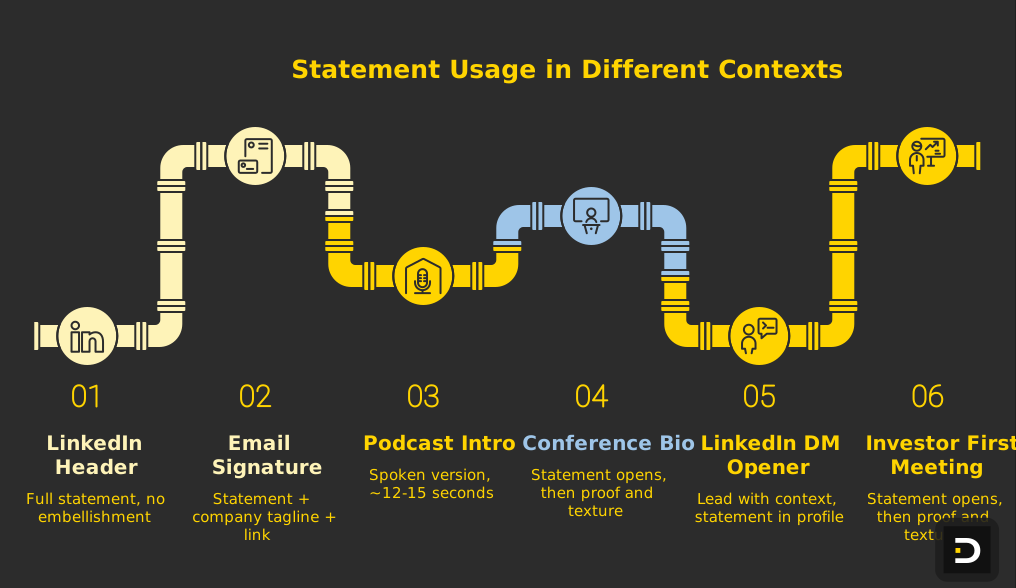
The statement appears in many places. The presentation changes by context:
LinkedIn header (250 chars max): The full statement, no embellishment.
Email signature: Statement + company tagline + link. Three lines max.
Podcast intro: Spoken version, ~12-15 seconds. Sometimes a slightly conversational rewrite of the same content.
Conference bio (200 words): The statement opens, then 3-4 sentences of proof and texture.
LinkedIn DM opener to a stranger: Don't lead with the statement. Lead with context. The statement appears in your profile if they look you up.
Investor first-meeting: Don't recite the statement. Live it. The investor reads your statement in your deck or LinkedIn before the meeting; the meeting is about whether you embody it.
The statement is the anchor. The expression of it adapts.
How long it takes for a brand statement to compound
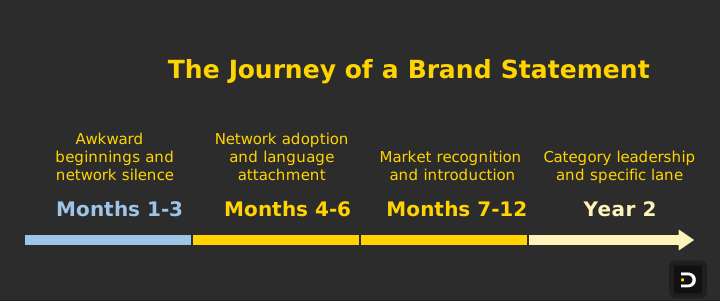
Personal brand statements work on the same timescale as personal thought leadership: slow at first, then suddenly.
Months 1-3: You feel awkward using it. Your network doesn't echo it back yet. This is normal.
Months 4-6: People who know you start using your language to describe you. "Oh, you mean the cybersecurity-founder-product-velocity guy?" The statement is starting to attach.
Months 7-12: People you've never met use language adjacent to your statement when introducing you. The market is doing the work.
Year 2: Your statement becomes how your category describes a specific lane you occupy. You stop having to explain what you do; everyone already knows.
Founders who quit using their statement at month four because it "doesn't feel like it's working" miss the compound. The ones who keep saying the same thing for 18 months end up category-defining.
One final test: the rivalry test
A real brand statement should make at least one credible peer in your space slightly uncomfortable. Not enemies - peers. The statement claims a lane. If no peer thinks "wait, that's my lane too," your statement isn't claiming enough.
This is the test most founders skip. It's the one that separates statements from slogans.
Common phrases to cut from any brand statement draft
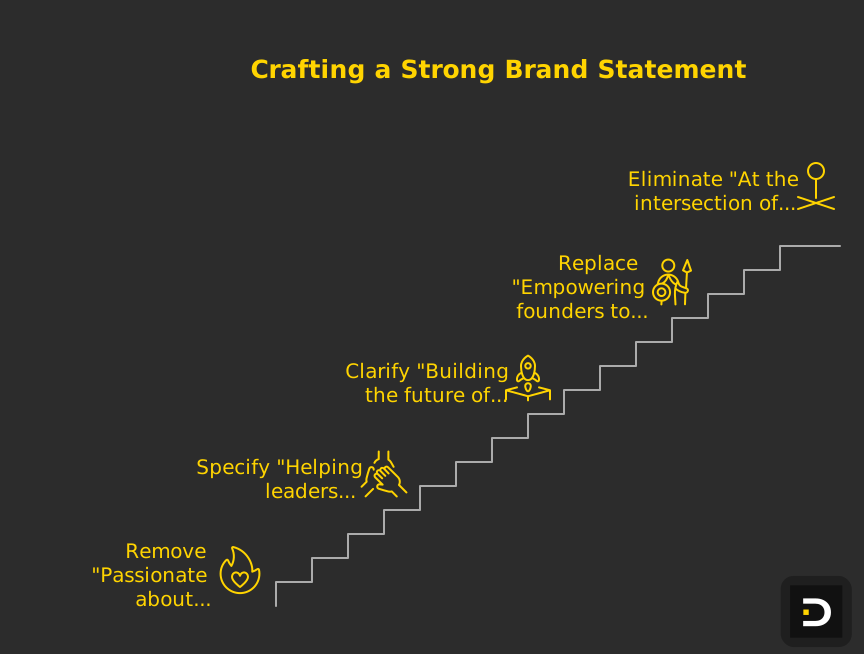
Five phrases that signal a weak statement. If your draft contains any, rewrite:
"Passionate about..." Everyone is passionate. The word adds nothing. Replace with what you actually do.
"Helping leaders..." Generic. Specify the leaders (cybersecurity CEOs? Series A founders?) and the help (what specific outcome?).
"Building the future of..." Vague aspiration. Replace with the specific market shift you're betting on.
"Empowering founders to..." Marketing-speak. Replace with the concrete capability you deliver.
"At the intersection of..." Code for "I have multiple identities." Pick one lane.
The pattern: weak phrases describe ambitions. Strong phrases describe what you actually do today.
How brand statements work for non-founders too
This guide focused on founders, but the framework works for anyone in a leadership role.
For VP-level operators: Your statement should describe the specific operational lane you own. "I help B2B SaaS sales teams compress their enterprise cycle by 40% through a redesigned discovery process."
For investor partners: Your statement should describe your thesis and method. "I back early-stage cybersecurity founders who treat the security buyer like a software developer."
For independent advisors: Your statement should describe the specific transition you help leaders navigate. "I help founder-CEOs shift to professional CEOs without losing the founder-energy that made the company work."
The framework - specific person, specific outcome, specific method - applies wherever someone wants to be known for something specific in a noisy market.
Your next step

Block 30 minutes tomorrow morning. Write five drafts of your brand statement. Test one with a peer. Commit to the one that scares you slightly because it stakes a real position. We help founders sharpen brand statements as part of our voice work at Foundera.
A closing note on conviction
The single hardest part of writing a personal leadership brand statement is the conviction it requires. You're staking a public position. You're claiming a lane. You're inviting peers to disagree.
Most founders soften their statements right before they ship them, hedging the position to feel safer. The softening is what makes the statement disappear into the noise.
The version that scares you slightly is the version worth shipping. The version that feels safe is the version nobody will remember.
Write the scary one. Test it for 12 months. The market will tell you whether you were right.
The TL;DR
Quick answer
A personal leadership brand statement is your one-sentence answer to who you are and what you stand for as a founder. It compresses your category POV into 12-25 words that a buyer can repeat. The 4-step framework: pick your one problem, take a position, name your standard, claim your moment. Below the article: 15 real founder examples.
Key takeaways
- 12-25 words. Anything longer is a paragraph; anything shorter is a tagline.
- Four ingredients: problem you solve, position you stake, standard you hold, moment you claim.
- Avoid 'helping companies' and 'passionate about' - the two most generic openings on LinkedIn.
- Test it with three peers: can they repeat it back? If not, rewrite.
- Refresh annually. Your statement should evolve with your category POV, not stay fixed.