You know the problem. You need to post LinkedIn twice a week to stay visible. Your content compounds—156% ROI on thought leadership versus 10% on generic marketing, according to Edelman and LinkedIn's 2025 B2B TL Report. But you're also building a company. You don't have 10 hours per week to write polished posts.
So you try pure AI. You feed ChatGPT a prompt, hit generate, copy-paste, post. It's fast. It's wrong. LinkedIn's algorithm penalizes AI-generated content—360Brew testing shows that pure-AI posts get 30-40% fewer impressions than authentic human voice. Plus, pure-AI content doesn't sound like you. It sounds like it sounds like everyone else.
The other trap: pure human. You write every post from scratch, 45 minutes per post, twice a week. That's 4.5 hours per week minimum. For founders, that's not scalable. You choose between shipping product and maintaining your brand.
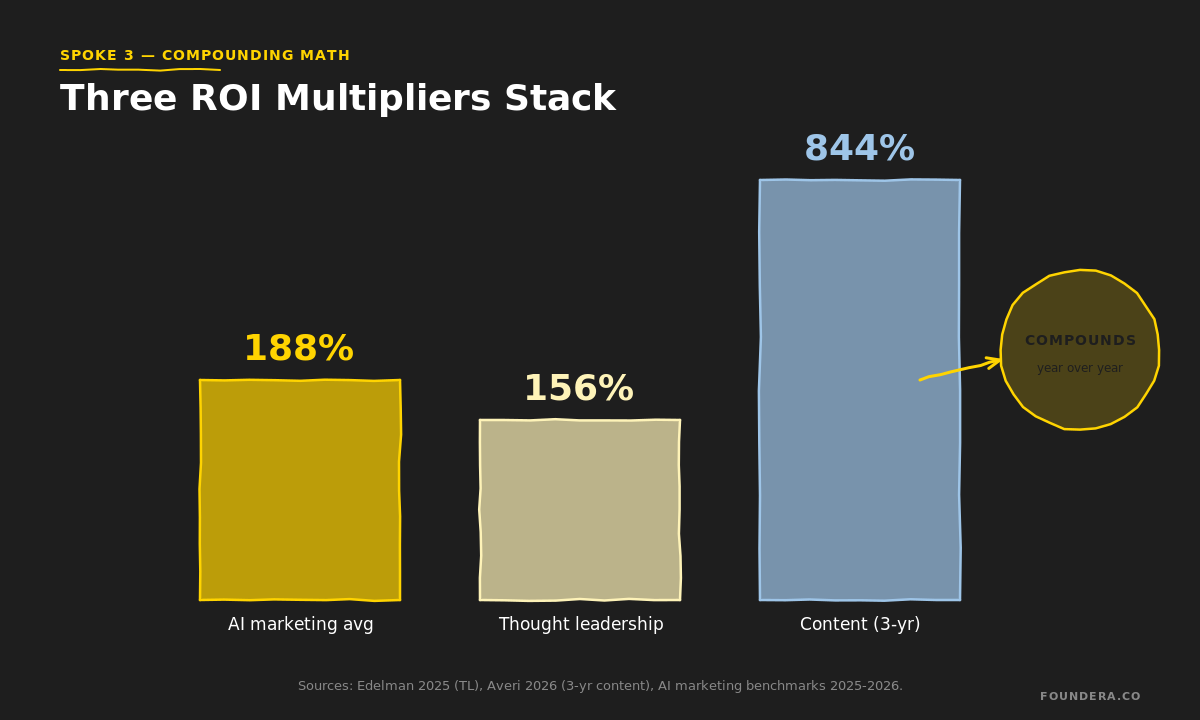
There's a third path: the hybrid workflow. This is what Foundera built, tested, and is sharing here. It's 6 steps. It uses AI as a tool, not a replacement. It takes 30 hours of setup and 3-4 hours per week thereafter. It compounds at 188% ROI (AI in B2B research), layered on top of the 156% TL ROI baseline. And it sounds authentically like you because, fundamentally, it is.
This guide walks you through the workflow, the exact toolchain with costs, the time math, and the mistakes founders make when they try to shortcut it.
The Two Failure Modes
Pure AI Doesn't Scale Trust
You can generate a post in 90 seconds. But here's what actually happens: LinkedIn's algorithm is trained to detect AI-generated content. 360Brew testing shows that posts written by large language models get flagged and de-prioritized. Your reach drops 30-40% compared to human-authored posts.
Worse, even if the algorithm doesn't catch it, your audience will. AI-generated posts sound like every other AI-generated post: they hit the same rhetorical patterns, the same sentence structures, the same emotional cues. After three posts, your audience senses something is off. They follow you expecting your voice. They get a generic voice. They unfollow.
For B2B founders, voice is your most scarce resource. Investors, customers, and recruits follow you because of how you think, not because of generic frameworks. When you outsource your voice to AI, you outsource your differentiation.
Pure Human Doesn't Scale Throughput
Most founders can write a solid post in 30-45 minutes. A good one—with a hook that lands, structure that scans, examples that resonate—takes an hour. Do that twice a week and you're looking at 8-10 hours monthly minimum.
Founders operate in increments. You have a 30-minute slot between meetings, an hour on Sunday morning, maybe two focused hours on Friday afternoon. Writing is hard work that requires momentum. Breaking it into fragments kills quality and motivation.
Most founders try, fail, then swing to either pure-AI or complete neglect. The result: silence. No LinkedIn presence. No compounding visibility. No 156% ROI on thought leadership.
The hybrid model solves both. It uses AI to handle the scaffolding (outlining, first draft, structure). It reserves your 30-45 minutes for what only you can do: adding your authentic voice, your specific examples, your contrarian take. The result is authentic human voice on a deadline that actually fits your life.
The Hybrid Workflow: 6 Stages
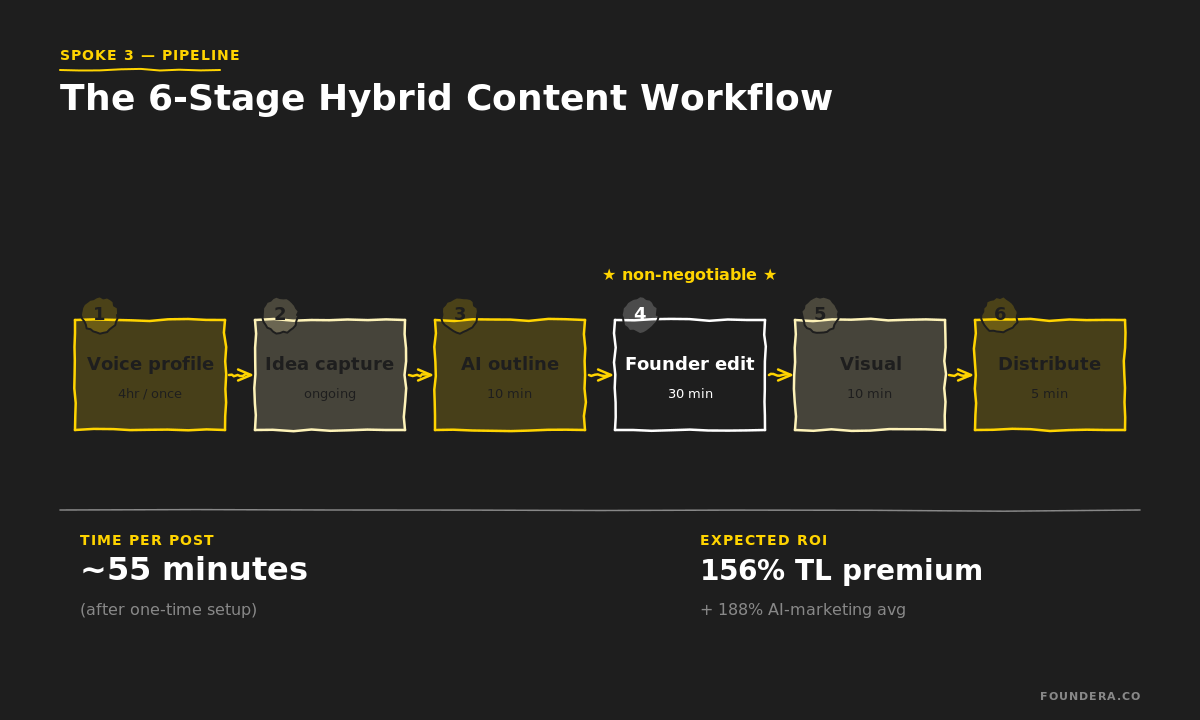
Here's what it looks like from 10,000 feet:
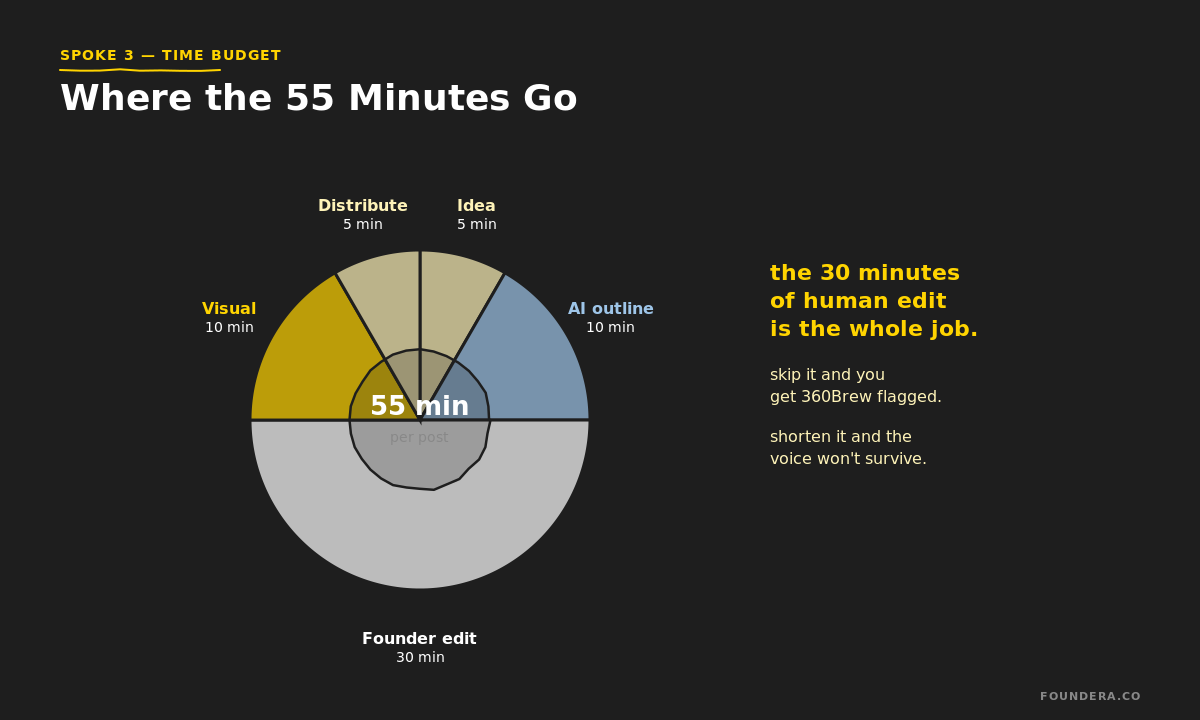
This is a 70-minute workflow end-to-end. The investment is front-loaded: 4 hours of voice profile setup, which only happens once. After that, you can produce three polished posts per week in the time you used to spend on one.
Let's walk each stage.
Stage 1: Voice Profile Capture (One-Time, 4 Hours)
Before you write a single AI-assisted post, you need to give AI access to your voice. This isn't magic. It's pattern extraction. You're teaching the system how you think, how you phrase things, what your syntax looks like, what you emphasize.
What to capture
Existing writing samples — Collect 5-10 of your best posts, emails, or essays. These are your reference library. AI will analyze them for sentence patterns, vocabulary, punctuation, tone.
Voice memo or transcript — Record yourself talking for 10-15 minutes about something you know deeply. Talk like you'd talk to a peer, not a presentation. AI will extract rhythm, casual phrases, how you build arguments verbally. If you have transcripts of podcast appearances or recorded presentations, even better.
Answer 15 reflection questions — Spend 30 minutes answering prompts like: "What's your most contrarian belief about [your market]?" "How do you think about risk?" "What makes you angry about your industry?" "What's a failure you learned from?" This teaches AI about your values and your perspective, not just your syntax.
Collect metaphors and recurring phrases — What do you reference repeatedly? What metaphors do you use? What's your signature move in an argument? This is the pattern layer that turns generic content into recognizable voice.
Tools for voice profile capture
Time investment: 4 hours, one-time. You'll use this voice profile for every post you generate going forward.
Stage 2: Idea Pipeline (Continuous Capture)
Great posts start with great ideas. The problem: ideas arrive randomly. You're in a customer call and hear something that could become a post. You're reading a research paper and have a reaction. You're in the shower and think of a contrarian take.
If you don't capture these moments, they evaporate. Then when it's time to write, you start from zero and stare at a blank page.
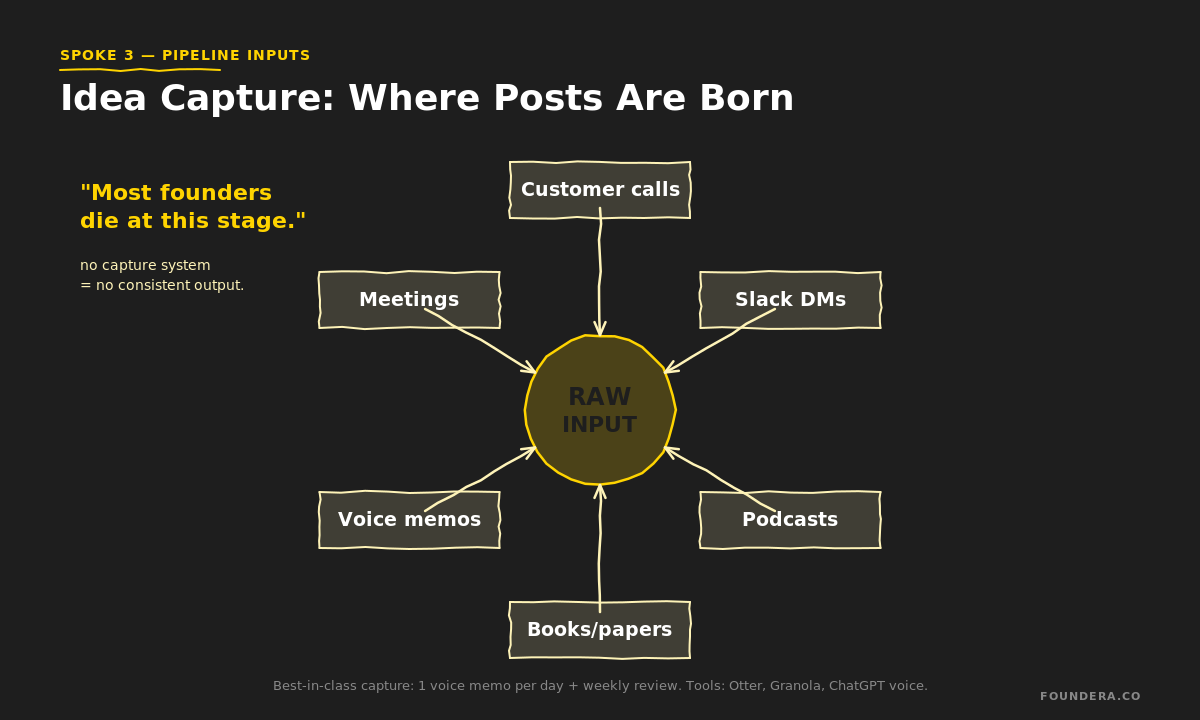
The hybrid workflow uses a lightweight capture system:
Capture systems
Slack channel: #content-ideas — Every time you have an idea for a post, you dump it there in 1-2 sentences. Raw, unpolished. This is not writing, it's capture. You're thinking out loud.
Customer call notes — After customer calls, take 5 minutes and note: "What did they say that surprised me?" "What problem came up?" "What metaphor did they use?" These become post seeds.
Voicemail to yourself — When you're in a meeting or driving, voice memo your thoughts. "This customer said X, which is different from what we're seeing with Y. That could be interesting." Convert to text with Otter later.
RSS feeds + read-it-later — Subscribe to feeds in your market (Twitter, newsletters, SubStack, HN). When you find something interesting, save it with a 1-line note: why you saved it, what it made you think, how it connects to your work.
Weekly review — Every Friday, spend 15 minutes reading your #content-ideas Slack channel. Pick three ideas to develop into posts next week. This batching prevents context-switching and lets you sequence ideas strategically.
Tools for idea capture
ToolCostUse CaseSlack$0-$150/monthReal-time idea dump, team visibilityOtter.ai$20/monthTranscribe voice memos to textNotion$0-$10/monthOrganized idea databaseFeedly$0-$10/monthRSS feed aggregationPocket/Instapaper$0-$3.99/monthSave-for-later functionality
The tooling here is lightweight. What matters is the habit: capture every idea the moment it arrives, review them weekly, sequence strategically.
Stage 3: AI-Drafted Outline + Tension Hook (20 Minutes)
Here's where AI earns its keep. You take your idea and a conversation with AI to produce a solid first draft.
The prompt template
Use this exact template (adjust for your voice and market):
I'm writing a LinkedIn post about [TOPIC].

Here's my voice and values:
[PASTE YOUR VOICE PROFILE]

Here's the idea I want to develop:
[YOUR IDEA: 1-2 sentences, raw]

Here's the raw context:
[BACKGROUND: customer quotes, stats, examples, problems you've seen]

My goal is to:
[Share a contrarian insight / help founders avoid a mistake / explain a process / share a win]

Write me an outline for this post that:
1. Starts with a tension hook (a problem or contradiction that's interesting)
2. Has 3-4 main sections
3. Each section has a specific insight or framework
4. Ends with a question that invites conversation or implies a CTA

Format it as:
- HOOK (1-2 sentences: the surprising thing or the problem)
- SECTION 1: [Title] (key insight)
- SECTION 2: [Title] (key insight)
- SECTION 3: [Title] (key insight)
- CLOSE: (question or CTA)
Write this in my voice, using the patterns and metaphors I've shared.
The result: a structured outline that's authentic to your voice and grounded in your examples. The AI is doing the scaffolding work: organizing your thinking, creating structure, suggesting section titles. You're not asking it to write the post. You're asking it to organize the idea.
What you'll do with the outline
You'll read it, probably edit 30% of it, maybe move sections around, then use it as the skeleton for the next step.
Time: 15-20 minutes of back-and-forth with AI (usually 2-3 rounds of refinement).
Stage 4: Founder Edit Pass (30 Minutes, Non-Negotiable)
This is the step that makes the workflow work. You take the outline and write the actual post in your voice.
Here's the ritual:
Read the outline cold. Print it or put it on a second screen. Read it like you're the audience. What's missing? What feels inauthentic? What example doesn't land?
Write from the outline. Don't edit as you write. Just write. Your job is to convert the outline into prose, adding your specific examples, your specific voice, your specific contrarian take. This is the 20-30 minutes of focused human work.
The five changes you must make:
One thing you must add: a specific number or name. Not "we saw results." "We saw a 40% increase in demo requests in 60 days." Not "a customer told me this." "Merav, a founder at Bondata, told me this."
Proofread once. Read for typos and rhythm. Fix anything that doesn't sound like you when you say it aloud.
Time: 30 minutes. Not 45. Not an hour. 30 minutes of focused, committed human work. Set a timer.
Stage 5: Visual + Thumbnail (10 Minutes)
Linkedin posts with images get 94% more views than text-only posts. You need a visual. The question is: AI-generated or human?
Rule: AI for scaffolding, human for differentiation.
When to use AI image generation
-
($10-$30/month) — highest quality, but requires some prompt engineering
-
($20/month, integrated in ChatGPT Plus) — easiest for quick graphics
-
When to use human design or stock photos
The thumbnail shortcut: Take a screenshot of your post, add a headline overlay with 3-4 words that summarize the post. Use Canva's simple templates. 2 minutes, done.
Time: 10 minutes total. Either a quick Canva graphic or an AI-generated image + overlay.
Stage 6: Publish + Repurpose (10 Minutes)
You've got a polished LinkedIn post. Now extract maximum value:
LinkedIn: Paste your post, add the image, tag 2-3 relevant people, hit publish.
Rewrite for Twitter: Twitter/X demands brevity and a different rhythm. Your LinkedIn post becomes 3-5 tweets in a thread. First tweet: your hook/tension. Middle tweets: one key insight per tweet. Last tweet: question or CTA. Use the same image or a different one.
Newsletter version: If you have a newsletter, add a 1-2 sentence intro and paste the full LinkedIn post. Add a "Read more" link to your LinkedIn post.
Notion database: Add a row to your content database: date posted, topic, link, engagement, repurposed formats. This becomes your content audit.
Time: 10 minutes. You're not rewriting. You're reformatting your existing work for different platforms.
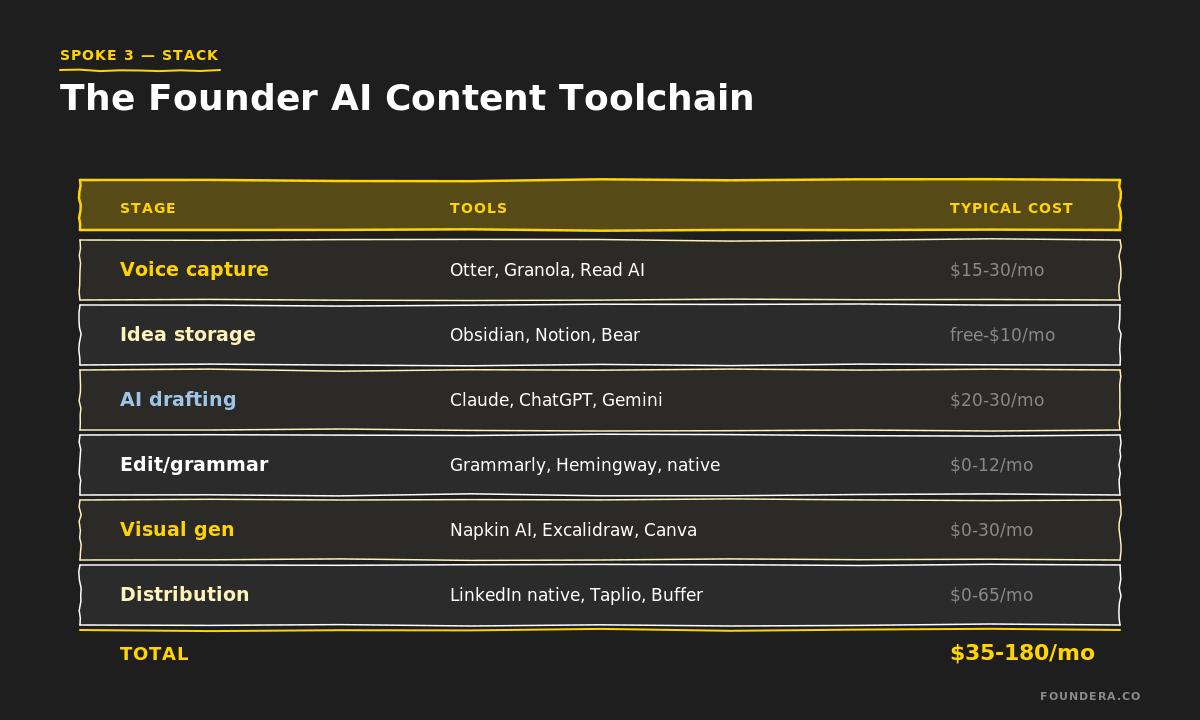
Toolchain: The Technology Stack That Works
Total cost: $73-$173/month depending on what you already have. For comparison, hiring a content contractor is $1000-2000/month. This is 5-15% of that cost.
Time Math: Hours Input vs Output vs ROI
Here's the investment timeline:
ROI breakdown:
According to [MarketingProfs](https://www.marketingprofs.com/articles/2025/53489/scalable-b2b-content-engine-using-ai)'s 2025 guide on building a scalable B2B content engine with AI, founders see three ROI multipliers:
Stacked together: A founder investing 4 hours/week in this hybrid workflow, posting 3x weekly consistently for 6 months, should expect:
Concrete example: If you're a Series A founder and your ACV is $50K, and 10% of your pipeline now comes from content (entirely possible after 6 months of consistent posting), you've generated $500K in pipeline from 4 hours/week of work. That's an ROI multiplier most paid marketing can't match.
Common Workflow Mistakes (What Not to Do)
1. Skip the voice profile
You think the outline AI produces is good enough, so you barely edit it. The result: 10 posts that sound like every other AI-generated post. After 10 posts, you notice your engagement hasn't grown and your audience isn't developing loyalty.
Fix: Invest the 4 hours upfront. The voice profile is the difference between authentic and generic. Don't skip it.
2. Post raw AI output
You generate an outline, AI writes the full post (you ask for "full blog post, not outline"), and you post it verbatim. It gets demonetized or de-prioritized. You think the workflow doesn't work.
Fix: AI does outline and structure only. You write the prose. This is non-negotiable. The edit pass is where authenticity lives.
3. No idea pipeline discipline
You wait until Thursday evening to figure out what to write. You stare at a blank page for 45 minutes trying to think of a topic. You either skip posting that week or post something mediocre.
Fix: Capture ideas continuously. Friday review, pick three topics for next week, you're set. No Friday panic.
4. Skip measurement
You post consistently for 3 months, get decent engagement, but don't track what's actually working. You don't know if customer wins posts are generating demo requests or if educational content is building audience. You can't double down on what works.
Fix: Track these metrics: engagement (comments/shares), demo requests mentioning LinkedIn, profile view growth, website traffic from LinkedIn. Use UTM parameters. Review weekly.
5. Treat this as a "set it and forget it" system
You set up the voice profile and idea system once, then ignore it. You don't update your voice profile when your thinking evolves. Your ideas pipeline gets stale. 6 months later, your posts feel stale because your actual thinking has moved on.
Fix: Update your voice profile quarterly. Review your ideas pipeline weekly. This system is alive. Treat it like you'd treat your product roadmap.
Frequently Asked Questions
What's the best AI model to use for the outline step?
We recommend starting with ChatGPT Plus ($20/month) because it's the most user-friendly and integrates DALL-E for images. If you're doing complex reasoning or want a second opinion, Claude is excellent. Don't overthink the tool choice. Pick one and stick with it for 30 posts so you learn how to prompt it effectively.
How do I avoid my posts sounding like they're AI-written?
The edit pass. This is where you add your specific examples, your contrarian take, your voice. If you're skipping the edit pass, your posts will sound generic. If you're spending 30 genuine minutes on the edit pass, your posts will be authentically yours. The edit pass is non-negotiable.
Should I use a voice cloning tool like TrueFan.ai?
Voice cloning is interesting for podcasts and video, not for written content. For LinkedIn posts, the ROI of voice cloning is low. The better use of your time is the edit pass—that's where your voice actually comes through. If you're interested in voice cloning for podcasts or audio content, TrueFan.ai projections show 300-600% ROI, which is compelling for that format specifically.
How long before I see demo requests from content?
Month 1: probably none. Month 2: 1-3. Month 3: 5-10. By month 6, consistent content usually generates 30-50 demo requests per month if you're at Series A scale. The key variable is consistency—3 posts per week for 6 months beats 5 posts per week for 2 months then nothing.
What if I don't have time for 4 hours of voice profile setup?
Do 2 hours instead. Answer the reflection questions. Collect 5 writing samples. That's enough for AI to learn your patterns. You can deepening over time.
Can I outsource the edit pass to a contractor?
No. The edit pass is where your authenticity comes in. If you outsource it, the post becomes the contractor's voice, not yours. Outsourcing kills the entire point of the hybrid workflow. Your personal brand is personal. You have to do the edit pass.
What content topics work best with this workflow?
All of them, honestly. Customer wins, product updates, founder lessons, market insights. The hybrid workflow works because it amplifies your voice, not because it constrains your topics. The better question: what topics align with your business goals? If you need demo requests, focus on customer wins + educational content. If you need to attract talent, focus on team/culture posts. If you need to position for fundraising, focus on metrics + founder narrative.
How do I know if this is actually working?
Track these metrics weekly: (1) engagement rate (comments + shares / views), (2) demo requests mentioning LinkedIn, (3) profile view growth, (4) website traffic from LinkedIn, (5) new customers who mentioned seeing your LinkedIn posts in sales discovery. After 12 weeks of consistent posting, you should see measurable growth in at least 3 of these metrics.
Can I batch this and do 10 posts at once instead of spreading throughout the week?
Yes and no. You can batch the outline/edit pass (do 10 outlines one day, edit them over the next 3 days). But you should spread posting throughout the week. Consistent, frequent posting gets better algorithmic boost than batched posting. LinkedIn's algorithm rewards sustained engagement.
Ready to Build Your Authentic AI-Assisted Content Workflow?
This isn't about replacing you with AI. It's about AI handling the scaffolding so you can focus on what only you can do: inject your authentic voice, your specific examples, your contrarian perspective.
The hybrid workflow is 70 minutes per post, 3 posts per week, compounding at 156% TL ROI + 188% AI ROI, reaching 844% three-year content ROI according to industry benchmarks. That's measurable business impact from something that actually fits into your founder life.
Start with the voice profile (4 hours, one-time). Set up your idea pipeline (Slack + Friday review ritual). Do one post end-to-end using this workflow. Measure the engagement, the demo requests, the reach. Then decide if it's worth continuing.
We built this at Foundera because we kept seeing founders choose between "ship product or build brand." This workflow says you don't have to choose. You can do both. It's just a different way of working.
For a deeper dive into founder voice authenticity with AI, check out founder-voice-ai-content-authenticity. For LinkedIn algorithm specifics, see linkedin-algorithm-ai-content-2026. And for the broader strategy this fits into, read ai-era-founder-marketing-2026.
Your voice is your competitive advantage. Protect it. Amplify it. Let AI handle the scaffolding. The result is content that's both authentic and scalable.