Most advice on how to find clients on LinkedIn is built for sales reps, not founders. Open any popular guide and you see the same pattern: scrape a list, blast cold connections, send a templated DM, follow up five times, book demos. It works for SDR teams. It does not work for founders selling complex products to senior buyers in 2026.
The founder version differs in four ways. You cannot fake authority, so cold volume tactics signal weakness. Your buyers decide based on what you publish, not what you pitch. Your time is the scarcest input, so a five-touch SDR cadence is a tax you cannot afford. And the platform now favors content depth and warm signal over outbound spray.
This playbook is the same model Foundera uses with the deep-tech founders we ghostwrite for. By the end, you will have an ICP framework, three content formats that pull buyers toward you, four DM scripts you can copy today, and a 20-minute discovery call structure.
Why traditional "find clients on LinkedIn" advice fails founders in 2026
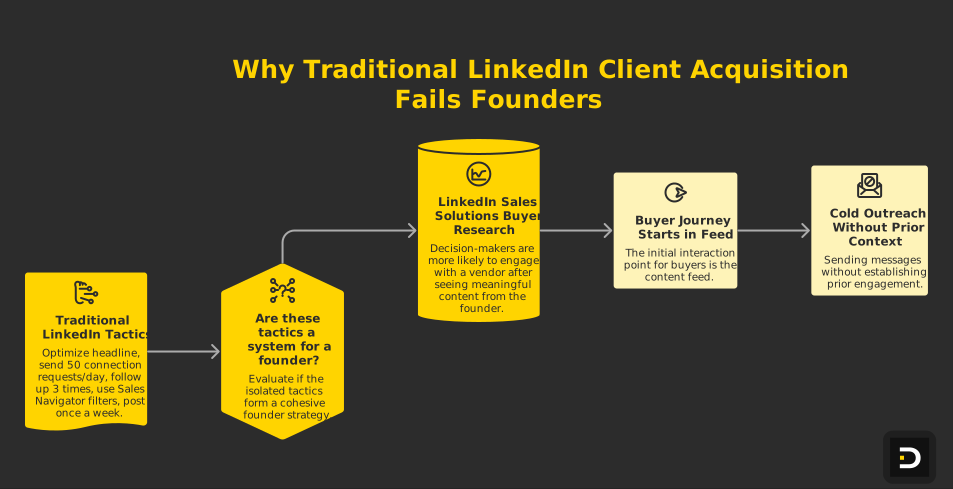
If you have researched this topic, you have read the same five tactics: optimize your headline, send 50 connection requests a day, follow up three times, use Sales Navigator filters, post once a week. None is wrong in isolation. All of it is wrong as a system for a founder.
According to LinkedIn Sales Solutions buyer research, decision-makers now report they are more likely to engage with a vendor after seeing meaningful content from that vendor's founder than after receiving any outbound message. The buyer journey starts in the feed, not the inbox. Cold outreach without prior context has gone from inefficient to actively counterproductive.
Most "find clients on LinkedIn" advice was written for B2B sellers with quotas, where reply rate is the optimization function. Founders need a different number. You do not need 200 replies per month. You need four to six warm conversations with the right buyers, of which one or two close. The tactics that maximize reply rate actively suppress conversation quality.
When a founder sends a templated DM, the buyer can tell. They have received the same template from twenty other people that month. It reads as either dishonest or incompetent.
What works instead: content does the qualifying, engagement does the warming, and the DM is the last step before the conversation, not the first.
The 4-step founder-led client acquisition system (overview)
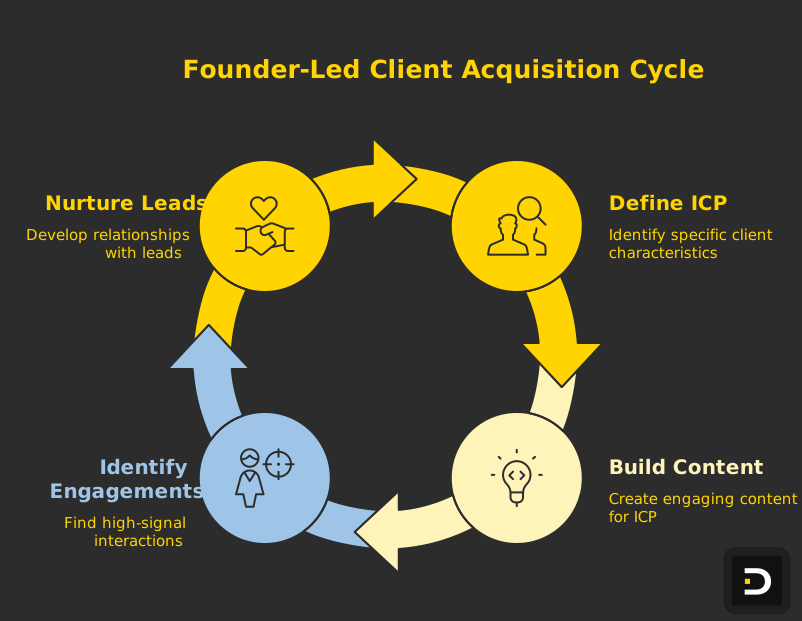
Here is the full system before we drill into each step.
Step 1: Define your ICP precisely. Not "B2B SaaS companies between 50 and 500 employees." A real ICP names the specific role, trigger, stack, and pain. The five-attribute framework gets you there in an afternoon.
Step 2: Build pull through content. Publish three formats that attract the ICP from Step 1. Signal-rich, opinion-forward pieces that filter for buyers who already share your worldview. Done correctly, your ICP starts commenting, liking, and following without you sending a single DM.
Step 3: Identify high-signal engagement. Inside that pool, a subset is actively in-market. Their behavior tells you which: who comments substantively, who follows after a specific post, who views your profile twice in a week, who shares a post.
Step 4: Send warm DMs that get 35 to 50 percent reply rates. The DM is no longer cold. The recipient knows your work. The message is short, specific, references how you encountered them, and asks a low-cost question.
The flow: content goes out. ICP buyers see it. A subset engages publicly. A smaller subset signals interest through profile views, repeat engagement, or shares. You DM that smaller subset. A 35 to 50 percent reply rate puts you on a 20-minute discovery call. From discovery, 30 to 40 percent move to paid scope. The math at the end shows why four to six DMs per month produces one to two closed clients consistently.
Step 1: Define your ICP precisely (the 5-attribute framework)
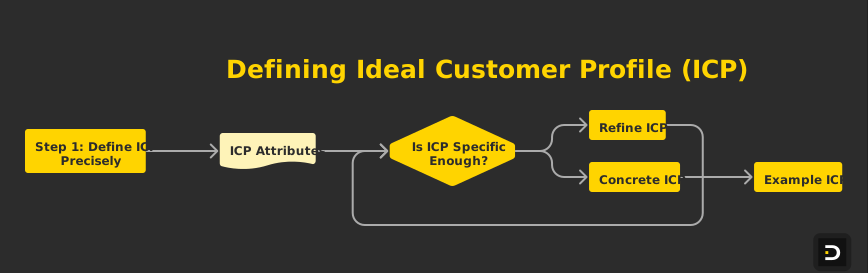
An ICP that is too broad is the most common failure point in founder-led sales. If you can describe your target customer in one sentence and a teammate pictures five different companies, your ICP is not specific enough.
Use these five attributes. Fill in each with a concrete answer.
| Attribute | What it means | Example (concrete) |
|---|---|---|
| Role and seniority | The exact person who feels the pain and has buying authority | VP of Engineering at a Series A or B fintech, 80 to 250 engineers |
| Trigger event | The specific event that creates urgency to solve this problem now | Recently failed a SOC 2 audit, or new compliance officer hired in last 90 days |
| Current stack | The tools they already use, which signal sophistication and fit | Uses Datadog, Vanta, GitHub Actions, has internal security champion |
| Pain shape | The specific shape of the pain in their language, not yours | "My engineers spend two weeks per quarter on audit evidence collection instead of shipping" |
| Budget and decision speed | What they typically spend on this problem and how fast they decide | $30K to $80K annual contract, decision within 30 to 60 days with security and CFO sign-off |
Founders resist this specificity because it narrows the market. It narrows on purpose. The pull strategy in Step 2 works because you are talking to a precisely-defined audience in their exact language. The narrower the ICP, the louder your content sounds in the heads of the people you want as clients.
One test: ask a friend whether they can name three companies that fit your ICP. If they cannot, it is too abstract. If they name ten, you are oversaturated. Three to five is the sweet spot.
For deeper methodology, see sales methodology for founders on LinkedIn.
Step 2: Build pull through content (the 3 formats that attract ICP)
This is where most founders skip ahead or do it badly. Generic "lessons learned" posts get likes from other founders but no clients.
The three formats below attract buyers in your ICP. Each stakes a position your ICP agrees with, then defends it with specifics only your ICP recognizes.
Format 1: The contrarian operating insight. Pick a piece of conventional wisdom in your buyer's world you believe is wrong. State it clearly. Explain what most people do. Explain what you have seen actually work, with specifics.
Example: "Most SOC 2 prep guides tell you to start with policy documentation. After ten audits, we have found the opposite. Start with evidence automation in your CI pipeline. Here is why, and what to ship in the first 30 days."
This signals expertise, filters for sophisticated buyers, and gives them something to disagree with, which drives the comments that warm the connection.
Format 2: The client teardown (anonymized). Walk through a real client situation with the specific decisions and tradeoffs. Do not skip to the lesson. The specifics are the whole point.
Example: "A fintech client came to us last quarter spending $180K a year on three overlapping security tools. The actual problem was not tool consolidation. Nobody owned the security roadmap. Here is what we changed, in order, and what it cost them."
Buyers in your ICP recognize themselves. They DM you because they see their own quarter ahead in your story.
Format 3: The framework or system. A repeatable framework you use, named and explained. This format builds long-term authority because it gives buyers a vocabulary to carry around.
Example: "We use a four-stage framework for evaluating whether a Series B company should bring security in-house or keep using fractional support. We call it the Security Maturity Ladder. Here are the four stages and the test for each."
Two to three posts per week across these formats produces more inbound interest within 60 days than any cold outreach campaign. If you want the content layer ghostwritten, that is what Foundera does. See thought leadership content for founders.
Step 3: Identify high-signal engagement (who to DM)
Once content is running, engagement accumulates quickly. The mistake is treating all engagement as equal. A like from a peer founder is not the same as a thoughtful comment from an ICP-fit VP.
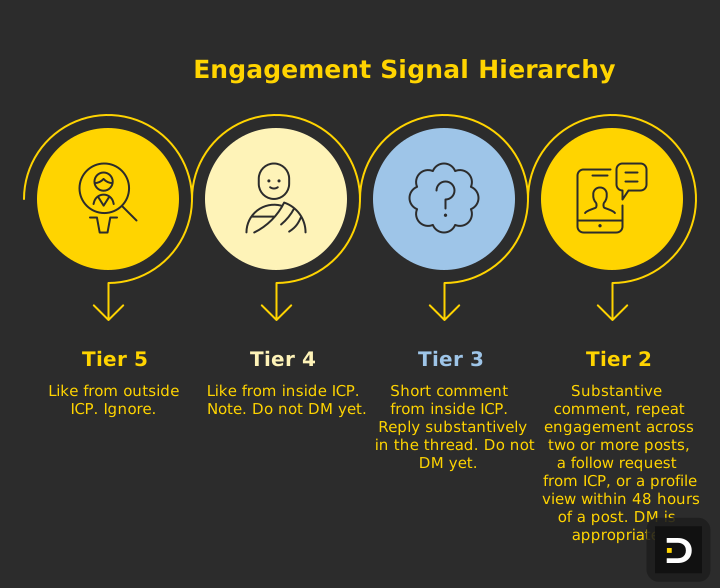
The signal hierarchy, weakest to strongest:
Tier 5: Like from outside ICP. Ignore.
Tier 4: Like from inside ICP. Note. Do not DM yet.
Tier 3: Short comment from inside ICP. Reply substantively in the thread. Do not DM yet.
Tier 2: Substantive comment, repeat engagement across two or more posts, a follow request from ICP, or a profile view within 48 hours of a post. DM is appropriate.
Tier 1: A share, a DM from them first, a tag of a colleague in your post, or a comment that explicitly references a problem they are facing. Reply same day.
Spend 20 minutes every morning scanning engagement from the past 48 hours. Pull the top three to five Tier 2 and Tier 1 signals into a list. Those are your warm DM targets.
Step 4: Warm DM scripts that get 35-50% reply rates
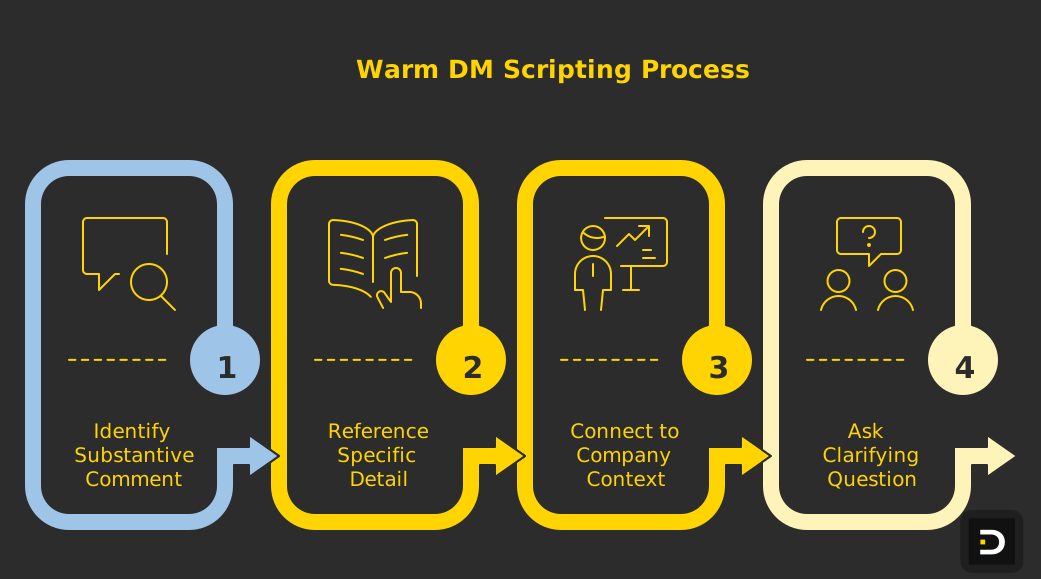
Because your DM is warm, the message looks nothing like cold scripts. Four scripts, each for a different scenario. Use them as starting points and rewrite in your own voice.
Script 1: They commented substantively on a post of yours.
Hey [first name], your comment on the [topic] post stuck with me, especially the part about [specific thing they said]. We see that pattern a lot at companies in the [stage / vertical] range. Out of curiosity, is that something you are actively working through right now, or more an observation from a previous role?
Why it works: references their specific words, low-cost yes/no closing question, no pitch.
Script 2: They follow you after a specific post, no prior interaction.
Hey [first name], thanks for the follow. I noticed you came in right after the [topic] post. Genuine question: is [specific problem in the post] something you are dealing with currently? Happy to share what we have seen work at companies like [their company type] if it is useful, no pitch.
Why it works: acknowledges the trigger (the post they followed after) so it reads as a continuation, not a cold open. "No pitch" removes the defensive crouch.
Script 3: They viewed your profile twice in a week, no engagement.
Hey [first name], LinkedIn told me you stopped by my profile a couple of times this week, which I always take as a signal worth saying hi for. We work with [their type of role] on [problem space]. If there is something specific you were poking around for, happy to point you in the right direction even if it is not us.
Why it works: profile views are active signals; naming them is disarming. "Even if it is not us" signals you are not desperate.
Script 4: They shared one of your posts.
Hey [first name], I saw you shared the [topic] post with your network. Thank you, that is the kindest signal anyone can send. Quick question: was there a specific angle that resonated with what you are working on right now, or did you share it as general FYI? Trying to learn what lands.
Why it works: a share is the strongest organic signal. Asking what specifically resonated opens a conversation about their situation without pitch.
Three rules across all four. Never mention pricing in the first DM. Never include a calendar link in the first DM. Never use any version of "would love to jump on a quick call." Each moves the relationship backward toward cold-DM dynamics.
For ongoing DM conversation structure, see LinkedIn lead generation for founders.
The discovery call: how to qualify in 20 minutes
Keep it to 20 minutes. Founders waste hours on 60-minute calls that should have ended after 10.
Minutes 0 to 3: Their context. "Before I say anything about what we do, walk me through what is happening on your side that made this conversation useful." Listen. Take notes on trigger, people, language.
Minutes 3 to 10: Diagnostic questions. Three questions that test fit. "How is this currently handled internally?" "What have you tried that did not work?" "If you do nothing for 90 days, what happens?" The last is the most important. If the answer is "nothing much," they are not a buyer this quarter.
Minutes 10 to 15: Your relevance. Two to three minutes on how you work with companies in their situation. One specific client analog. No features. No slides.
Minutes 15 to 20: Next step or no. If fit: "Next step would be a 45-minute working session on [their problem]. I would propose Thursday afternoon. Does that work?" If no fit: "Based on what you described, I do not think we are the right partner. The pattern fits more like [different solution]. Want me to point you in that direction?"
The "not a fit" exit creates more credibility than founders realize. Buyers remember it. Many come back months later.
Pricing conversation: how to anchor to value not hours
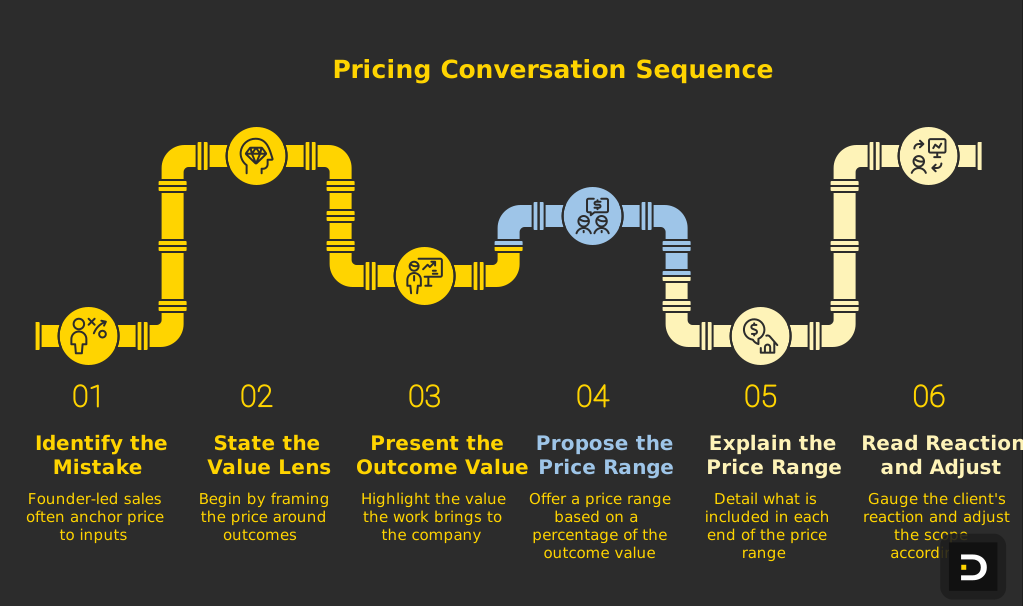
This is where founder-led sales most often falls apart. The mistake: anchoring price to inputs (hours, days) instead of outcomes.
The frame that works: state the value lens before the number. "We price against the outcome. If the work lands, the value to a company in your situation is usually [outcome value]. We capture 5 to 15 percent of that, depending on scope. For you, that puts us in the range of [your price] to [higher price]. Let me walk through what is in each end."
This anchors in their outcome before your fee. The range lets you read reaction and adjust scope rather than negotiating price.
If they push back, do not discount. Reduce scope. "The way to fit this into a tighter budget is to narrow scope rather than discount. We could pull [phase] out and revisit once the first phase has proven value. That brings us to [lower price]."
Never give a price live on a call unless the shape is fully reflexive. For new shapes: "let me think on scope tonight and send a proposal tomorrow with two options." Two-option proposals close at higher rates than single-option.
For more, see founder-led marketing on LinkedIn.
The follow-up cadence (don't ghost, don't pester)
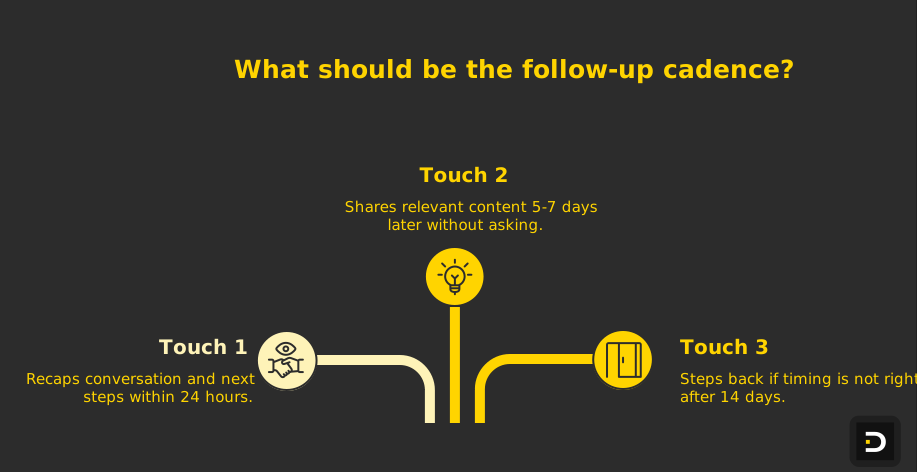
Founders either disappear or pester. The cadence that works is three touches.
Touch 1 (within 24 hours): Short message recapping the conversation, restating the next step, including any artifact you promised.
Touch 2 (5 to 7 days later, if no reply): A useful message unrelated to closing. Share content relevant to what they described. No ask. Subtext: "I am still thinking about your situation."
Touch 3 (14 days after Touch 2): "Hey [name], I am going to step back on this. Sounds like the timing is not right, which is fine. If anything shifts, you know where I am. Best of luck with [specific thing they mentioned]."
The third message is the most important. It produces either the reason for silence ("we just hired," "pushed to next quarter") or "sorry, lost track, let me come back this week." A surprising percentage of deals close after close-the-loop because it removes pressure.
If touch 3 gets silence, stop. Add them to your content audience. Six months from now, they come back.
Closing without pressure: 3 frame shifts
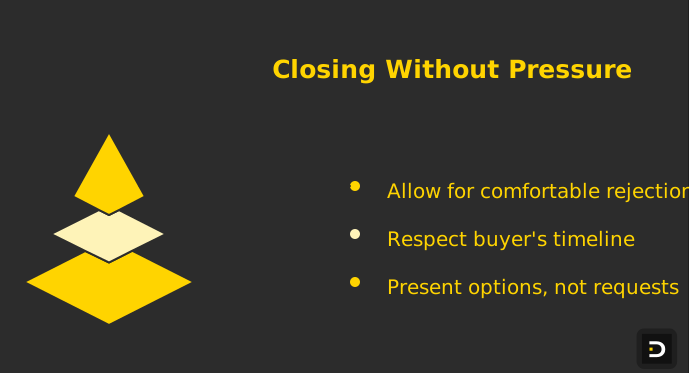
Founders close badly because they internalize the wrong frame: "I am asking them to give me money." Every closing moment then feels like an imposition.
Frame 1: You are offering a decision, not asking. "Based on everything we have discussed, the next step would be either [option A] or [option B]. Which fits better?" Agency goes back to the buyer.
Frame 2: Match the buyer's tempo. Do not force your timeline. Ask: "What timeline feels right, and what would need to be true for us to start by then?"
Frame 3: Make the no easy. "I want to make sure you have the space to say no if it is not right. What would have to be wrong about the proposal for you to pass?" This produces the actual objection rather than a polite stall.
Across all three: you are not the one with something to prove. You are the expert helping the buyer reach the right decision, whether or not it involves you.
For the philosophy, see the executive thought leadership framework.
The math: 4-6 inbound DMs per month = 1-2 closed clients
Assume two to three posts per week, a defined ICP, and daily signal scanning. That produces 10 to 15 Tier 2 or Tier 1 signals per month. You send four to six warm DMs.
At 35 to 50 percent reply rate, you get two to three replies that move to a 20-minute discovery call. Roughly half qualify as fits. That is one to two fit discovery calls per month.
From discovery to close, well-qualified founder-led pipelines convert at 30 to 50 percent over 30 to 90 days. According to OpenView Partners SaaS benchmarking, this range is consistent across founder-led B2B SaaS pipelines under $100K ACV. That gives one to two closed clients per month from a sustained four to six DM cadence.
Content compounds. Every post stays in the feed. By month six, your engagement pool is two to three times its month-one size.
Compare to cold outreach. HubSpot's sales research shows cold DM reply rates of 1 to 3 percent. To produce one to two closed clients per month on cold, a founder needs 400 to 800 messages per month. Unsustainable, off-brand, and a waste of the founder's most expensive hour.
The warm system trades volume for precision. The math works at four to six DMs per month. It does not work at 400.
What this looks like for 3 founder archetypes (consultant / SaaS / agency)
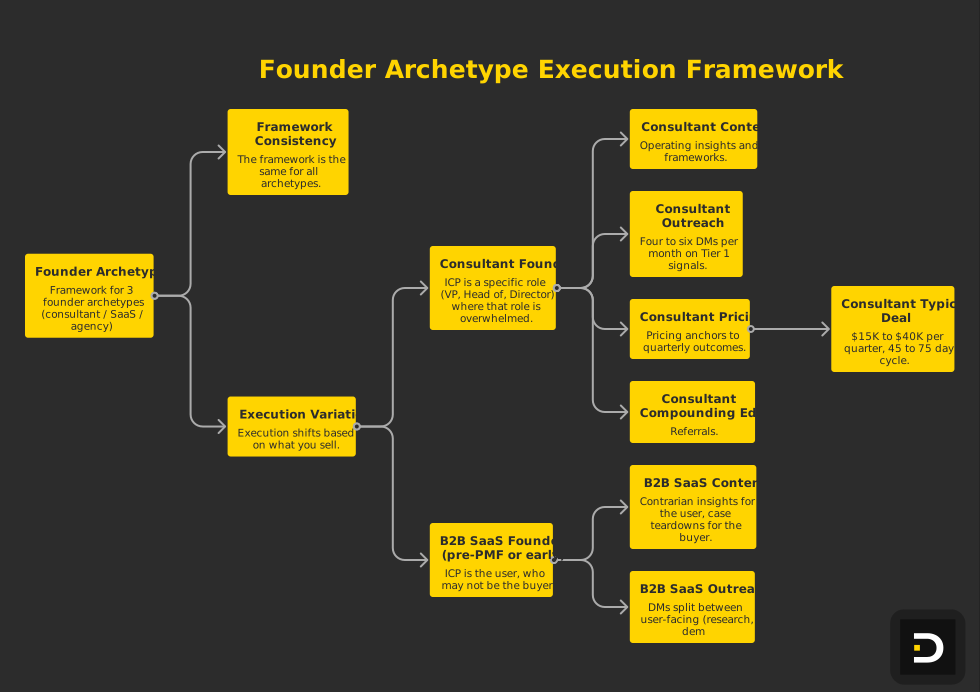
The framework is the same. Execution shifts based on what you sell.
The consultant founder. ICP is a specific role (VP, Head of, Director) where that role is overwhelmed. Content: operating insights and frameworks. Four to six DMs per month on Tier 1 signals. Pricing anchors to quarterly outcomes. Typical: $15K to $40K per quarter, 45 to 75 day cycle. The compounding edge is referrals.
The B2B SaaS founder (pre-PMF or early). ICP is the user, who may not be the buyer. Content: contrarian insights for the user, case teardowns for the buyer. DMs split between user-facing (research, demos) and buyer-facing (commercial). Pricing anchors to seats or usage. First contract: $20K to $80K ARR. Cycle: 30 to 60 days for early adopters.
The agency or productized services founder. ICP is a marketing leader or founder in a revenue band ($2M to $20M ARR). Content: teardowns demonstrating productized methodology. Six to eight DMs per month is sustainable. Pricing anchors to packaged retainers. Typical: $5K to $25K per month on a six-month minimum. Compounding edge is case studies.
For brand positioning across all three, see personal leadership brand statement examples for founders.
Your next move
The system works. The hard part is sustaining the content layer for the 60 to 90 days before the engagement pool gets dense enough for the warm DM math to fire.
Most founders abandon at week four. They post for a month, see modest engagement, and conclude LinkedIn does not work. What they are concluding is that one month is not enough to build the pull layer.
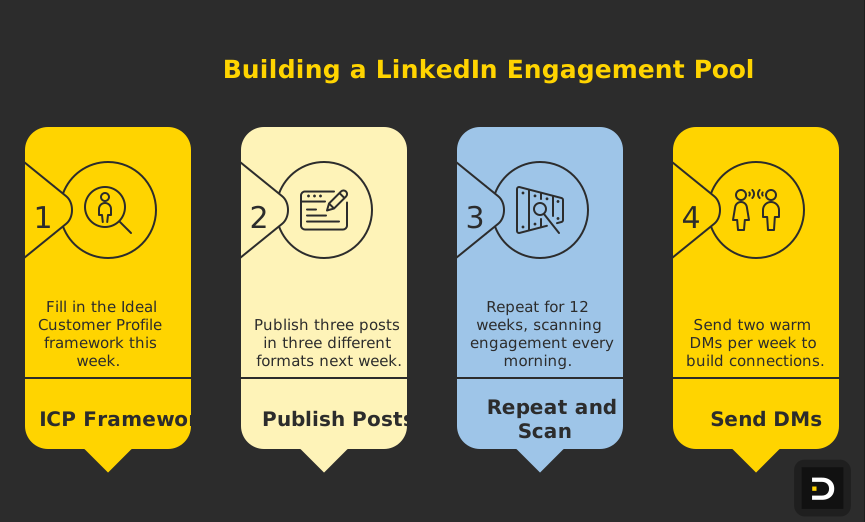
To build it yourself: this week, fill in the ICP framework. Next week, publish three posts in the three formats. Repeat for 12 weeks, scanning engagement every morning, sending two warm DMs per week. By week 12 you will have closed your first client.
If you want help running the content layer so you can focus on conversations and closing, that is what Foundera does. We ghostwrite the content, identify the signals, draft the DMs, and hand you the warm conversations. Founders we work with typically close their first contract within 60 to 90 days. See how we work.
FAQ
How long before I see clients from this system?
60 to 90 days for the first closed contract, assuming a 2 to 3 post per week cadence and daily signal scanning. Faster if you have an existing audience. Slower from a cold start.
Do I need Sales Navigator?
For the warm DM system, no. Sales Navigator is built for cold outbound at volume. The warm system runs on engagement signals from your own feed, which free LinkedIn surfaces fine. Add Sales Navigator later if you layer in outbound to accounts outside your engagement pool.
What if my ICP is not active on LinkedIn?
The most common objection, almost always wrong. LinkedIn has senior-buyer reach across nearly every B2B vertical, including technical and security roles founders assume are absent. Test it: search three to five named ICP companies and see if the role posts or engages. If even one in five does, the channel works.
How many posts per week is the minimum?
Two is the floor. Three is comfortable. Five is overkill. At one post per week, your name appears too rarely to stick between posts.
What if I am too senior to send my own DMs?
If you genuinely cannot spend 10 to 30 minutes per week sending four to six DMs, you should not be running founder-led sales at all; hire a head of sales or fractional exec. For everyone else, the DM volume here is within every founder's budget.
Does this work for non-English-speaking markets?
Yes, with adjustment. Where LinkedIn adoption among the buyer cohort is lower, the engagement pool is smaller and the warm DM math takes longer. Supplement with WhatsApp, email, or in-person events for closing. Framework ports directly. Cadence stretches.
What if my industry punishes opinion-forward content?
Regulated financial services and certain enterprise security contexts require caution. Lean harder on framework content and anonymized teardowns, which are opinion-forward in substance but defensible in surface form. The contrarian format may need softening. The system still works.
Should I hire a ghostwriter?
Only if they preserve your voice and operating worldview. A bad ghostwriter produces generic founder content. A good one extracts your actual operating thinking and packages it into the three formats. Math: if the system produces one to two closed clients per month and your average contract is north of $20K, the investment pays back inside the first deal.
The TL;DR
Quick answer
Cold DM volume tactics fail founders in 2026. The 4-step warm system: define ICP precisely (5 attributes), build pull through 3 content formats, identify high-signal engagement, send warm DMs. Reply rates run 35-50%. The math at 4-6 DMs per month produces 1-2 closed clients consistently. Cold equivalent requires 400-800 messages.
Key takeaways
- Five-attribute ICP: role, trigger event, current stack, pain shape, budget and decision speed.
- Three content formats pull buyers: contrarian operating insight, anonymized teardown, named framework.
- Signal hierarchy: tier 1 (share, DM) demands same-day reply; tier 2 (substantive comment) warrants DM.
- Never mention pricing, send a calendar link, or say 'quick call' in DM #1.
- 20-minute discovery: 3 min their context, 7 min diagnostics, 5 min relevance, 5 min next step or no.