Search "how to become a LinkedIn Top Voice" and you'll get a stack of articles that all sound the same. Post daily. Use hooks. Engage in the first hour. Build a "personal brand." Wait for the blue badge.
None of it is wrong, exactly. It's just not how the badge actually gets earned in 2026, especially for technical founders building real companies.
LinkedIn Top Voice status is a lagging indicator: it signals that you've become a person other operators in your space actually want to hear from. The badge is downstream of that. Not the other way around.
This guide is the honest path, based on work with deep-tech founders at Foundera who've crossed (or are close to crossing) the line. It takes 12 to 18 months and requires consistency most founders quit before they reach. If you want shortcuts, close the tab.
What LinkedIn Top Voice Actually Is in 2026 (and How It Changed from Old Top Voices)
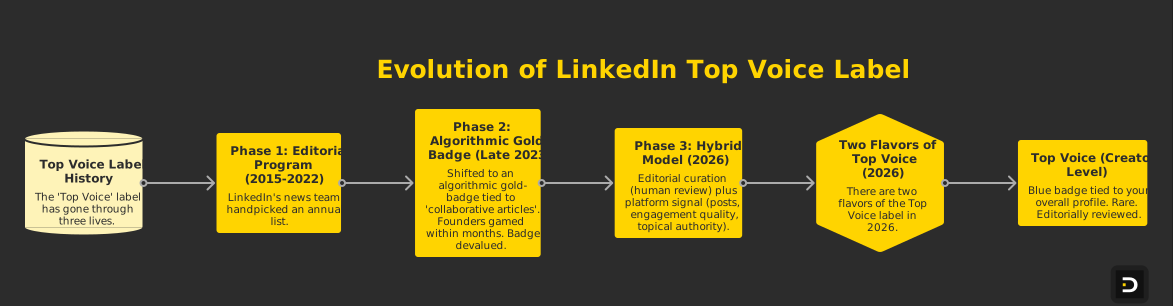
The "Top Voice" label has gone through three lives. From 2015 to 2022 it was an editorial program: LinkedIn's news team handpicked an annual list. In late 2023 it shifted to an algorithmic gold-badge tied to "collaborative articles," which founders gamed within months. The badge devalued. LinkedIn knew.
The version you're chasing in 2026 is a hybrid: editorial curation (human review) plus platform signal (posts, engagement quality, topical authority). There are two flavors:
- Top Voice (creator level): blue badge tied to your overall profile. Rare. Editorially reviewed. Given to founders, journalists, and executives who consistently publish original thinking.
- Topic-level Top Voice: badge specific to a topic (cybersecurity, AI, leadership). More attainable. Awarded when you rank as a top contributor over a sustained period.
- Community Top Voice: the leftover gold badge from collaborative articles. Largely ignored by founders now. Don't optimize for this one.
When founders say "I want to be a LinkedIn Top Voice," they mean the blue creator-level badge. That's what this guide is about.
The Official Criteria LinkedIn Uses (and the Unofficial Signals)
LinkedIn doesn't publish a checklist. The moment they do, every growth hacker on the platform games it within a week.
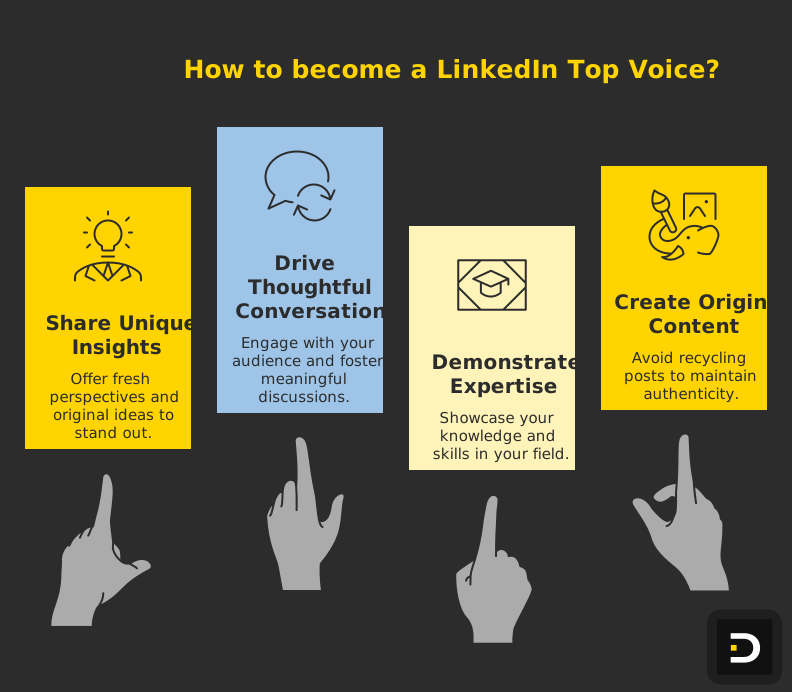
What LinkedIn does say publicly: Top Voices are selected because they "share unique insights, drive thoughtful conversations, and demonstrate expertise in their field." That's the line across their Top Voices page and editorial communications.
From watching the badge get awarded, here's the actual signal mix:
What LinkedIn weighs heavily:
- Originality of content. Recycled takes don't qualify. The editorial team can spot a thread-warmed-over post in seconds.
- Sustained cadence over 6 to 12 months. Not a viral month. A pattern.
- Engagement quality, not volume. 200 thoughtful comments from senior operators beats 5,000 likes from random accounts.
- Topic concentration. You need to be visibly "about" something specific.
- Citations off-platform. Are you being quoted, linked, or referenced in industry newsletters, podcasts, and articles?
- Profile completeness and seriousness. Real role, real company, real photo.
What LinkedIn doesn't seem to weigh much:
- Raw follower count past a threshold (usually 5,000 to 10,000).
- Post frequency past a baseline (3 to 5 substantive posts per week is plenty).
- Time of day or "best posting times."
- Use of carousels vs. text vs. video. Format doesn't matter. Quality does.
The unofficial signal that matters most: whether senior people in your industry would describe you as a "must follow" if asked. That's the bar. The badge approximates it.
The 4 Stages: From Random Poster to Top Voice
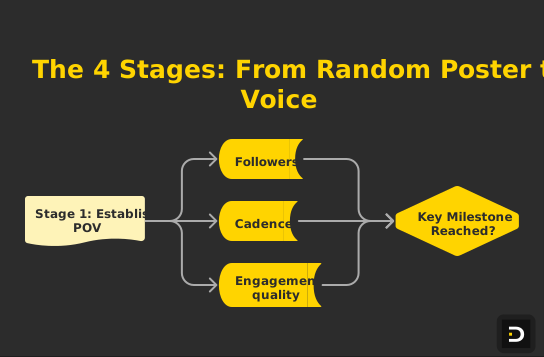
Almost every founder who gets the blue badge moves through the same four stages. They look different on the surface (a fintech founder's content is nothing like a security founder's), but the progression is identical.
Here's the milestone table to figure out where you are right now:
| Stage | Timeframe | Followers | Cadence | Engagement quality | Key milestone |
|---|---|---|---|---|---|
| 1. Establish POV | Months 1-3 | 500 to 1,500 | 2-3 posts/week | Mostly close network | A peer says "I always read your posts" |
| 2. Build cadence | Months 4-6 | 1,500 to 5,000 | 3-4 posts/week | Industry peers commenting | A post breaks 20K impressions organically |
| 3. Get cited | Months 7-12 | 5,000 to 15,000 | 3-5 posts/week | Senior strangers in your space | A newsletter, podcast, or article quotes you by name |
| 4. Top Voice candidate | Months 12-18 | 15,000+ | Steady, recognizable | Cross-industry, off-platform | Inbound: a journalist or LinkedIn editor reaches out |
The next four sections break down what each stage actually requires.
Stage 1: Establish a Recognizable POV (Months 1-3)
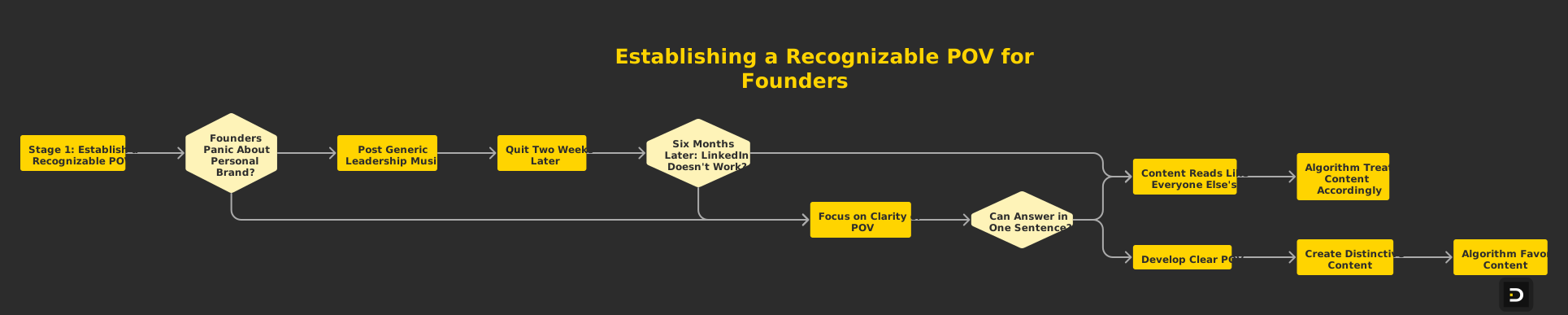
This is where 80% of founders fail before they start. They panic about what their "personal brand" should be, post a generic leadership musing that could've been written by any consultant on the platform, and quit two weeks later. Six months on they tell themselves LinkedIn doesn't work for technical founders.
The fix in stage 1 isn't volume. It's clarity of POV.
Answer this in one sentence: "What do you believe about your space that most people in it don't?" If you can't, your content will read like everyone else's and the algorithm will treat you accordingly.
This is where a real personal leadership brand statement matters. Not a tagline. An articulated position. For a security founder: "Most SOCs are buying tools to feel safe, not to be safe." For an AI infra founder: "GPU economics for the next two years will be decided by inference, not training."
Once you have that, every post either reinforces it, illustrates it with a story, or argues with a counter-position. Three months in, you'll hear "I always read your posts" from people you respect. That's the stage 1 milestone. Not follower count. Recognition.
Tactical guidance for months 1-3:
- 2 to 3 posts a week. Not daily. Daily burns out founders.
- Pick three sub-topics under your POV and rotate. For a security founder: technical insights, GTM observations, founder lessons.
- Don't engagement-farm. Don't ask "what do you think?" at the end of every post.
- Comment thoughtfully on 5 to 10 posts a week from people one tier above you.
Our executive thought leadership framework covers the operating cadence we use with clients.
Stage 2: Build Cadence and Engagement (Months 4-6)
The quitters have quit. Your POV is clear, at least to you, and you've started to notice patterns in what your audience reacts to.
The work here is to professionalize cadence without losing voice. Three to four posts a week, every week. No skipped weeks because you're traveling or closing a round. The point isn't the posts. The point is that you become the kind of person who shows up.
Engagement also shifts. In stage 1, comments came from cofounders, ex-colleagues, friends. In stage 2, you see CISOs commenting on a security founder's post, heads of platform on an infra founder's. This is the signal LinkedIn's algorithm tracks closely.
The milestone is a post that breaks 20,000 organic impressions. Not a viral hit. A real signal that your content is reaching beyond your network. When it happens, study it. Then write three more like it.
Two traps. First: chasing what worked. A hiring post breaks through, so you write five more on hiring, and two months later your feed reads like an HR consultant's. Stay anchored to your POV. Second: writing for the algorithm. Around month 5, you'll want to start every post with a one-line hook and add 11 line breaks before your first sentence. Resist. Founders who write like founders convert. Founders who write like LinkedIn coaches don't.
Stage 3: Get Cited (Months 7-12)
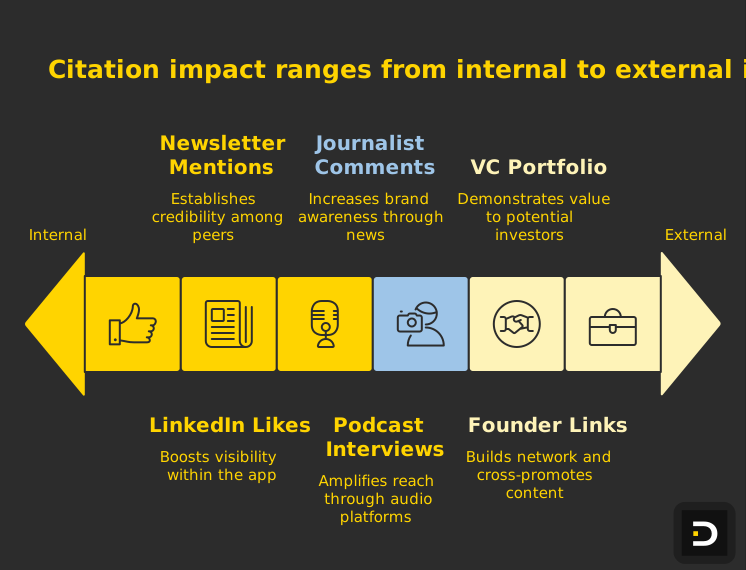
Stage 3 is where the curve goes vertical for some founders and flat for others. The split: whether your work starts to get cited off-platform.
Off-platform citation means an industry newsletter quotes you. A podcast invites you. A journalist DMs for a comment. Another founder links to one of your posts. A VC sends your post to their portfolio.
These citations are how LinkedIn calibrates that you're actually influential, not just popular on the app. They want Top Voices who are voices in their industry, not just on the platform.
The work is to make your content citable:
- Strong opinions stated cleanly. "Most cybersecurity ROI calculators are theater" is citable. "Some thoughts on ROI" is not.
- Original data or framing. If you have data from your company, customers, or industry, use it. Real numbers travel.
- Distinctive language. A named framework, a coined phrase. These are what newsletter writers reach for when crediting an idea.
- Shareability outside LinkedIn. Posts that work in screenshots, that survive being pasted into Slack.
This is when founders start producing what we call thought leadership content in the real sense: pieces that change how people in your space think about a problem. Not "10 lessons from my startup journey." Position pieces. Argument pieces.
The milestone is the first off-platform citation. The first time you see your name in someone else's newsletter or hear yourself quoted on a podcast, you're in the conversation.
Stage 4: Top Voice Candidate Signal (Months 12-18)
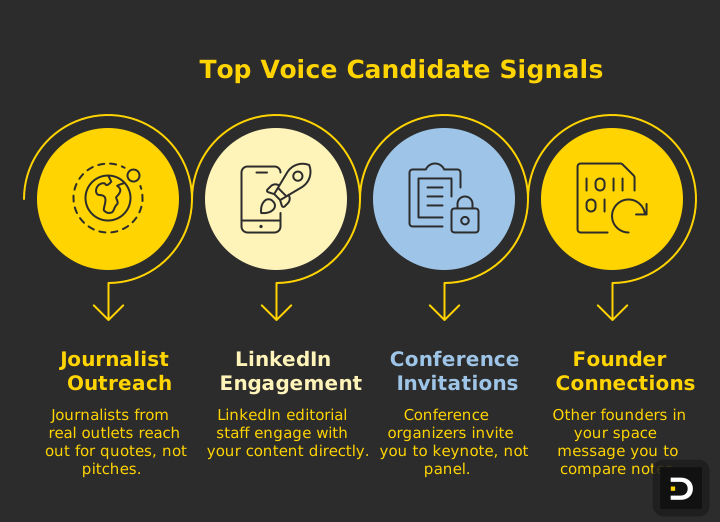
Stage 4 is mostly a waiting game. If you've done stages 1 through 3 properly, the signal compounds without you having to push it.
The signal you've crossed into Top Voice candidate territory is inbound:
- Journalists from real outlets reach out for quotes, not pitches.
- LinkedIn editorial staff engage with your content directly.
- Conference organizers invite you to keynote, not panel.
- Other founders in your space message you to compare notes.
The temptation here is to start optimizing for the badge directly. DM LinkedIn employees. Ask your network for nominations. Suddenly post about "LinkedIn culture" because that gets editorial attention. Don't. The fastest way to lose candidacy is to start posting like someone who wants a badge. The badge goes to people who'd be Top Voice candidates whether or not the badge existed.
Our piece on how to become a LinkedIn influencer as a founder covers this inflection point in detail.
What's NOT in the Criteria (Myths Debunked)

The Top Voice mythology is dense. Here's a comparison of what gets repeated vs. what actually drives the badge.
| Myth | What actually matters |
|---|---|
| You need to post every day. | 3-5 substantive posts a week is plenty. Daily often hurts quality. |
| You need to pay for LinkedIn Premium. | Premium has zero impact on Top Voice consideration. |
| You need to be active in the first hour after posting. | Engagement quality matters more than speed. Real comments from real operators count. |
| You need 100,000+ followers. | Many Top Voices are in the 15K-50K range. Concentration beats size. |
| You need to get into a "pod" or engagement group. | Pods are detectable, hurt reach, and disqualify you from editorial consideration. |
| You need to write about LinkedIn itself. | Top Voices write about their industry, not the platform. |
| You need to use video. | Format is neutral. The best founder Top Voices are mostly text. |
| You need to apply or pitch yourself. | There's no application. Selection is observational. |
The biggest myth: the badge is achievable in 90 days with the right "playbook." It's not. It's achievable in 12 to 18 months with the right substance. Anyone selling you faster is selling you a worse outcome.
Topic-Level Top Voice vs Creator-Level Top Voice: Which to Pursue
If you're impatient, the topic-level Top Voice badge is the right place to look. Faster, more attainable, arguably more useful for business outcomes.
Topic-level badges are awarded for sustained contribution on a defined topic like "Cybersecurity," "Artificial Intelligence," or "Product Management." LinkedIn rotates them. You can hold one for a quarter, lose it, earn it back.
The path:
- Concentrate 60%+ of content on that specific topic. Not adjacent. The topic.
- Engage substantively with other top contributors in it.
- Drive measurable engagement from accounts already associated with the topic.
- Sustain for 3 to 6 months.
For most founders, topic-level is the right interim goal. It signals authority to your buyer (CISO, CTO, head of platform) and to investors. The blue creator-level badge is a bigger lift and frankly more useful for journalists and conference programmers than for direct revenue.
Aim for topic-level in months 6 to 12. If creator-level happens, it happens.
Real Founder Top Voice Case Study with Monthly Metrics
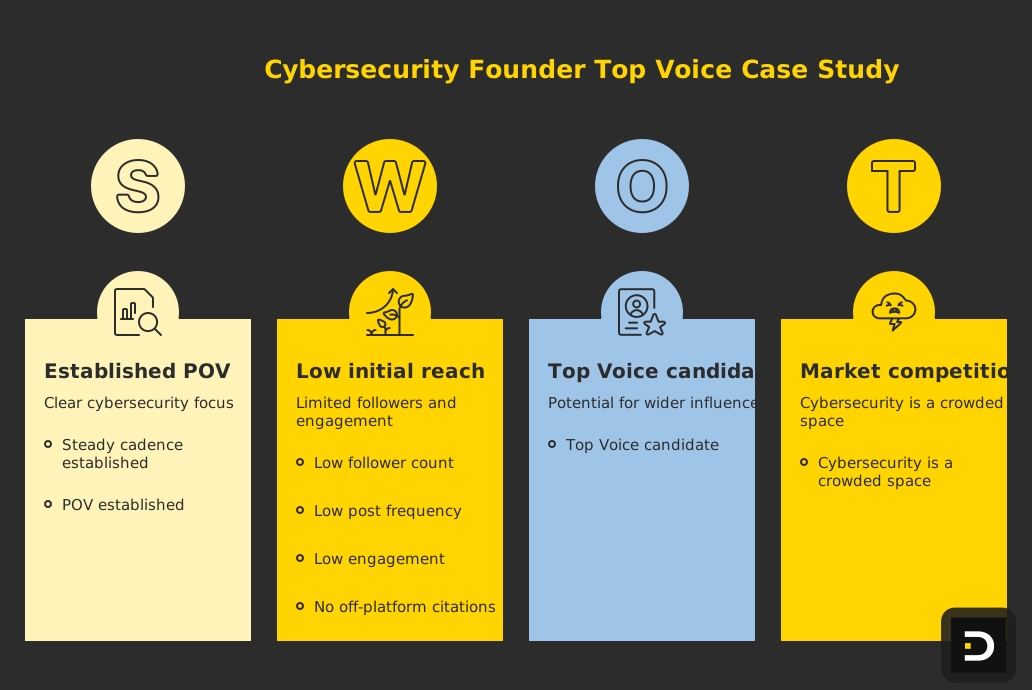
Here's the trajectory of a deep-tech founder we worked with (anonymized, with permission). She runs a Series A cybersecurity company and crossed into Top Voice candidate territory at month 14.
Starting point (Month 0):
- Followers: 2,300 (mostly ex-colleagues and friends)
- Posts in prior 12 months: 14
- Average engagement: 35 reactions, 4 comments
- Off-platform citations: 0
Month 3:
- Followers: 3,100
- Posts: 10 in the quarter (steady cadence established)
- Average engagement: 85 reactions, 12 comments
- POV established: "Most cybersecurity buying is theater. Here's what actually changes risk."
Month 6:
- Followers: 5,800
- First breakthrough post: 41,000 impressions, 480 reactions, 67 comments
- First comments from named CISOs at Fortune 500s
- Off-platform citations: 1 (a regional security newsletter)
Month 9:
- Followers: 9,400
- Cadence: 4 posts/week, consistently
- Off-platform citations: 5 (newsletters, one podcast appearance)
- First inbound from a tier-1 trade publication
Month 12:
- Followers: 14,600
- Topic-level Top Voice badge awarded (Cybersecurity)
- Off-platform citations: 12
- Speaking inbound: 4 conferences
Month 14:
- Followers: 18,200
- Inbound from LinkedIn editorial for a feature in an industry roundup
- Off-platform citations: 21
- Blue Top Voice badge awarded
Notice what's not in this story: a viral moment, a gimmick, a platform hack. Steep but smooth. Cadence stayed near-constant. Followers grew because the content earned them. Citations compounded. This is what the real path looks like.
Why Most Founders Won't Qualify (and Why That's Fine)
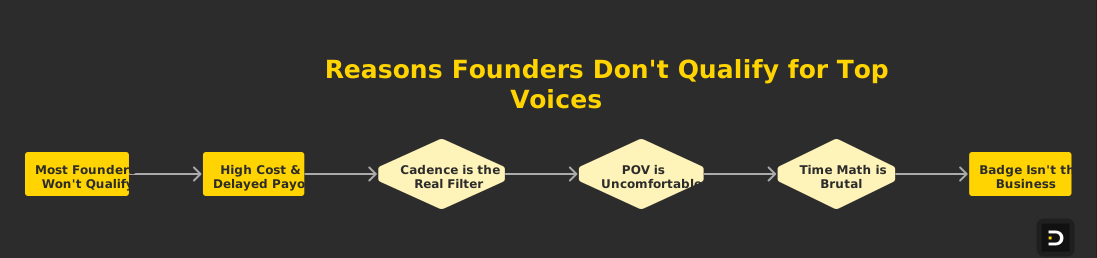
Most founders who set out to become Top Voices won't make it. Not for lack of talent. The cost is higher than they expect and the payoff lands later than they want.
- Cadence is the real filter. 70% of founders quit between month 2 and 4 because the early signal is thin and the work is real.
- POV is uncomfortable. Strong public opinions create friction. Founders who can't tolerate that revert to safe content and stall.
- Time math is brutal. 4-6 hours a week, every week, for 12+ months. Hard to sustain alongside fundraising and shipping.
- The badge isn't the business. Many founders realize at month 9 they're already getting the inbound, deal flow, and recruiting they wanted. They opt out of stage 4.
The Top Voice badge is a status marker, not a business metric. Plenty of successful deep-tech founders have 8,000 to 20,000 followers, no badge, and a fully booked calendar. They have real influence and don't need platform validation.
If you want the badge, pursue it honestly. If you want the outcomes it represents (authority, inbound, deal flow), you can get most of that without ever crossing the line.
Your Next Move
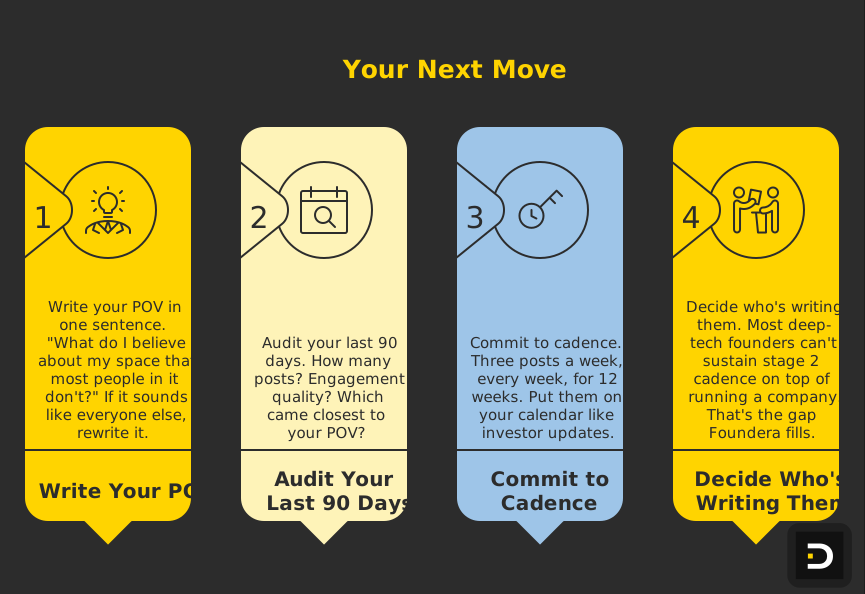
If you're still in, here's what to do this week.
First, write your POV in one sentence. "What do I believe about my space that most people in it don't?" If it sounds like everyone else, rewrite it.
Second, audit your last 90 days. How many posts? Engagement quality? Which came closest to your POV?
Third, commit to cadence. Three posts a week, every week, for 12 weeks. Put them on your calendar like investor updates.
Fourth, decide who's writing them. Most deep-tech founders can't sustain stage 2 cadence on top of running a company. That's the gap Foundera fills. We work with technical founders to build a sustainable cadence in their actual voice, drawn from their actual thinking, so content stays unmistakably theirs while you stay focused on building.
Our breakdown of the best personal branding tool for founders walks through the operating system we use with clients. For LinkedIn's own perspective, LinkedIn's Editorial standards and the LinkedIn for Creators resources are the closest thing to a primary source.
The badge is real. The path is honest. 12 to 18 months. If you can sustain it, the compounding is enormous. If you can't, get help from people who do this for a living. Either way, stop reading the hack articles.
FAQ
How long does it take to become a LinkedIn Top Voice as a founder?
For topic-level, 6 to 12 months of consistent posting in a single topic is realistic. For the blue creator-level badge, plan on 12 to 18 months minimum. Anyone selling faster is either lucky, lying, or counting the gold "Community Top Voice" badge most operators ignore in 2026.
Do you have to apply for Top Voice status?
No. There is no application. Selection is observational, based on a mix of platform signals and editorial review. You can't pitch yourself in. You can occasionally get nominated by someone with editorial access, but that's not a reliable path. The reliable path is to do the work and let the signal accumulate.
Does follower count matter for becoming a Top Voice?
Less than people think. Many creator-level Top Voices sit in the 15,000 to 50,000 follower range, not the millions. What matters more is engagement quality, off-platform citations, and concentration in a topic. A founder with 12,000 followers who's quoted in industry newsletters monthly is a stronger candidate than one with 80,000 generic followers.
Can I become a Top Voice if I post mostly about technical topics?
Yes. In fact, technical concentration is an advantage. Topic-level Top Voices in areas like cybersecurity, AI, and engineering leadership are often more technical than the average LinkedIn creator. The risk with technical content is making it inaccessible. Write for senior operators in your space, not for the broadest possible audience.
What's the biggest mistake founders make trying to become Top Voices?
Writing like a LinkedIn creator instead of like a founder. Around month 4 or 5, founders get tempted by the platform's stylistic tics (one-line hooks, excessive line breaks, "agree?" questions). It usually hurts. Write like yourself.
Is the LinkedIn Top Voice badge worth pursuing for a deep-tech founder?
It depends on your goals. If you want inbound deal flow, recruiting leverage, and direct sales conversations, you'll get most of that benefit at stage 3 (around 5,000 to 15,000 followers) without the badge. If you want journalist inbound, conference keynote inbound, and industry-level authority, the badge accelerates it. For most deep-tech founders, the honest answer is that stage 3 is the high-ROI plateau and stage 4 is optional.
The TL;DR
Quick answer
LinkedIn Top Voice status is a lagging indicator that takes 12-18 months. Four stages: establish POV (months 1-3), build cadence (4-6), get cited off-platform (7-12), Top Voice candidate signal (12-18). Topic-level badges (Cybersecurity, AI) are more attainable and arguably more useful for business outcomes than the blue creator-level badge.
Key takeaways
- Three flavors: blue creator-level, topic-level, and the leftover gold badge from collaborative articles.
- Real signal mix: originality, sustained cadence, engagement quality, topic concentration, off-platform citations.
- Many Top Voices sit in the 15K-50K follower range. Concentration beats size.
- Engagement pods are detectable, hurt reach, and disqualify you from editorial review.
- Topic-level in months 6-12 is the high-ROI target. Creator-level is optional.