Table of Contents
- What Is Founder-Led LinkedIn Content?
- Why Tech Founders Are Investing in Founder-Led Content
- How Founder-Led Content Works (Step-by-Step)
- What Makes a Great Content Partner for Founders
- Voice Matching: Keeping It Authentic
- Pricing Ranges and What You Get at Each Tier
- Questions to Ask Before Hiring a Content Partner
- Common Mistakes Founders Make with Founder-Led Content
- The ROI of Founder-Led LinkedIn: What to Expect
- How to Get Started Without Breaking Your Focus
- FAQ
What Is Founder-Led LinkedIn Content?
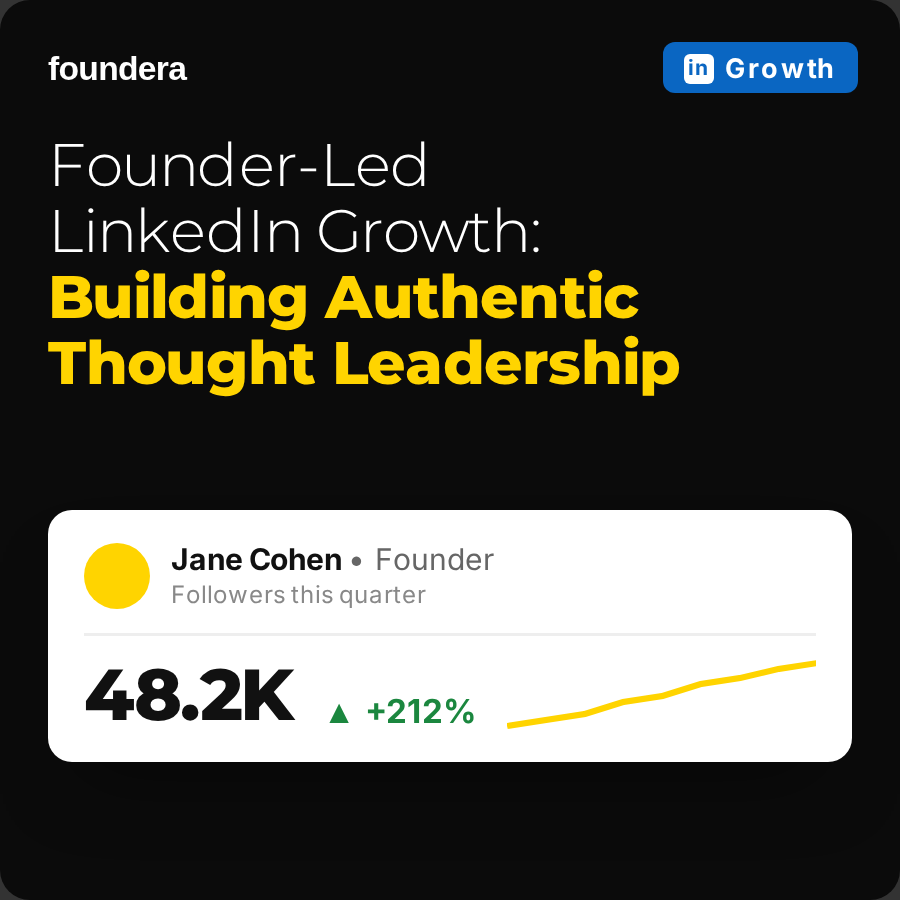
Founder-led LinkedIn content is a strategic approach where a professional content partner researches, drafts, and manages content on a founder’s behalf—typically 2–5 posts per week—while maintaining the founder’s authentic voice, perspective, and leadership position. The founder approves each post before publication, ensuring accuracy and alignment with personal brand strategy. According to the LinkedIn B2B Institute, founder profiles generate 315% more engagement than company pages, making founder-led content a practical way for busy founders to maintain a consistent presence without sacrificing execution-focused time.
Founder-led content differs fundamentally from templated content or AI-generated posts. A skilled content partner interviews the founder, absorbs their communication style, embeds proprietary insights from their business, and creates posts that sound native to that person’s voice—not like they were written by committee or algorithm.
For tech founders in cybersecurity, AI, DevOps, and cloud infrastructure, founder-led content unlocks a critical lever: thought leadership at scale, without the daily writing burden.
Why Tech Founders Are Investing in Founder-Led Content
The Time-to-Value Problem
Most founders know LinkedIn matters. They see competitors posting daily. They understand that 82% of B2B buyers are influenced by leadership team expertise (LinkedIn B2B Institute). Yet they don’t post—not because they don’t want to, but because there are only 24 hours in a day, and 23 of them are spent on product, sales, and investor relations.
Founder-led content solves this math problem. Instead of a founder spending 3–5 hours per week writing, editing, and scheduling, they spend 30 minutes reviewing and approving drafts. The leverage is substantial.
The Engagement Multiplier
A consistent posting schedule compounds engagement. Founder profiles that post 5x per week see approximately 8X pipeline impact compared to sporadic posting. This isn’t coincidence—it’s algorithmic. LinkedIn’s feed prioritizes accounts with consistent engagement patterns. A founder who disappears for two weeks and then posts loses momentum; one who posts regularly captures attention.
The Credibility Shortcut
For a founder launching a deep-tech company—whether in cybersecurity, AI, or DevOps—the LinkedIn profile is the credibility beacon. Investors, customers, and talent researchers check it. A polished, active, insight-rich profile signals seriousness. Founder-led content ensures that signal stays live, even during product sprints or fundraising cycles.
The Strategic Delegation Model
Hiring a content partner feels like outsourcing. In reality, it’s strategic delegation. A founder who delegates content creation is doing exactly what good leaders do: identifying a high-leverage task, finding an expert, and focusing their own energy on what only they can do.
How Founder-Led Content Works (Step-by-Step)
Phase 1: Discovery & Voice Capture (Weeks 1–2)
The content partner conducts 2–3 interviews with the founder, each 30–60 minutes. The goal isn’t to extract a speech; it’s to absorb perspective (how does the founder see their market?), vocabulary (what words and phrases do they naturally use?), stories (what do they come back to repeatedly?), opinions (where do they disagree with the mainstream?), and rhythm (short, staccato sentences or longer, meandering thoughts?).
The partner also reviews the founder’s past content (emails, tweets, talks, interviews) to identify patterns and tonality.
Output: A voice guide document (1–2 pages) that becomes the reference for all future posts.
Phase 2: Content Strategy & Pillar Development (Weeks 2–3)
The content partner and founder co-create a content strategy that covers pillar topics (e.g., for an AI founder: LLM safety, RAG patterns, model optimization), content mix (65% educational authority, 25% personal narrative, 10% product/ask), editorial calendar (quarterly overview of planned topics, tied to product launches, industry events, or seasonal themes), and posting cadence (typically 3–5x per week for optimal engagement).
Output: A 90-day content calendar and pillar framework.
Phase 3: Weekly Drafting & Approval (Ongoing)
Each week, the content partner submits 3–5 draft posts (typically on Monday or Tuesday). The drafts are written in the founder’s voice, backed by specific data or real examples from the founder’s business, formatted for LinkedIn (short paragraphs, line breaks, 1–2 CTA lines), and tagged with timing suggestions.
The founder reviews and approves within 24–48 hours. Changes are tracked; the partner adjusts and re-submits if needed. Once approved, posts are scheduled and published.
Output: 12–20 published posts per month, typically scheduled across the week.
Phase 4: Performance Review & Iteration (Monthly)
The content partner tracks metrics: engagement rate, comment sentiment, click-through rates, profile views. Each month, the partner and founder review performance and adjust: are certain topics resonating more than others? Are CTA lines driving action? Should the posting frequency increase or decrease? What questions are followers asking in comments?
This feedback loop ensures the strategy stays sharp and responsive.
What Makes a Great Content Partner for Founders
A great founder-focused content partner reads everything the founder has written—past emails, LinkedIn posts, podcast transcripts, interview clips. They ask questions, not assumptions—rather than guessing the founder’s opinion on a topic, they ask and listen. They write tight, readable copy because long paragraphs don’t perform on LinkedIn. They stay current on industry news—for a cybersecurity founder, they track breach news, new frameworks, emerging threats. They know how to turn shop talk into audience-relevant insights.
The difference vs. a generic copywriter: domain knowledge (deep expertise in founder-led positioning vs. general business language), industry specifics (knows cybersecurity, AI, DevOps natively vs. researches on demand), voice matching (makes you sound like you vs. “professional”), engagement mechanics (understands LinkedIn’s algorithm vs. writes long-form copy), founder psychology (understands founder pressures vs. treats founder like client), speed of onboarding (1–2 weeks vs. 3–4 weeks).
Voice Matching: Keeping It Authentic
The biggest concern founders raise: Will it sound like me?
Done well, founder-led content is invisible. Readers don’t detect it because the partner has absorbed the founder’s patterns and beliefs so thoroughly that the writing feels native.
The content partner catalogs signature phrases (e.g., “Let me be clear,” “Here’s the thing,” “What I see in the field”), sentence rhythm (Do they use periods or em dashes? Do they love lists or prefer narrative?), favorite examples (Do they reference their own code? Customer conversations? Market observations?), and emotional tone (Are they optimistic or skeptical? Formal or irreverent?).
The first 5–10 posts are the audition. The founder reads them and flags anything that doesn’t sound right. The partner adjusts. By post 15, the voice locks in.
As the founder’s thinking evolves, so does the content voice. If a founder shifts from one strategic perspective to another, the partner adapts.
The authenticity guarantee: nothing gets published that the founder hasn’t approved. This is non-negotiable. The founder’s signature is on the post; they own it entirely.
Pricing Ranges and What You Get at Each Tier
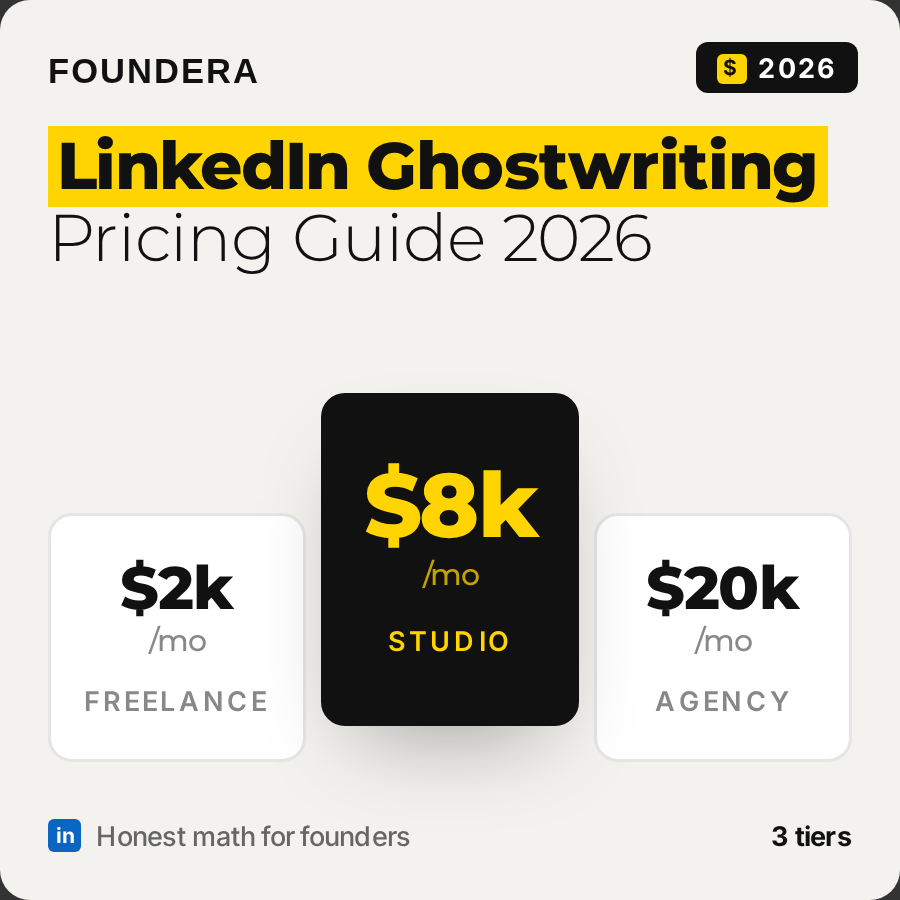
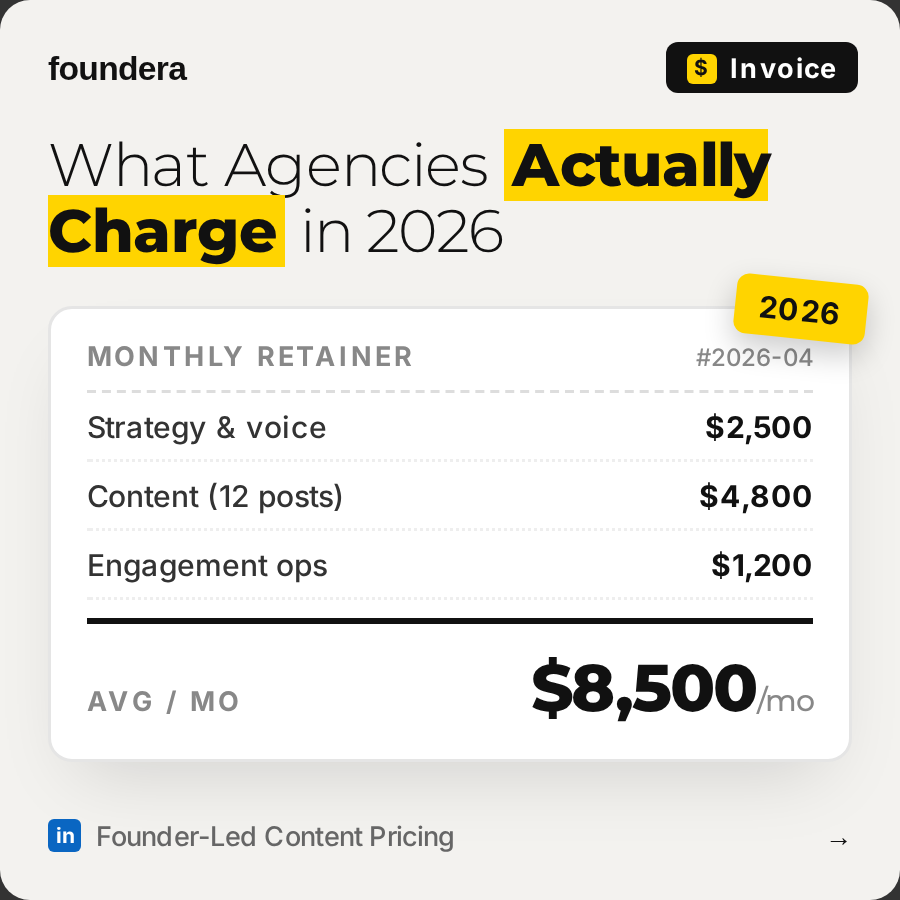
Founder-led content pricing varies widely based on scope, frequency, and experience level.
Starter ($1,000–$2,000/mo, 2–3x per week): 8–12 posts/month, basic approval process, no strategy. Best for founders testing the channel.
Growth ($3,000–$5,000/mo, 3–5x per week): 12–20 posts/month, monthly strategy review, content calendar, voice capture. Best for early-stage founders with growth goals.
Scale ($6,000–$10,000/mo, 5x per week): 20+ posts/month, real-time analytics, bi-weekly strategy calls, profile optimization. Best for founders building thought leadership at scale.
Premium ($10,000–$15,000+/mo, 5–7x per week): 25+ posts/month, strategy sprints, LinkedIn profile optimization, LinkedIn newsletter, custom content series. Best for founders raising capital or expanding to new markets.
What’s Hidden in “Low-Cost” Services
Agencies offering founder-led content for $200–$500/month typically deliver AI-generated or templated posts, no voice customization, high turnover, no strategy, just posting, and high risk of sounding generic. This is a false economy. A post that sounds like it was written by someone else doesn’t build credibility—it dilutes it.
What to Expect at Foundera
Foundera’s model (in the $5,000–$10,000 range) includes a dedicated content partner (no rotation), weekly 1:1 approval calls, monthly strategy reviews with metrics, profile optimization and headline testing, real performance tracking (engagement, profile views, DM inquiries), and unlimited revisions during approval phase.
Questions to Ask Before Hiring a Content Partner
1. Can You Show Examples of Work That Sound Authentically Different? A great content partner’s portfolio shows different voices. If all posts sound like they came from the same writer, they’re not doing voice matching well.
2. How Do You Handle Accuracy and Proprietary Information? Your content partner will learn sensitive details about your business: financial metrics, customer conversations, product roadmap. How do they protect that?
3. What Happens if You Don’t Like a Post? Unlimited approval drafts? A set number of revisions? What’s the escalation if you disagree on tone or message?
4. How Do You Measure Success? Founder-led content should drive tangible outcomes: more profile views, more inbound messages, more sales conversations. How does your partner track this?
5. What Happens if We Change Direction? Strategy isn’t static. What if you pivot markets, launch a new product, or shift your positioning?
6. Do You Work with Founders in My Industry? A content partner who understands DevOps is worth more to a DevOps founder than a generalist. Industry context matters.
7. What’s Your Process for Staying Current? The cloud and security landscape moves fast. Your partner needs to track new frameworks, breaches, model releases, regulatory changes.
Common Mistakes Founders Make with Founder-Led Content
Mistake 1: Treating It Like a Commodity. “I’ll just hire the cheapest option.” This backfires. A poorly matched content partner produces generic posts that tank engagement and erode credibility. Fix: Invest in quality. A $5,000/month partner is worth 5X a $1,000/month one.
Mistake 2: Not Investing Time in Voice Capture. Founder-led content requires founder input upfront. If you rush the discovery phase or give vague feedback, the writer can’t nail your voice. Fix: Block 2–3 hours for initial interviews. Provide specific feedback on early drafts.
Mistake 3: Approving Posts You Don’t Believe In. Approval isn’t rubber-stamp. If a post doesn’t feel right, say so. The partner adjusts. Fix: Be opinionated during approval.
Mistake 4: Setting It and Forgetting It. Founder-led content isn’t a “set and forget” service. It requires monthly strategy reviews, feedback, and adaptation. Fix: Schedule 30-minute monthly calls.
Mistake 5: Asking Your Partner to Handle Engagement. Some founders hire a content partner, then go silent in the comments. This kills authenticity. Fix: You respond to comments. Your partner creates the posts; you own the relationships.
Mistake 6: Not Leveraging Off-Platform Amplification. A post published to 10,000 followers is good. A post published and shared in your Slack, email, and investor updates is great. Fix: Repurpose your posts.
Mistake 7: Ignoring the Metrics. Your content partner can track engagement, but you need to care about it. Fix: Look at the data. Adjust strategy based on what performs.
The ROI of Founder-Led LinkedIn: What to Expect
Pipeline Impact
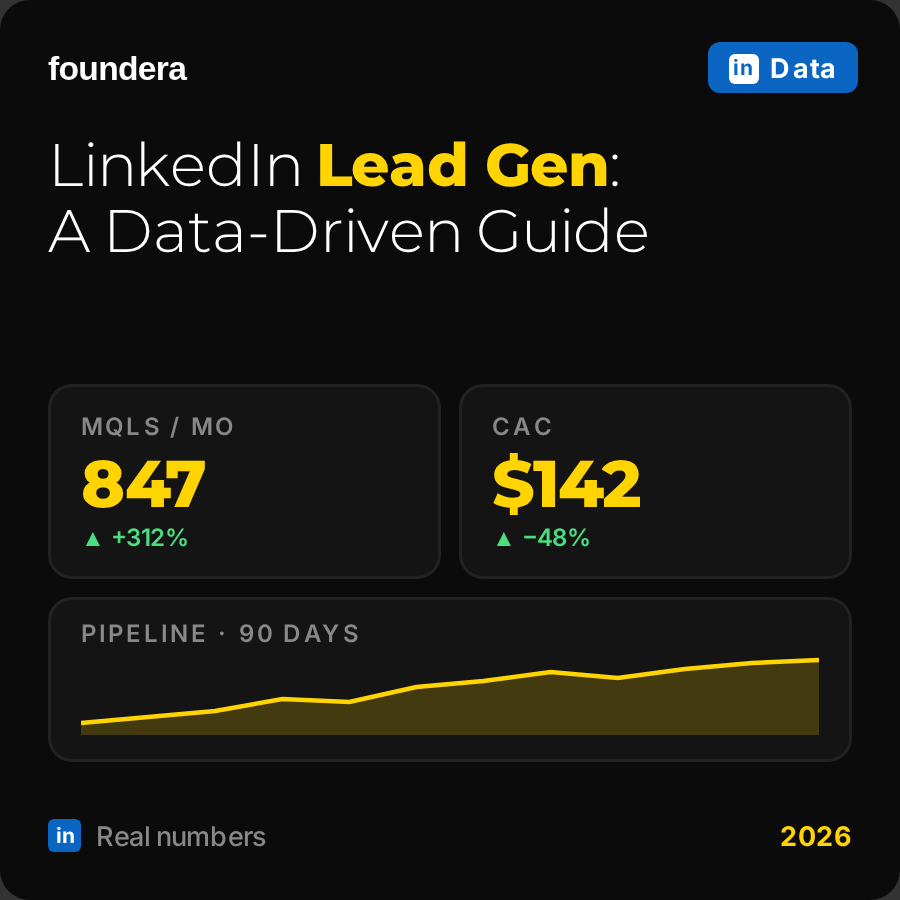
According to Foundera’s client data (2025), founders who maintain consistent LinkedIn presence with co-created content support see 150% increase in profile views (within 3 months), 95–150% increase in engagement (comments, shares, meaningful interactions), 40–60% increase in qualified inbound messages (from investors, customers, and talent), and 30% reduction in sales cycle length (prospects come warm because they’ve been following the founder’s thought leadership).
These aren’t guaranteed—they depend on strategy, consistency, and market conditions. But they’re directional.
Competitive Advantage
In deep-tech markets (cybersecurity, AI, DevOps), the founder’s LinkedIn profile is a hiring and credibility filter. A strong profile makes top talent more likely to apply, makes investors more confident before first calls, makes customers more willing to take meetings, and attracts speaking opportunities and partnerships.
Time Value
A content partnership costs $3,000–$10,000/month. A founder’s time is worth far more. If founder-led content saves 5 hours per week ($500–$1,000 in founder time), it pays for itself immediately. Everything else is upside.
How to Get Started Without Breaking Your Focus
Step 1: Audit Your Current LinkedIn Presence. Before engaging a partner, understand what you’re working with: profile strength (headline, summary, profile picture quality), current engagement (what posts perform, what’s falling flat), content gaps (topics you should be covering but aren’t).
Step 2: Define Your Content Pillars. What should you be known for? For a cybersecurity founder: supply chain attacks, threat landscape shifts, detection strategies. For an AI founder: model architecture, training efficiency, inference optimization. Spend an hour mapping 5–7 pillar topics.
Step 3: Hire and Onboard. Allow 2–3 weeks for voice matching and discovery. This is non-negotiable.
Step 4: Establish a Workflow. Content partner submits drafts by Tuesday. You review and approve by Wednesday. Posts scheduled for Thursday–Monday publication. Monthly strategy call on the first Friday.
Step 5: Show Up in Comments. Content partner handles publishing. You handle relationships. Reply to comments, ask follow-up questions, engage thoughtfully.
FAQ
Q: Will people know my posts are co-created? Not if it’s done well. Founder-led content is invisible when the partner matches your voice accurately.
Q: What if I change my mind about a post after it’s published? You can delete it from LinkedIn. Most content partnerships include a window (24–48 hours) for unpublished revisions.
Q: How much time do I need to invest? Realistically, 30 minutes per week for review and approval. That’s it. Monthly strategy reviews add another 30 minutes.
Q: Can my content partner handle LinkedIn articles too? Yes. Long-form articles (500–2,000 words) are an add-on service. They typically cost $500–$1,500 per piece.
Q: What if my partner and I disagree on strategy? This happens. The best agencies build in a “strategy sprint” process: you articulate your concern, discuss it together, and course-correct.
Q: Can I switch partners if I don’t like my current one? Yes, though there’s a ramp-up cost. The new partner needs 2–3 weeks to capture your voice. Most agencies offer a trial period (30–60 days).
About the Author
Ron Fybish is the founder of Foundera, a LinkedIn ghostwriting studio for deep-tech founders in cybersecurity, AI, DevOps, and cloud. He works with technical CEOs, CPOs, and CROs to translate their daily thinking into authentic LinkedIn content that builds pipeline, attracts talent, and compounds credibility — without taking up their calendar.
Related reading
These pieces dive deeper into the tactics behind founder-led LinkedIn growth in 2026:
- Founder-Led Marketing on LinkedIn (2026) — the B2B growth playbook turning founder content into pipeline
- LinkedIn Engagement Pods vs. Organic Growth — what actually works for sustainable reach
- How to Build Your Personal Brand on LinkedIn — the 2026 founder branding guide
- 7 Reasons Startup Founders Struggle on LinkedIn — the failure modes and how to fix each one
- LinkedIn Thought Leadership for Founders (2026) — 50+ examples plus the underlying frameworks