Picking a LinkedIn ghostwriting agency is one of the highest-leverage and highest-risk decisions a founder makes in 2026. Get it right and your LinkedIn becomes a competitive advantage that compounds. Get it wrong and you spend $50K a year on content that sounds like a chatbot wrote it and damages your credibility every week.
The bad news: most LinkedIn ghostwriting agencies in 2026 are content factories that produce interchangeable output across dozens of clients. The good news: you can spot them in 20 minutes with the right vetting framework.
This is the exact 9-question framework we share with founders evaluating agencies (including us). It's built from working with 50+ tech CEOs and watching what separates the agencies that work from the ones that don't.
What a LinkedIn ghostwriting agency should and should not do
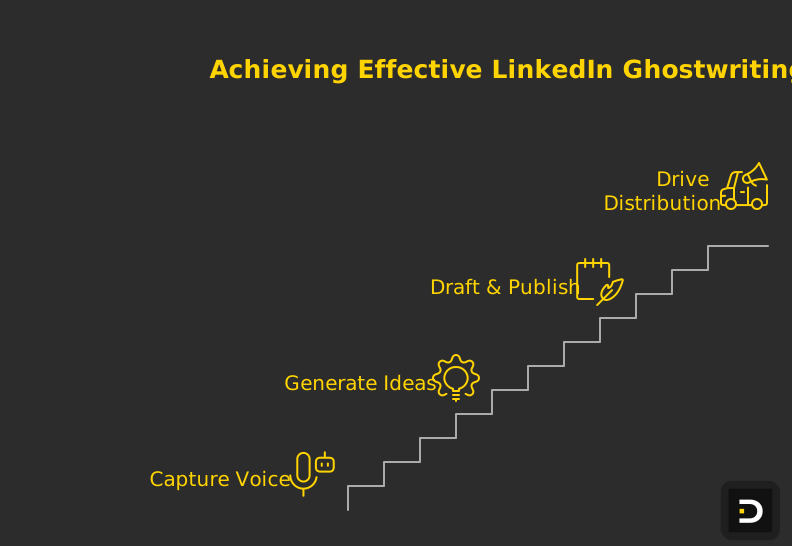
Before you vet anyone, lock down what you actually want. Real LinkedIn ghostwriting agencies do four things:
- Capture your voice in a way that sounds like you, not like them.
- Generate ideas from your daily work, conversations, and POV.
- Draft, format, and publish posts on a consistent cadence.
- Drive distribution so the posts actually get seen.
What they should not do:
- Auto-generate generic AI content with your name on it.
- Recycle the same hooks across all their clients.
- Send cold DMs from your account without explicit approval.
- Promise "guaranteed virality" or "10x reach in 30 days."
If a provider pitches the should-not list, walk away.
The 9-question vetting framework
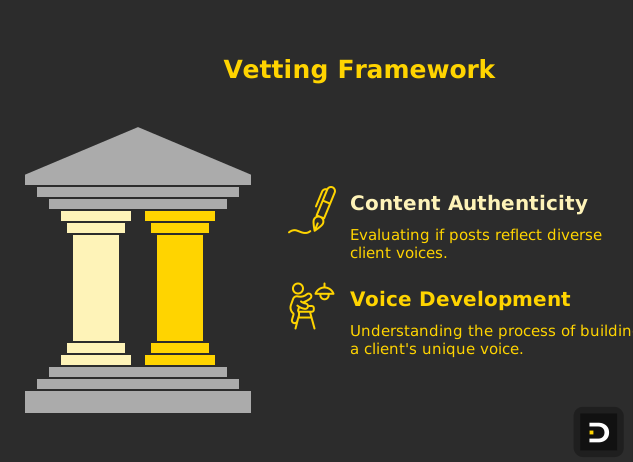
Run every agency through these. Time investment: 20 minutes per agency. ROI: avoiding a $50K mistake.
Question 1: Show me five posts you wrote for five different clients in my category
The agency should pull up examples instantly. The key test: do the five posts sound like five different people, or do they all share the same hooks, structure, and rhythm? If posts from different clients sound like the same author wrote them, they did. Walk away.
Question 2: How do you build voice for a new client?
The right answer involves a real discovery process: voice interview, sample collection (the founder's existing writing, emails, talks), a voice document, and a feedback loop. The wrong answer is "we have a great content team that learns fast." Vague process means generic output.
Question 3: Who actually writes the posts?
Real writers, not just AI plus an editor. Ask for the actual writer's LinkedIn. Look at their background. A writer who has never sold to CISOs cannot write a cybersecurity CEO's voice no matter how good their prose is. Match the writer to your category or skip.
Question 4: How many active clients does each writer have?
Above six, quality drops. Above ten, the writer is shuffling templates. The right answer is 3-5 active accounts per writer, with each writer specializing in a vertical.
Question 5: What's your approach to AI in 2026?
You want to hear: "We use AI to speed up research and idea capture, but every post is drafted by a human writer and edited for the founder's voice." You don't want to hear: "Our AI generates posts in your voice from a brief prompt." LinkedIn's algorithm flags low-quality AI content. You don't want to be flagged.
Question 6: What's your engagement and amplification strategy?
Content alone doesn't rank. The agency should have a real plan for early engagement: an internal team that comments in the first hour, an amplification network of operators in your category, or a relationship system. If the answer is "we hope your network engages," they have no plan.
Question 7: How do you measure success?
Real metrics: profile views from ICP, inbound DMs from buyers, sales cycle compression, named-hire referrals citing your content. Vanity metrics: likes, follower count, impressions. If they only track vanity, they're optimizing for the wrong thing.
Question 8: What happens if I'm not happy?
The right answer: 30-day satisfaction period, clear off-ramp, all assets (voice profile, drafts, audience) stay yours. The wrong answer: 12-month contract, big termination fee, agency owns everything.
Question 9: Who are three founders you've worked with that I can talk to?
Three named references, ideally in your category. Then call them. Ask: did the agency capture your voice? Did the cadence hold? Was the engagement amplification real or theater? Would you renew?
Red flags that signal a content factory
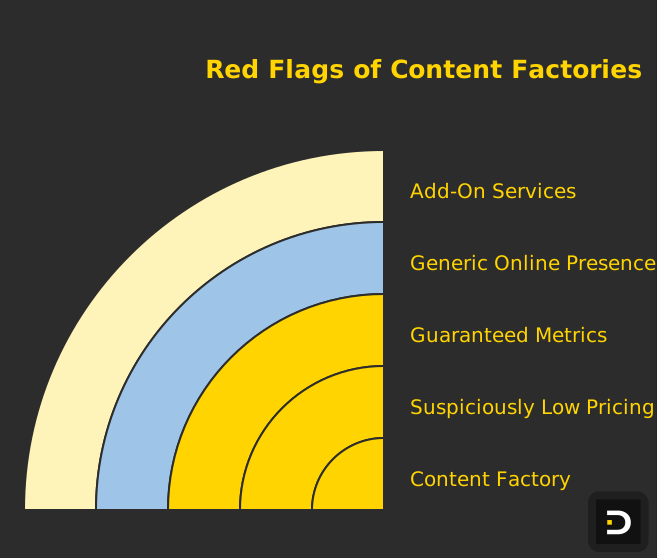
Any one of these is a warning. Two or more and you should walk.
- They show you a "before/after" deck with screenshots of follower count or vanity metrics
- They guarantee a specific number of likes, impressions, or followers
- The pricing is suspiciously low (under $1,500/month for founder-tier ghostwriting) - that's a content factory rate
- They mention "viral templates" or "proven hook formulas"
- Their own LinkedIn presence is generic or non-existent
- They won't show you the actual writer's portfolio
- They sell add-on services for engagement, DMs, follower growth at extra cost
- The sales process feels rushed with artificial urgency
- They name-drop big brands but can't show specific work
Real ghostwriting agencies move slowly through the sales process. They're vetting you as much as you're vetting them.
Voice tests every founder should run
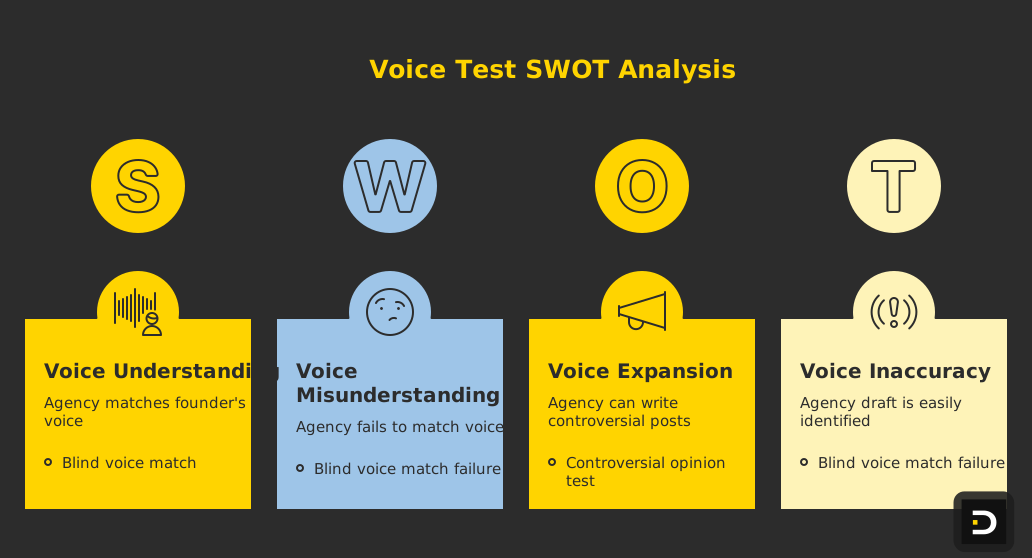
Two practical tests before signing:
Test 1: The blind voice match. Ask the agency to write a sample post in your voice. Then show that draft alongside three of your own posts to someone who knows you well (cofounder, head of marketing, spouse). Ask them to identify which one was you. If they can't tell the difference, the agency understands your voice. If they immediately pick out the agency draft, walk.
Test 2: The controversial opinion test. Ask the agency to write a post in your voice that takes a position you'd actually take but that some of your peers would disagree with. Generic agencies can't do this - they produce safe, vanilla content. Real ghostwriters who understand you can.
Pricing benchmarks for 2026
Honest market rates for founder-tier LinkedIn ghostwriting:
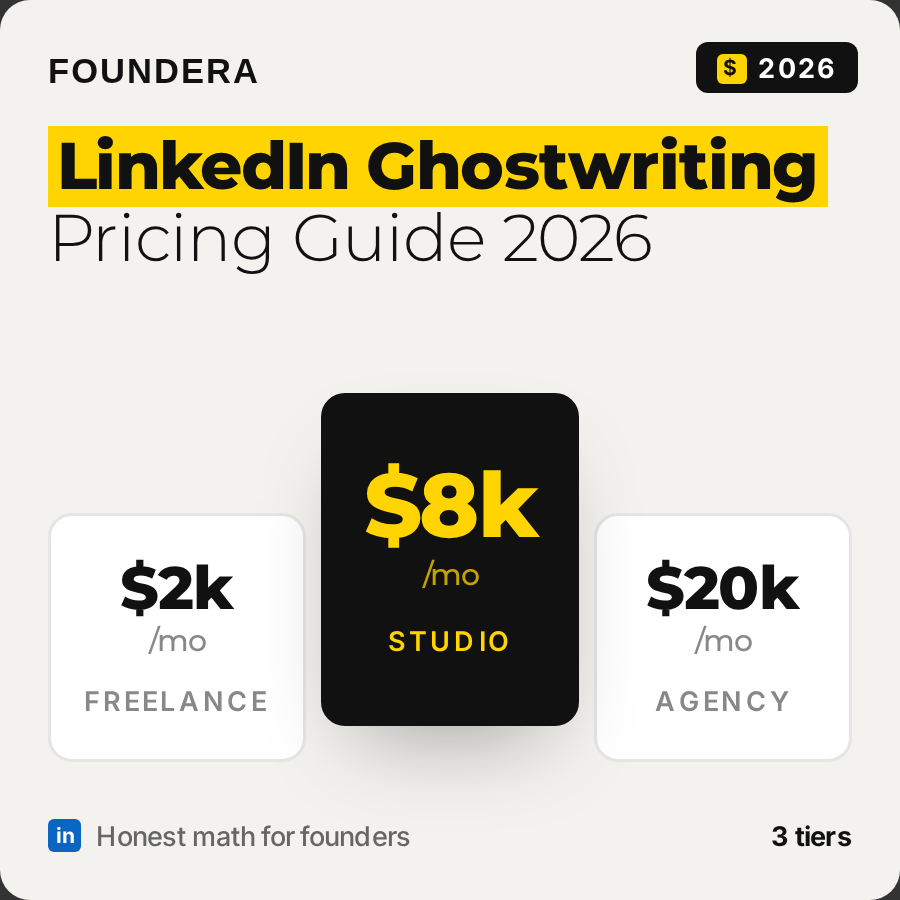
| Tier | Price/month | What's included |
|---|---|---|
| Budget | $1,000-2,500 | 4-8 posts/month, basic editing, no amplification |
| Mid-market | $2,500-4,500 | 8-12 posts/month, voice profile, light engagement |
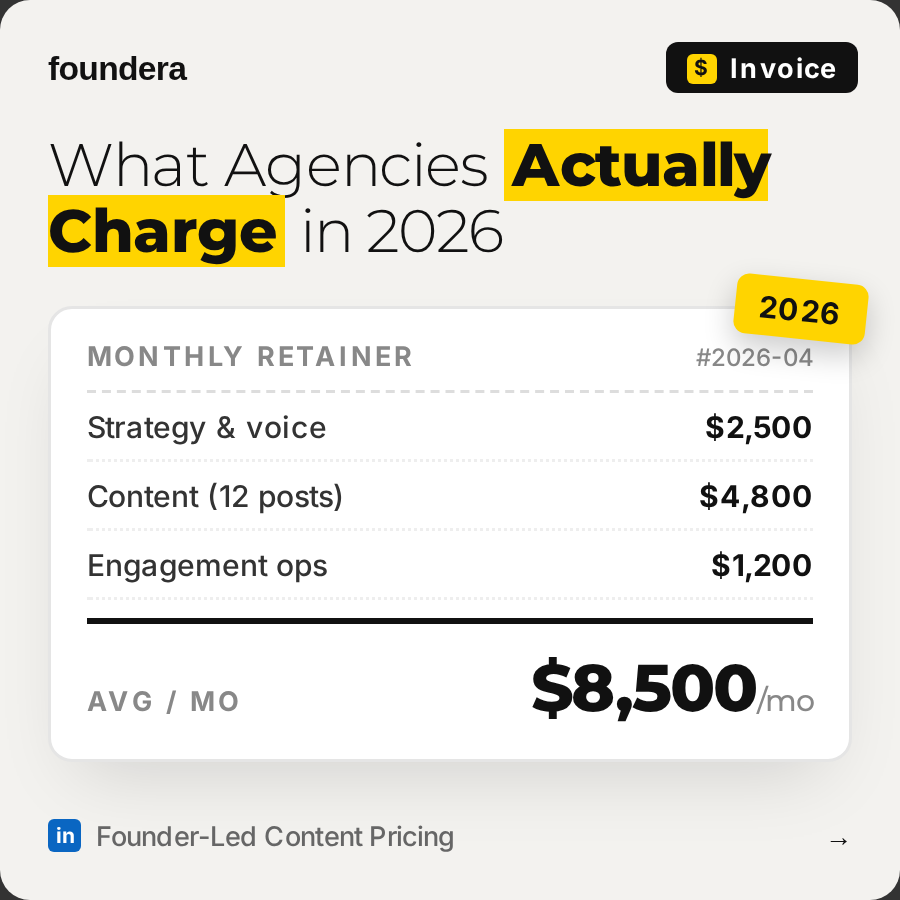
| Premium founder-tier | $4,000-8,000 | 8-12 posts/month, deep voice work, amplification network, weekly strategy |
| White-glove | $8,000-15,000 | Full content engine, multi-channel, executive-level account management |
For tech CEOs raising rounds or driving enterprise pipeline, premium tier is usually the right answer. The cheaper tiers don't deliver the voice depth that protects the founder's credibility.
Contract terms that matter
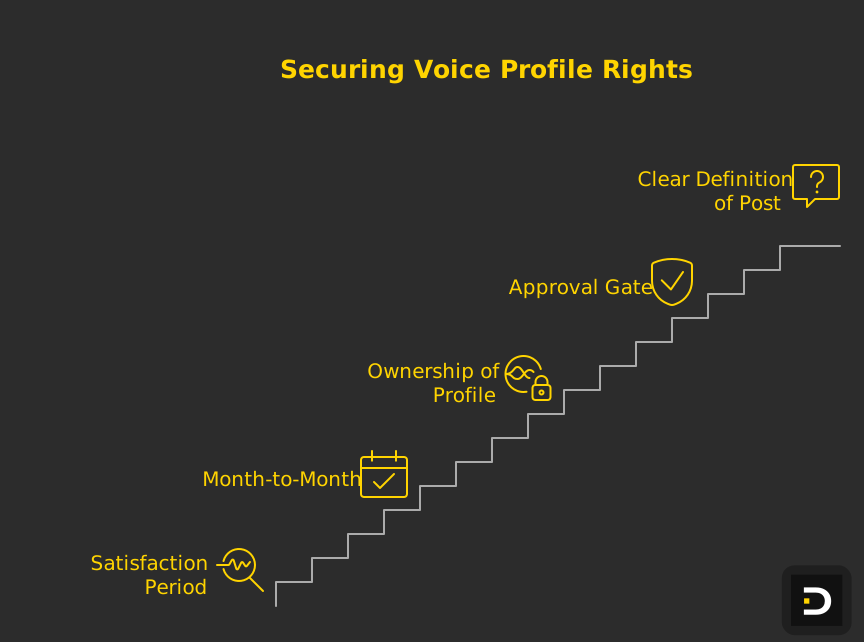
Five clauses to negotiate or insist on:
- 30-60 day satisfaction period - full refund if voice doesn't match
- Month-to-month after the initial term - no 12-month lock-in
- You own the voice profile and all drafts - they don't walk away with your IP
- Approval gate on every post - nothing publishes without your or your designee's sign-off
- Clear definition of "post" - what counts, what doesn't, what about reshares and comments
Push back on agencies that resist these. The ones with confidence in their work agree to all five.
Frequently asked questions
What's the difference between a LinkedIn ghostwriter and a LinkedIn ghostwriting agency?
A ghostwriter is one person handling 3-5 clients. An agency is a team handling 20-100+ clients with writers, editors, and account managers. Agencies offer more scale; solo ghostwriters often offer deeper voice work. Match to your needs.
How long until a LinkedIn ghostwriting agency shows results?
Voice match should be visible in week 2. Cadence stable by month 1. Engagement compounding by month 3. Real business outcomes (inbound DMs, deal acceleration) by month 4-6.
Should I hire one writer or an agency?
For most founders, an agency wins on consistency and amplification. A solo writer can match an agency's voice work but rarely matches its distribution and engagement systems.
How do I know my LinkedIn ghostwriter is actually working?
Track three signals: posts ship on schedule, the voice consistently matches yours, and ICP engagement (not vanity likes) shows up. If any of the three slips, raise it immediately.
What's the biggest mistake founders make picking a LinkedIn ghostwriting agency?
Picking on price. The cheapest agency saves $30K/year and costs you in brand damage that takes years to repair.
Can a LinkedIn ghostwriting agency damage my brand?
Yes, easily. Generic AI content with your name on it makes you look interchangeable with every other founder posting AI content. The damage is slow and cumulative.
Should I keep writing some posts myself?
Yes, ideally one per month minimum. Your own posts (slightly rougher, more personal) prove the account is genuine. Pure ghostwritten accounts read as too polished.
Your next move
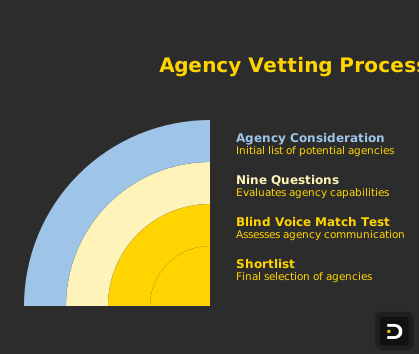
Open a doc, list three to five agencies you're considering. Run each through all nine questions above. Eliminate any that can't answer cleanly. For the survivors, run the blind voice match test. The agency that passes both is your shortlist of one or two.
We built Foundera to be the answer to this vetting process for tech founders specifically. If we're on your shortlist, we'll happily run our own framework against ourselves on a discovery call.
What to say in your first agency call
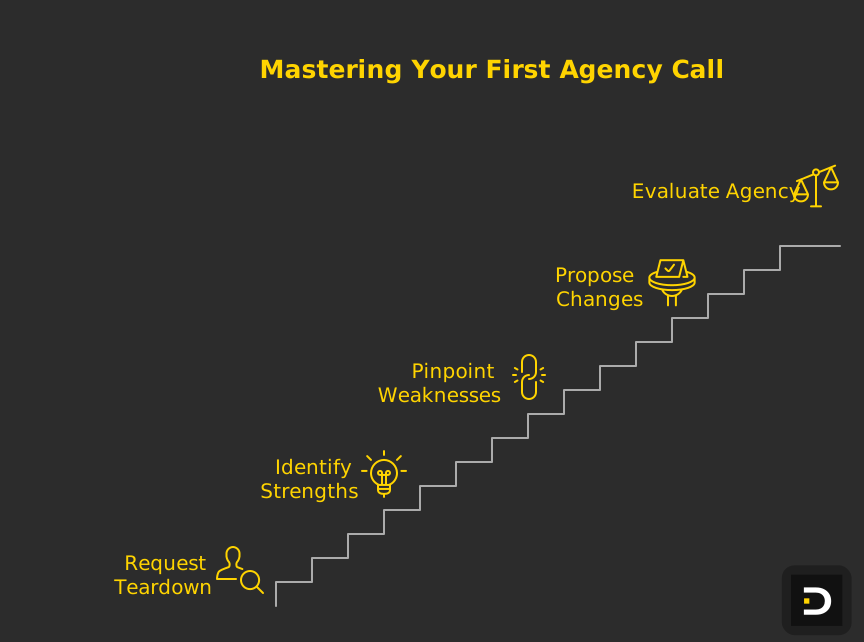
The agency is selling. You're buying. Most founders go into the first call asking for a demo of capabilities. Wrong move. Ask for a teardown of your own existing LinkedIn presence.
Open with: "Before we talk about what you do, walk me through what's working and what's not on my current LinkedIn. Be specific. What posts of mine are landing? What's missing? What would you change in the next 30 days?"
Two things happen. Agencies that have done their homework give a sharp, honest read in 10 minutes. Agencies that are pitching templates flounder - they haven't looked at your account beyond your follower count.
This single question filters 70% of agencies in your shortlist before the actual sales pitch starts.
Red-flag pricing patterns
Beyond the headline rate, watch for these contract structures that signal the agency is optimizing for revenue, not for you:
Per-post pricing. Sounds modular, but creates incentive to post more, not better. Real ghostwriting is paid as a retainer because volume isn't the value.
Tiered upgrades. "Basic, Standard, Premium" usually means the basic tier is loss-leader and the upsell is where the unit economics work. The middle tier is overpriced on purpose - classic pricing trap.
Add-on fees for distribution. If amplification isn't included in the base price, the agency doesn't have a real network - they're rebilling work they outsource. Real founder-tier agencies bundle distribution because it's how content actually performs.
Long contract terms. Anything over 6 months locked-in is the agency hedging against churn instead of staking on quality. The best agencies offer month-to-month because they're confident in renewal economics.
The cleanest contract structure: flat monthly retainer, month-to-month after a 60-day satisfaction period, no add-ons, all assets owned by you. Five lines. Push for it.
Onboarding red flags in the first 30 days
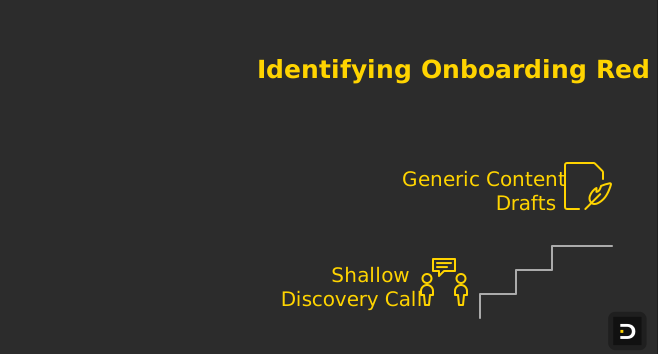
You signed the contract. Now the real test begins. Three signals that the engagement is going to fail, all visible inside the first month:
Red flag 1: Discovery call is shallow. The kickoff session lasts 60 minutes and you do most of the talking. A real voice capture session lasts 90-120 minutes and the agency does most of the asking. Specific questions about your category, your buyers, your contrarian opinions, your edge cases. If the discovery feels generic, the voice profile will be generic.
Red flag 2: First drafts feel like content marketing. Week 2 or 3 of the engagement, drafts start arriving. If they read like product marketing with a founder name attached, the agency is shoehorning you into a template they use for every client. The voice gate failed before publishing began.
Red flag 3: Account manager keeps changing. You spoke to Sarah on the kickoff, James on the first draft review, Maya on the strategy call. Premium engagements have a single account lead. Rotation suggests you're being treated as a low-priority account.
If you see any of these in the first 30 days, raise it explicitly. Most agencies will course-correct when called out. The ones that don't are the ones to fire fast.
How to off-board an agency cleanly
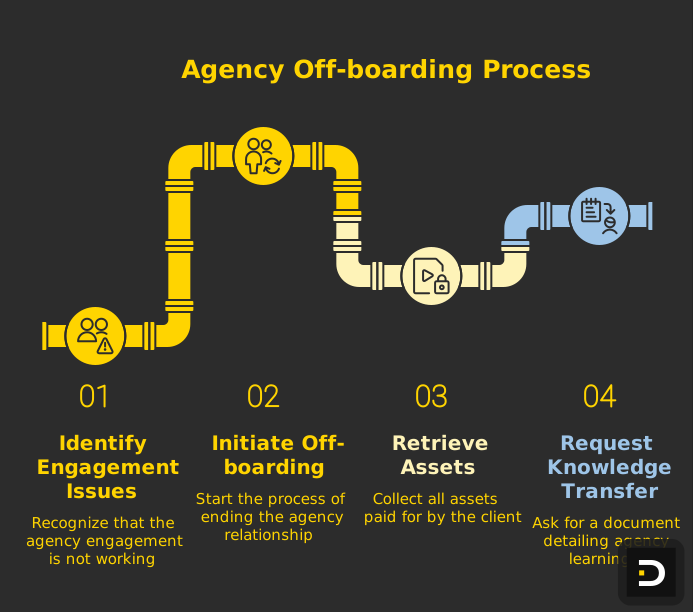
If it's not working at month 3, end it. The mistake is dragging an engagement that's clearly broken for another six months hoping it'll fix itself. It won't.
The clean off-ramp:
Step 1: Get every asset you paid for. Voice profile, content calendar, drafts in progress, analytics exports, the amplification network roster if they shared one. If your contract didn't specify these stay yours, push for them anyway.
Step 2: Ask for a knowledge transfer document. What did the agency learn about your voice, your audience, what worked, what failed? Even from a failed engagement, this institutional knowledge is valuable for the next agency or in-house lead.
Step 3: Pause your account for two weeks before restarting. Don't immediately switch agencies. Use the pause to write a few posts yourself, see what feels right, and figure out what you actually need from the next agency. The pause also resets the algorithmic patterns of the failed engagement.
Step 4: Document the failure mode. Was it voice mismatch? Cadence drift? Bad amplification? Generic AI content? The specific failure tells you exactly what to vet harder next time.
A clean off-ramp leaves you in a better position than you started, even after a failed engagement. The agency that resisted the off-ramp told you everything you needed to know about how they treat customers.
What to do after a successful month 6
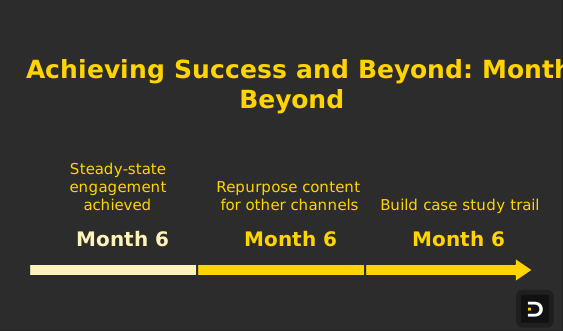
Most founder-agency engagements that succeed reach a steady-state by month 6: posts ship, voice is consistent, ICP engagement is healthy, inbound is meaningful. This is where most founders relax. Don't.
Month 6 is when the second-order work begins:
Repurpose for other channels. Your best LinkedIn posts from months 1-6 can become podcast topic seeds, conference talk outlines, newsletter content. The agency should help you bridge these.
Build the case study trail. Document specific deals or hires that came from content. This becomes the proof point for your own internal marketing and for justifying the budget in year two.
Refresh the voice profile. Six months of real data tells you which voice elements were strongest and which were assumed. Update the profile based on what actually landed.
A premium engagement that doesn't evolve past steady-state is leaving 30-50% of the value on the table.
Quick test: would you hire this agency for your CEO?
If you wouldn't trust them to write under your CEO's name at your last company, don't trust them at your current one. The litmus test cuts through every other consideration. Voice work is high-trust work; only sign with agencies you'd put your professional reputation behind.
One sentence to take away
The right agency makes you sound more like yourself, not more like every other founder posting today. If you can't tell the difference between the agency's output for you and their output for three other clients in your category, the engagement has already failed - you just haven't seen the consequences yet.
The TL;DR
Quick answer
Vet a LinkedIn ghostwriting agency in 20 minutes with nine questions covering voice capture, writer assignment, AI use, amplification, success metrics, contract terms, and references. Most agencies in 2026 are content factories producing interchangeable output. The 9-question framework separates real ghostwriting from generic AI drafting.
Key takeaways
- Ask to see five posts written for five different clients in your category. If they sound like the same author wrote them, they did.
- Real voice capture takes 4-6 weeks. Agencies that say they'll be posting in week one are using templates.
- Each writer should handle 3-5 active clients max. Above six, quality drops; above ten, they're shuffling templates.
- Pricing under $1,500/month for founder-tier work is a content-factory rate. Premium founder-tier runs $4-8K/month.
- Contract must include 30-60 day satisfaction period, month-to-month after initial term, and full asset ownership for you.