A founder we work with bought three personal branding courses last year. Total spend: about $3,400. Total LinkedIn posts published after completing them: four. Total inbound: zero.
He is not lazy. He runs a Series B deep-tech company with 80 engineers, a board, and customers who expect him in the room when things break. He took those courses because every podcast told him personal branding was the single highest-ROI thing a technical CEO could do in 2026. He believed it. He still believes it. He just could not get a course to translate into actual posts that sounded like him.
This is the pattern we see constantly at Foundera. Founders spend $500 to $2,000 on a LinkedIn course, finish the videos, fill out the worksheets, and nothing changes. Feed stays empty. Inbound stays flat. The course was not bad. It was not the right tool for the job.
If you are evaluating whether to drop $1,500 on the next big personal branding course, read this first. We will tell you what these courses do well, where they fall apart for CEOs, and what actually builds authority in 2026.
What personal branding courses actually teach
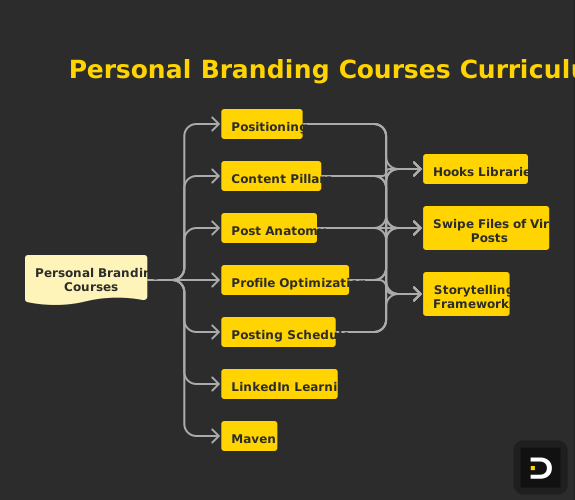
Let us be fair before we get critical. Most personal branding courses sold to founders cover roughly the same curriculum, and a lot of it is useful.
You typically get modules on positioning, content pillars, post anatomy (hook, body, CTA), profile optimization, and a posting schedule. Better courses add hooks libraries, swipe files of viral posts, and storytelling frameworks.
Platforms like LinkedIn Learning offer dozens of these in the $30-$50 range. Premium creators on platforms like Maven sell cohort-based versions for $1,500-$5,000. The teaching is often excellent.
The problem is not the curriculum. The problem is what happens after the curriculum ends.
Why courses fail for founders specifically
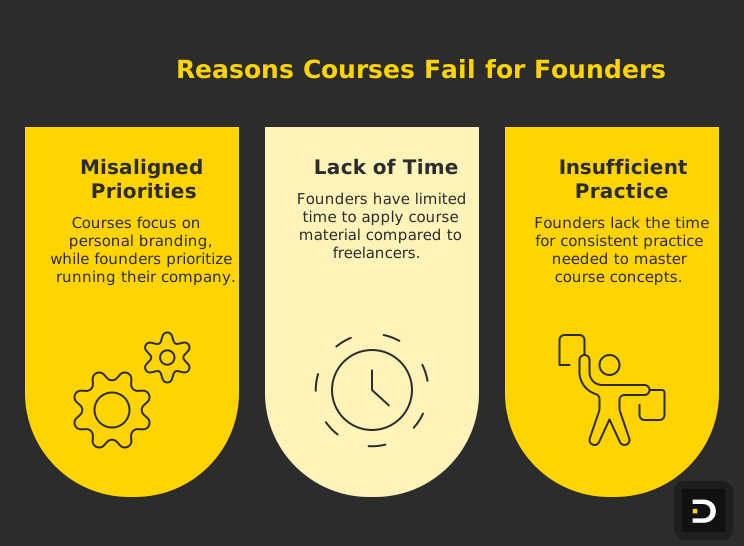
Courses are built for people whose primary job is to build a personal brand. That is not a founder. A founder's primary job is to run a company. Everything else is secondary, including the LinkedIn presence they know they should have.
When a marketing freelancer takes a personal branding course, they have 10 to 20 hours a week to apply what they learned. They can write five drafts, A/B test hooks, and refine their voice over six months of consistent practice. The course gives them theory. Their time gives them reps.
A founder running a 30-person startup does not have 10 hours a week. They have 30 minutes on a Thursday between board prep and a customer escalation. The course taught them what to write. It did not teach them how to write it in 30 minutes while their phone is buzzing with a Slack thread about a P1 incident.
Personal branding courses assume the bottleneck is knowledge. For founders, the bottleneck is almost never knowledge. It is time, energy, and the ability to produce consistent output under load.
The 4 gaps every course leaves
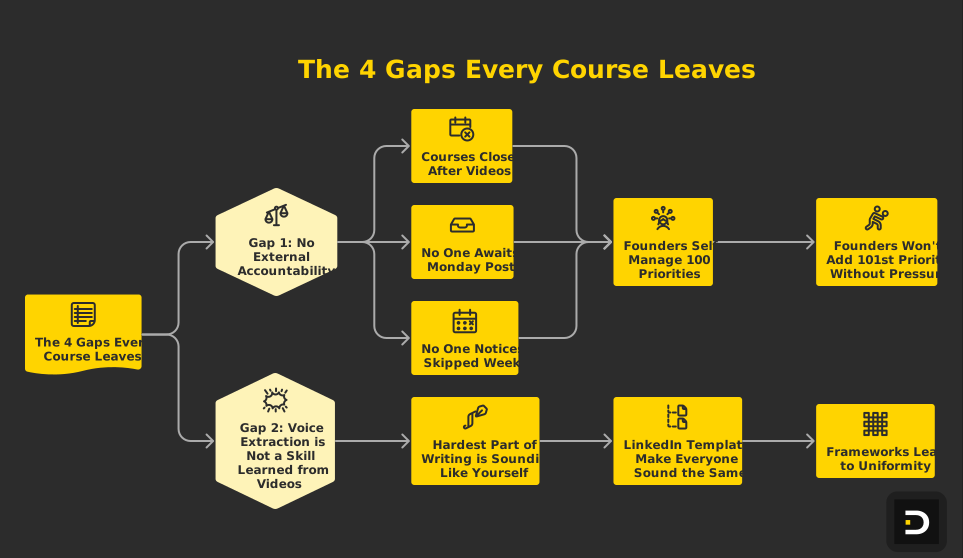
After talking to 50+ founders who tried courses and abandoned them, we keep seeing the same four gaps. None are fixable with more lessons.
Gap 1: No external accountability. A course closes when you finish the videos. Nobody is waiting for your Monday post. Nobody notices when you skip a week. Founders who already self-manage 100 priorities will not add a 101st without external pressure.
Gap 2: Voice extraction is not a skill you learn from videos. The hardest part of writing as a founder is sounding like yourself, not like a LinkedIn template. Frameworks make everyone sound the same. Real founder voice comes from somebody sitting across from you, asking sharp questions, and capturing how you actually talk about your business. No course delivers this because it cannot scale.
Gap 3: Idea generation runs dry by week 3. Founders who finish a course typically post a strong opening series drawn from their three or four obvious stories. Then they hit the wall. They have no system for surfacing new angles from customer calls, internal Slack debates, or product decisions. Mining your own week for content requires a workflow, not a worksheet.
Gap 4: The production loop is brutal. Even if you know what to write, the loop of drafting, editing, formatting, scheduling, and tracking what worked takes three to five hours per post when you are doing it yourself with no system. Multiply by three posts a week and you have a part-time job nobody told the founder about in the sales page.
Courses cannot close these gaps because the gaps are not informational. They are operational.
What founders actually need (the system)
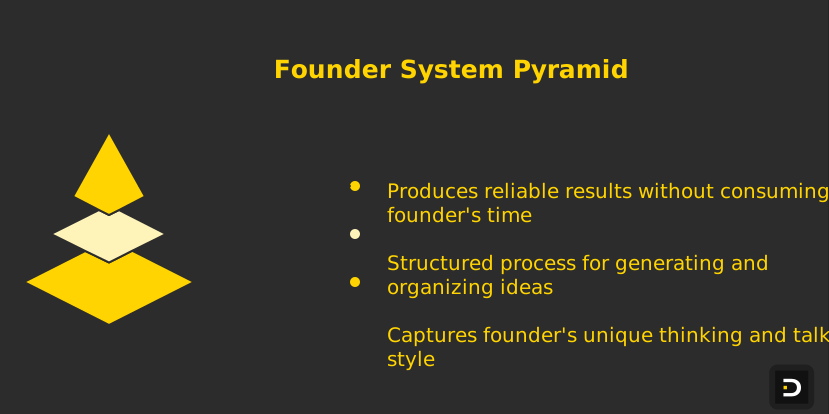
What works for busy founders is not a course. It is a system: a repeatable, low-friction workflow that produces consistent output without consuming the founder's calendar. The components look like this:
A voice-extraction process. Somebody (a ghostwriter, an editorial partner, an AI workflow trained on hours of your audio) captures how you actually think and talk. Without it, every post sounds slightly off, and the founder will reject drafts they cannot articulate why they hate.
An idea pipeline. A weekly 30-minute conversation, a tagged Slack channel, or a structured intake form that pulls fresh material from the founder's actual week. The system mines, the founder approves.
A draft engine. Whether human ghostwriter, AI tooling, or a hybrid, something that turns raw ideas into 80% finished drafts the founder reviews instead of writes. The founder's job becomes editing and approving, not drafting from a blank page.
A publishing rhythm. Posts go out on a schedule the founder is not personally managing. The founder is not setting alarms or logging into LinkedIn at 8:47am to hit publish.
A feedback loop. Someone tracks what is working, what topics drive inbound, and adjusts the strategy. Most founders never close this loop because they are too close to it. An outside party with pattern recognition across many founder accounts does this in 20 minutes a week.
None of this is taught in a course. A course gives you a post framework. It cannot run the system that produces 150 posts a year while you ship product.
Real founder authority comes from 4 things
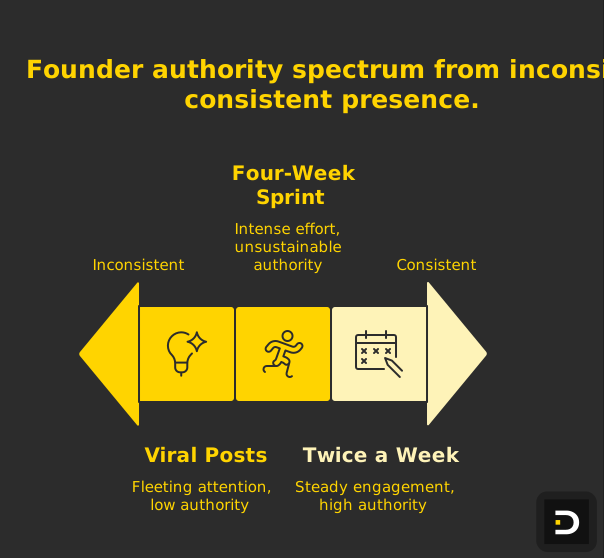
Authority on LinkedIn for founders is not about going viral. It is about being undeniably present, sharp, and specific over time in front of the audience that matters. Four things drive it.
Consistency over months, not weeks. Founders who post 12 times in a month and then disappear for two months build less authority than founders who post twice a week for 18 months. Most courses get founders to a strong four-week sprint and then watch them flame out. Authority requires output you cannot summon through willpower alone.
Specificity that only an operator could write. Generic founder content (10 lessons from raising a Series A) does not build authority. Specific founder content (we lost our first enterprise deal because our pricing page implied seat-based billing when we sold usage-based) does. Courses teach you that specificity matters. They do not give you a process for mining specific stories from your week, every week.
Distinctive point of view. The founders who break out have an actual opinion about their industry that other people in their industry would disagree with. They are willing to be wrong in public. A good editorial partner pushes founders to take sharper positions than they would naturally take alone. Courses tell you to have opinions. They do not pull stronger opinions out of you.
Volume in the right places. Authority is a function of impressions in front of the right audience. For a deep-tech founder, that means CISOs, CTOs, CIOs, VCs, and other founders in adjacent categories. Hitting that audience consistently requires post volume and engagement on other people's posts. This is a daily workflow, not a weekly worksheet.
For more on how this works in practice, see our piece on building an executive thought leadership framework.
Course vs system: side-by-side comparison
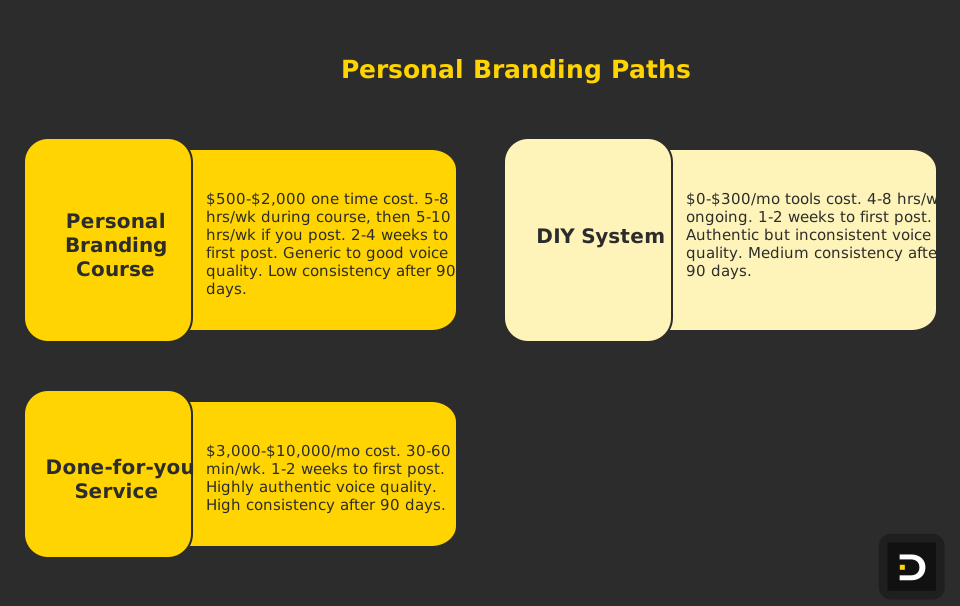
How the three paths stack up:
| Dimension | Personal Branding Course | DIY System | Done-for-you Service |
|---|---|---|---|
| Cost | $500-$2,000 one time | $0-$300/mo tools | $3,000-$10,000/mo |
| Founder time per week | 5-8 hrs (during course) then 5-10 hrs/wk if you actually post | 4-8 hrs/wk ongoing | 30-60 min/wk |
| Time to first post | 2-4 weeks (after course) | 1-2 weeks | 1-2 weeks |
| Voice quality | Generic to good (depends on founder) | Authentic but inconsistent | Highly authentic (with right partner) |
| Consistency after 90 days | Low (most founders stop) | Medium (depends on discipline) | High (it is somebody's job) |
| Idea generation | Founder figures it out alone | Founder figures it out alone | Structured intake process |
| Accountability | None after course ends | Self-imposed only | External, contractual |
| Risk of voice mismatch | None (it is you) | None (it is you) | Real, requires good partner |
| Best for | Founders with 10+ hrs/wk and a writing background | Founders who genuinely enjoy writing | Founders running real companies |
If you have 10 hours a week and you enjoy writing, take the course. Genuinely. It will work. If you have 60 minutes a week and you do not enjoy writing, no course is going to fix that. For a deeper look at the tooling side, see our breakdown of the best personal branding tools for founders.
When a course IS the right answer
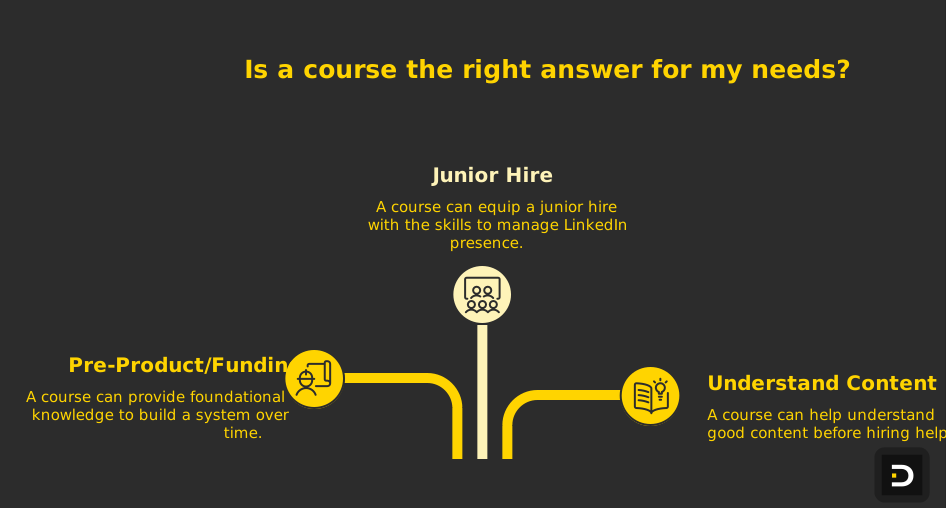
We are not anti-course. Courses are the right answer in three specific situations.
First, if you are pre-product or pre-funding and have meaningful free time. A course can give you the foundational knowledge to build your own system over the next six months.
Second, if you have a junior marketing hire who you want to run your LinkedIn presence. Send them to a cohort-based course. They have the time and the job mandate to apply it.
Third, if you want to understand what good content looks like before you hire help. A $300 course will save you from hiring a bad ghostwriter because you will know how to evaluate their work.
Where courses are the wrong answer is the most common case: a Series A-C founder running a real company who wants LinkedIn presence to drive inbound, recruiting, and category authority. That founder does not need to learn how to write a hook. They need somebody to run the system. For more on what to post when that system is in place, see our piece on thought leadership content for founders.
The $5K problem: what 50+ founders told us
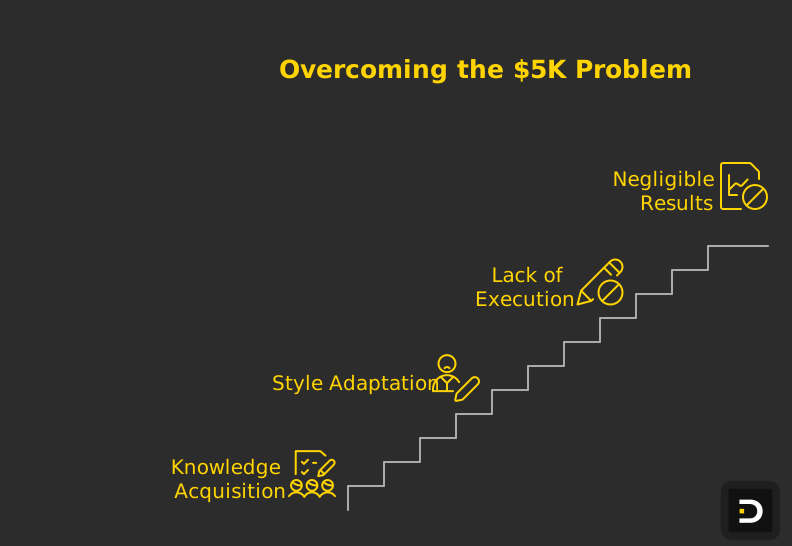
Over the last 18 months we have talked to more than 50 founders who tried the course route before they came to Foundera. Their average spend across courses, coaching, and abandoned ghostwriter experiments was around $5,000. Their average posts published in the six months after their first course: 11. Their average inbound from those posts: negligible.
What they told us, almost universally, came down to four sentiments:
"I knew what to write, I just could not get myself to do it." Knowledge was never the bottleneck.
"When I tried to write in the style the course taught, it did not sound like me, and I hated my own posts." Founders rejected their own output because the frameworks were generic.
"I posted for three weeks and then a customer crisis hit and I never restarted." Consistency died at the first real distraction.
"I have no idea if any of it worked because I never tracked anything." Without a feedback loop, motivation evaporated.
These are not knowledge problems. They are system problems. Once we identified that pattern, our approach at Foundera shifted from "teach founders to write better" to "build the system that produces the writing for them with their voice intact."
That is what Foundera does. We are not a course. We are not a generic ghostwriting shop. We are a managed editorial system for deep-tech founders that handles voice extraction, idea pipeline, drafting, publishing, and feedback loops, so the founder spends 45 minutes a week and ships three high-signal posts. Our breakdown of premium LinkedIn ghostwriting walks through the full workflow.
Frequently asked questions
Are personal branding courses ever worth it for founders?
Yes, in three situations: you are pre-product with free time, you are training a junior hire to run your LinkedIn, or you want to evaluate ghostwriters before hiring one. For a Series A-C founder trying to drive inbound, a course is the wrong tool.
How much does a good personal branding course cost?
Anywhere from $30 on LinkedIn Learning to $5,000 for premium cohort-based programs. The $300 courses often have substantially the same curriculum as the $3,000 ones. The difference is community, accountability, and proximity to the instructor.
Can I learn LinkedIn ghostwriting from a course and do it myself?
Technically yes. Realistically, founders who try this almost always abandon it within 90 days. Writing for yourself as a busy CEO is one of the hardest disciplines in marketing because the work is never urgent compared to your operational fires.
What is the difference between a ghostwriter and an editorial system?
A solo ghostwriter writes posts for you, usually a freelancer juggling 5-10 clients. Quality varies and voice consistency is a real risk. An editorial system, like what Foundera runs, is a structured workflow with voice extraction, idea pipelines, drafting protocols, and feedback loops, run by a team with accountability across the full process.
How long until LinkedIn actually drives inbound for a founder?
For deep-tech founders with the right audience and consistent posting, meaningful inbound (DMs, intros, deals) typically starts in months 3-4 and compounds from there. Founders expecting results in week 2 quit before the compounding kicks in. This is part of why courses fail: they imply good content gets immediate engagement, which is not how authority works.
Is it worth it for a technical founder who hates marketing?
It is more worth it for that founder than for almost anyone else. Technical founders who hate marketing tend to have the most interesting, opinionated things to say once somebody extracts it from them properly. The question is not whether it is worth it. The question is how to do it without the founder having to become a marketer. Our guide on building a personal brand on LinkedIn as a startup founder covers the technical founder case in depth.
Your next move
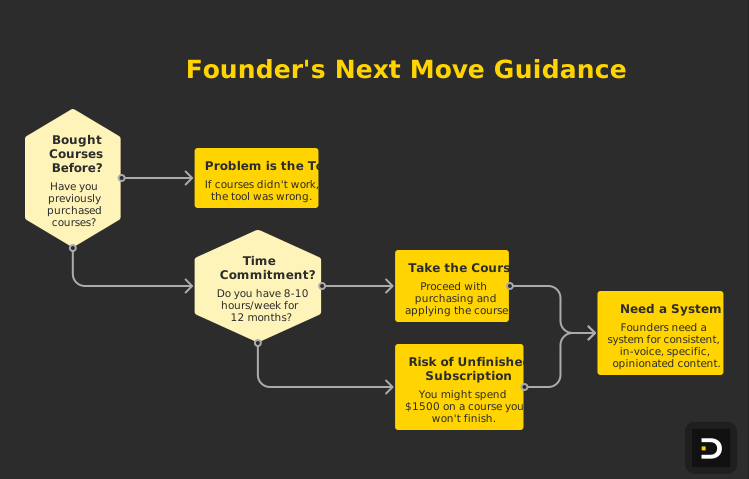
If you have already bought a course or two and they have not worked, you are not the problem. The tool was wrong for the job. Courses teach. Founders need systems.
If you have not bought a course yet, ask yourself one question: do you have 8 to 10 hours a week, every week, for 12 months, to apply what it teaches? If yes, take the course. If no, you are about to spend $1,500 on a Netflix subscription you will not finish.
What founders actually need to build authority in 2026 is not more knowledge about LinkedIn. It is a system that produces consistent, in-voice, specific, opinionated content without consuming the founder's calendar. That is what we built Foundera around. If you want to talk about what that looks like for your category, your audience, and the time you can realistically commit, that is the conversation worth having.
The TL;DR
Quick answer
Personal branding courses teach what to post but leave four operational gaps: no external accountability, voice extraction you can't learn from video, idea generation that runs dry by week 3, and a brutal production loop. Founders need a system that produces consistent in-voice content, not another curriculum. 50+ founders spent an average $5K on courses and shipped 11 posts in six months.
Key takeaways
- Courses assume the bottleneck is knowledge. For founders, the bottleneck is time and energy.
- Voice extraction is not a skill you learn from videos. It requires conversation.
- Average founder spent $5K on courses, shipped 11 posts in 6 months, got zero inbound.
- Courses work if you have 8-10 hours a week. Most Series A-C founders don't.
- Authority requires output you cannot summon through willpower alone.